
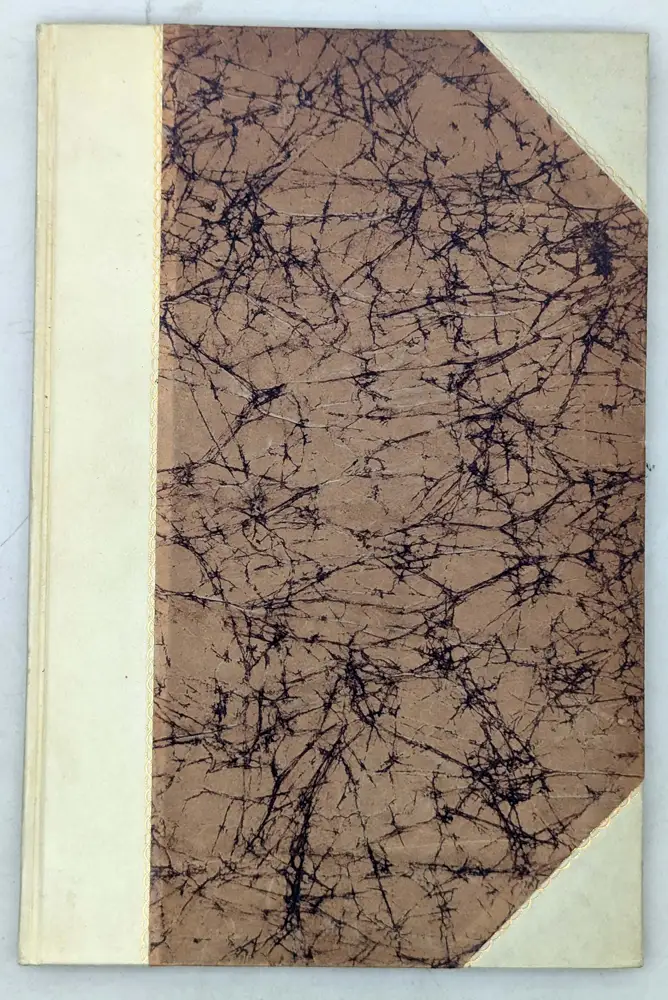
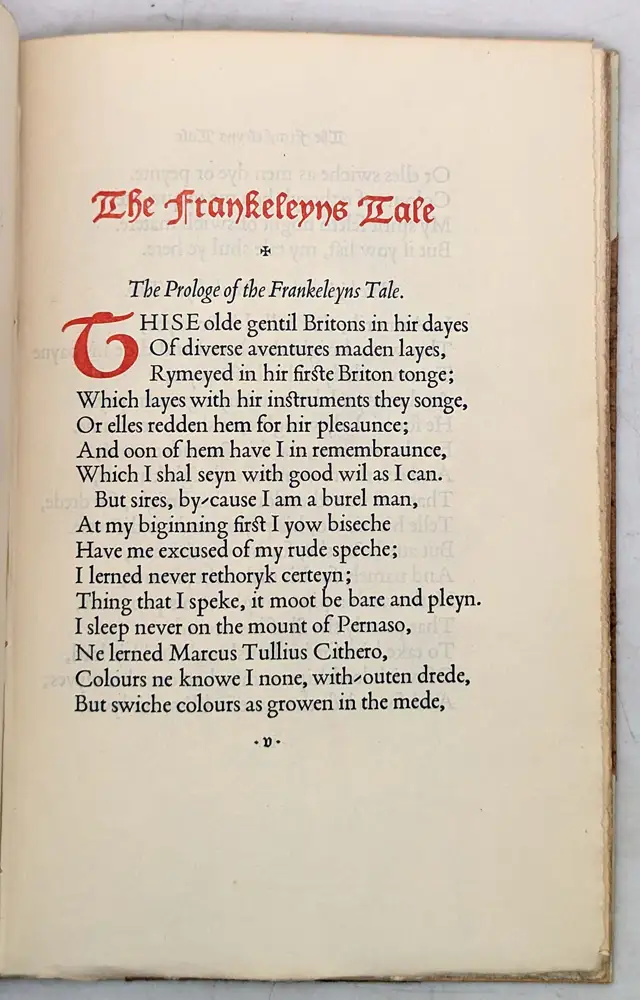
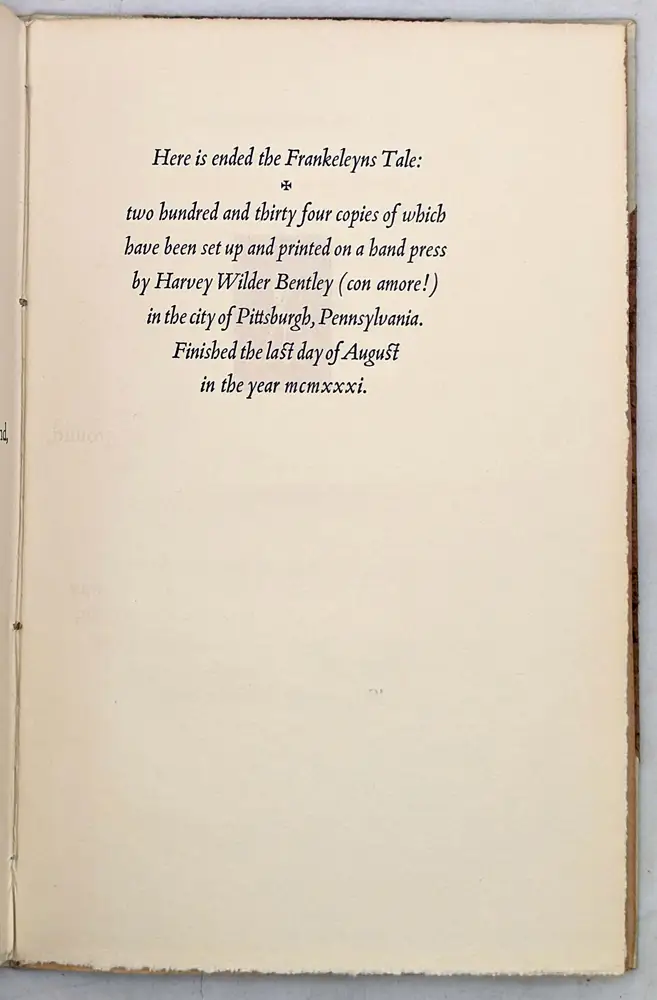
The Frankeleynes Tale from The Canterbury Tales by Geoffrey Chaucer, published by The Bentley Press, represents a distinguished example of private press bookmaking dedicated to one of English literature’s most beloved narratives. The Bentley Press, operating in the tradition of fine printing that flourished in the early to mid-twentieth century, produced this edition as a tribute to Chaucer’s art, treating the tale with the typographic care and craftsmanship befitting its literary stature.
The Frankeleynes Tale occupies a unique place within The Canterbury Tales. Presented as the contribution of a medieval landowner—a country gentleman of means and refinement—the tale is a Breton lay, a romantic narrative of chivalry, magic, and marital virtue. It recounts the story of Dorigen, whose husband Arveragus departs for knightly adventure, leaving her vulnerable to the unwanted advances of the squire Aurelius. When Aurelius, despairing of winning her love, secures the aid of a magician to make the coastal rocks of Brittany disappear—a feat she had jokingly set as the condition for her favor—Dorigen is placed in an impossible position. Chaucer explores themes of honor, fidelity, generosity, and the tension between private promise and public duty, concluding with a celebrated discourse on the nature of true nobility and the virtue of mercy over rigid adherence to obligation.
The Bentley Press edition would have been produced with careful attention to the visual presentation of Chaucer’s Middle English text. The book featured hand-set type, high-quality paper, and thoughtful page design that honored the medieval origins of the work while ensuring legibility for modern readers. The choice of The Frankeleynes Tale for special treatment reflects the tale’s enduring popularity among Chaucer’s works, admired for its elegant structure, psychological depth, and the humane wisdom of its conclusion. Such an edition would have been produced in limited numbers, appealing to collectors, bibliophiles, and admirers of Chaucer who valued the union of literary content with fine press craftsmanship.
As an object, this Bentley Press publication exemplifies the ideals of the private press movement: that a book, as a physical artifact, should reflect and enhance the quality of the text it contains, creating a reading experience of aesthetic integrity and lasting value.