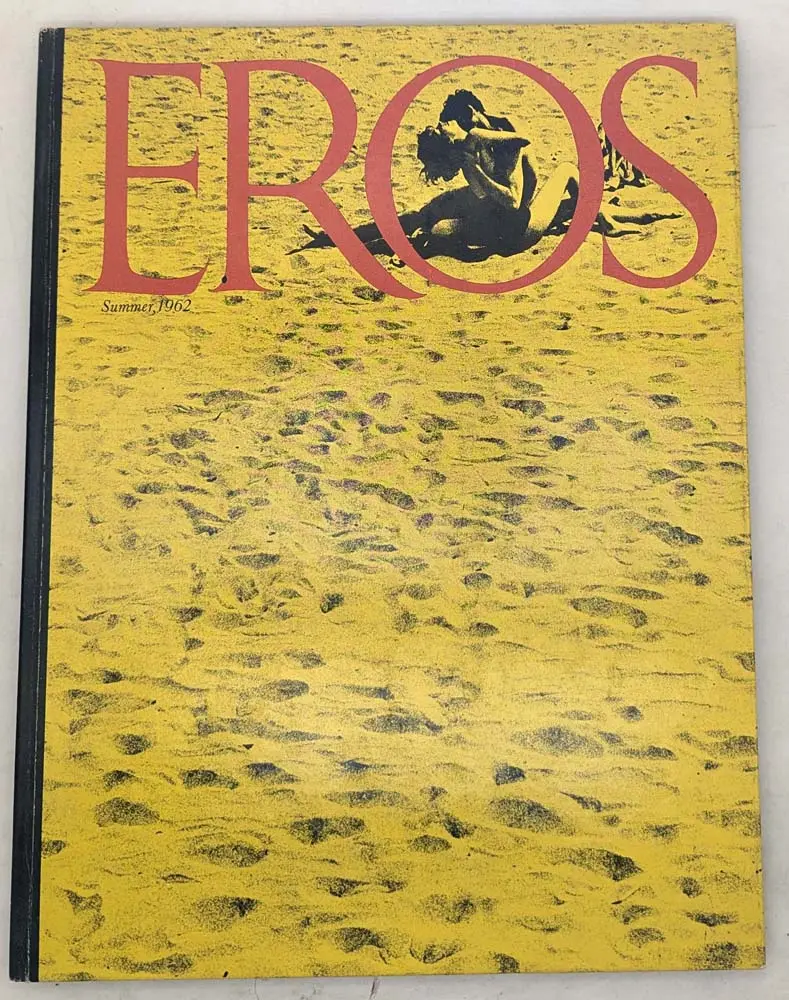
Published in the summer of 1962, Eros magazine, Volume 1, Number 2, was the second of only four issues of a landmark periodical edited and published by Ralph Ginzburg . Conceived as a “lavishly produced quarterly bound in hard covers,” Eros aimed to explore themes of love and sex with artistic and literary sophistication, a stark contrast to the illicit and lowbrow erotica of the time . The magazine’s very format signaled its ambition: it was a large folio, hardcover book rather than a traditional pamphlet-style magazine .
This particular issue features a distinctive cover design by art director Herb Lubalin, depicting a young couple in swimsuits sharing a passionate kiss . The image is printed in black and a greenish-yellow, with a striking red-orange logo, and the theme continues inside with endpapers in bold red and blue . The contents are a varied mix of high and popular culture, a testament to Ginzburg’s editorial vision . It includes:
- “We All Love Jack,” a photographic tribute to President John F. Kennedy .
- A short-short story by renowned science fiction author Ray Bradbury .
- A humor piece by Mark Twain, likely his famously bawdy 1601 .
- Photo essays on subjects such as French prostitutes and the erotic art of India .
Beyond the Kennedy tribute, the issue, like others in the series, pushed the boundaries of what was permissible in print. The third issue, for example, would feature the last studio portraits of Marilyn Monroe by Bert Stern, while the fourth ultimately led to Ginzburg’s indictment . The magazine is notable for contributions from significant photographers, including Marvin E. Newman .
Eros was immensely popular but short-lived. Ginzburg’s aggressive direct-mail marketing campaign generated both substantial interest and a wave of complaints . In December 1963, he was convicted under the Comstock Act for sending “obscene matter through the mails,” a verdict that led to a five-year prison sentence (of which he served eight months) and effectively ended the magazine’s run . Today, surviving copies of Eros, particularly this second issue, are sought-after collectibles, representing a pivotal moment in the battle between artistic expression and censorship in 20th-century America