
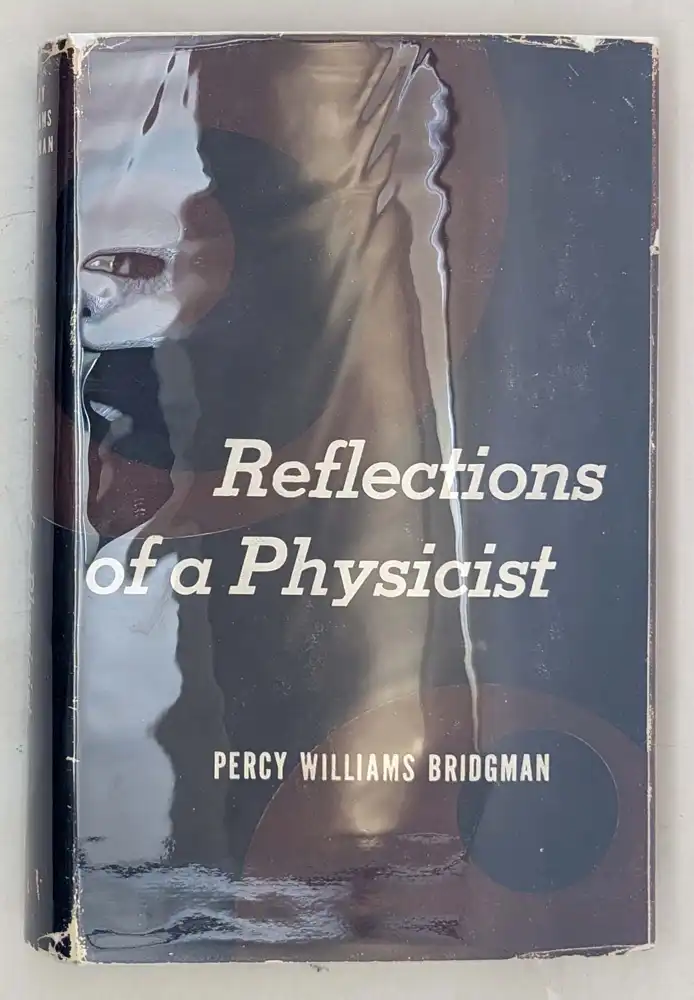
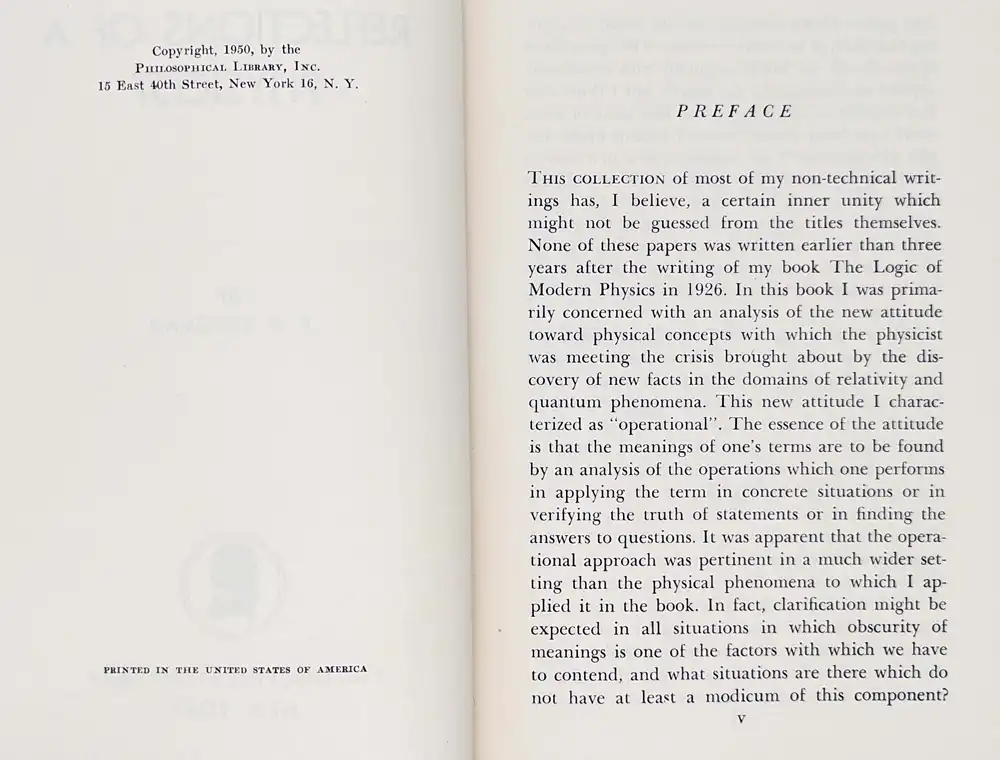
Reflections of a Physicist by Percy Williams Bridgman, published in 1950, is a collection of essays and addresses that extends the Nobel laureate’s thinking beyond the laboratory into the nature of knowledge, meaning, and human understanding. Bridgman, who won the 1946 Nobel Prize in Physics for his work on high-pressure phenomena, was equally renowned as a philosopher of science—specifically as the architect of “operationalism,” the idea that a concept is nothing more than the set of operations used to measure or define it.
The book brings together previously published pieces from the 1930s through the late 1940s, allowing readers to trace the evolution of Bridgman’s thought. Early essays lay out his core philosophical position. He argues that concepts like length, time, and mass have no absolute meaning outside the specific experimental procedures used to determine them. An electron, for example, is the tracks it leaves in a cloud chamber, the way it bends in a magnetic field, and the other physical operations that bring it into measurable reality. Abstract speculation divorced from empirical operation, Bridgman warns, leads to empty metaphysics.
Later essays apply this operational framework to broader questions: the nature of scientific law, the limits of logical reasoning, the relationship between physics and common sense, and the proper role of mathematics in describing physical reality. Bridgman writes with characteristic bluntness, dismissing several influential philosophical schools—including logical positivism and Bergsonian intuition—as either circular or irrelevant to the practicing scientist. He also includes several personal reflections on the ethical responsibilities of scientists in the atomic age, written with the sober wisdom of a man who had witnessed his own work applied to weapons of mass destruction.
What distinguishes Reflections of a Physicist is its refusal to soften technical ideas for a popular audience. Bridgman assumes an educated reader but offers no concessions to easy sentiment. The prose is dense, careful, and occasionally combative—the voice of a brilliant mind unwilling to accept imprecision in language any more than he would accept it in a pressure gauge. The book remains a challenging but rewarding exploration of how physicists actually think when they strip away comfortable illusions and ask what they truly mean by what they say.