Arthur Conan Doyle: The Collector’s Guide to First Editions, Rare and Collectible Books
Sir Arthur Conan Doyle: The Literary Genius Behind Sherlock Holmes
Early Life and Formative Years
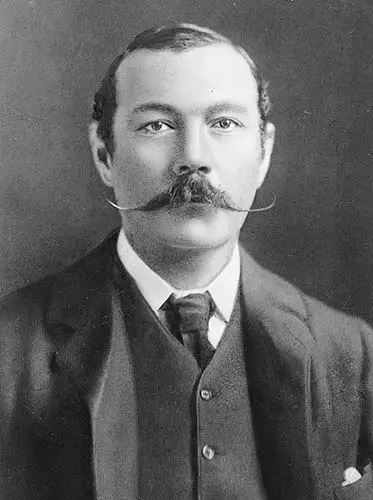
Arthur Ignatius Conan Doyle was born on May 22, 1859, in Edinburgh, Scotland, into an Irish-Catholic family with a rich artistic heritage. His father, Charles Altamont Doyle, was a talented illustrator who unfortunately struggled with alcoholism and mental illness, while his mother, Mary Foley Doyle, was a well-educated woman who instilled in young Arthur a love of storytelling. This early exposure to both creative brilliance and personal tragedy would profoundly shape Conan Doyle’s life and work.
Education and Medical Career
Conan Doyle’s education began at the Jesuit preparatory school Hodder Place, followed by Stonyhurst College. He later studied medicine at the University of Edinburgh from 1876 to 1881, where he encountered two figures who would significantly influence his most famous creation. Dr. Joseph Bell, one of his professors, was renowned for his extraordinary powers of observation and deduction – qualities that would later define Sherlock Holmes. Another professor, Dr. William Rutherford, may have inspired Holmes’s scientific approach to investigation
After completing his medical degree, Conan Doyle served as a ship’s surgeon on a whaling vessel and later on a steamer traveling to West Africa. These adventures provided rich material for his later writings. In 1882, he established his own medical practice in Southsea, Portsmouth, though it proved only moderately successful. This relative lack of patients afforded him ample time to write, and in 1887, he published “A Study in Scarlet,” introducing the world to Sherlock Holmes and Dr. John Watson.
The Creation of Sherlock Holmes
Sherlock Holmes made his debut in “A Study in Scarlet,” published in Beeton’s Christmas Annual. The character combined the deductive methods of Dr. Joseph Bell with the eccentric brilliance of Edgar Allan Poe’s detective C. Auguste Dupin. While the novel received modest attention, it laid the foundation for what would become one of literature’s most enduring franchises
Conan Doyle’s breakthrough came with the publication of Holmes stories in The Strand Magazine, beginning with “A Scandal in Bohemia” in 1891. The public’s appetite for Holmes was insatiable, and Conan Doyle found himself writing story after story to meet demand. However, he grew weary of the character that overshadowed his other literary ambitions. In 1893, he famously killed off Holmes in “The Final Problem,” sending him plunging to his apparent death at Reichenbach Falls while battling his nemesis, Professor Moriarty.
Public outcry was immediate and overwhelming. Fans wore mourning armbands, and The Strand Magazine lost 20,000 subscriptions. The pressure eventually forced Conan Doyle to resurrect Holmes in 1901’s “The Hound of the Baskervilles” (set before Holmes’s death) and fully bring him back in 1903’s “The Adventure of the Empty House.”
Literary Work Beyond Holmes
While Sherlock Holmes remains Conan Doyle’s most famous creation, he considered his historical novels his most important work. “The White Company” (1891), set during the Hundred Years’ War, was particularly dear to him. He also wrote science fiction (“The Lost World”), horror stories, and plays. His non-Holmes works demonstrate remarkable range, from the Napoleonic era adventures of Brigadier Gerard to the supernatural tales of Professor Challenger.
Conan Doyle was a prolific writer of nonfiction as well, producing works on military history, spiritualism, and true crime. His two-volume history of the Boer War, for which he was knighted in 1902, remains an important historical document, as does his campaign journalism exposing wrongful convictions.
Personal Life and Interests
In 1885, Conan Doyle married Louisa “Touie” Hawkins, with whom he had two children. When Louisa was diagnosed with tuberculosis in 1893, he moved the family to Switzerland for her health. After her death in 1906, he married Jean Leckie, with whom he had three more children.
Conan Doyle’s later years were increasingly devoted to spiritualism, a passion that began after the deaths of several family members, including his son Kingsley from wounds sustained in World War I. He became one of spiritualism’s most prominent advocates, writing books on the subject and engaging in public debates. This commitment sometimes brought him ridicule, particularly his belief in fairies following the Cottingley Fairies hoax, though he maintained his convictions until his death.
Later Years and Legacy
Arthur Conan Doyle died of a heart attack on July 7, 1930, at age 71, in his garden at Windlesham Manor in Crowborough, Sussex. His last words, reportedly spoken to his wife, were: “You are wonderful.” He was initially buried in the rose garden at Windlesham, but later reinterred at Minstead churchyard in Hampshire.
The legacy of Sherlock Holmes has grown exponentially since Conan Doyle’s death. Holmes has become the most portrayed literary character in film and television history, with hundreds of adaptations. The detective’s methods influenced the development of forensic science, and the character established many conventions of the detective genre.
Baker Street, Holmes’s fictional address, now houses the Sherlock Holmes Museum, and the character’s popularity shows no signs of waning in the 21st century. Conan Doyle’s creation has spawned an entire industry of pastiches, scholarly works, and fan societies worldwide.
Assessment and Critical Reception
During his lifetime, Conan Doyle was frustrated that his serious historical fiction never achieved the popularity of his detective stories. Modern critics, however, recognize his broader literary contributions while acknowledging Holmes as his masterpiece. His clean, efficient prose style and gift for plotting influenced generations of writers.
The Sherlock Holmes stories are remarkable for their combination of tight plotting, memorable characters, and vivid Victorian atmosphere. Conan Doyle’s medical training lent authenticity to the stories’ scientific elements, while his imaginative power created one of fiction’s most compelling protagonists. The dynamic between Holmes’s cold logic and Watson’s human warmth continues to fascinate readers.
Arthur Conan Doyle’s life was as fascinating as his fiction. From his medical training to his war service, from his sporting achievements (he was an accomplished cricketer and golfer) to his spiritualist crusades, he lived with remarkable energy and conviction. While he might have been ambivalent about his most famous creation, Sherlock Holmes stands as one of literature’s immortal characters – a testament to Conan Doyle’s storytelling genius.
More than ninety years after his death, Conan Doyle’s works continue to captivate new generations of readers. The Sherlock Holmes stories in particular remain remarkably fresh, their blend of mystery, character study, and social observation proving timeless. As long as readers enjoy a good mystery and admire brilliant, eccentric characters, Arthur Conan Doyle’s literary legacy will endure.
His creation, Sherlock Holmes has become the most famous detective of all time, inspired and influenced countless authors including Agatha Christie‘s Hercule Poirot, Ellery Queen, Robert Goren, Philip Marlowe, Gil Grisom, Sam Spade, Patrick Jane, Perry Mason, Jonathan Creek, Shawn Spencer, Columbo, Dick Tracy, Adrian Monk, August Derleth, Gregory House, Dr Edward Fitzgerald, the children’s book series Encyclopedia Brown, and even the comic book hero Batman.
Sir Arthur Conan Doyle – First Editions Identification Guide
A Complete Bibliography of Sir Arthur Conan Doyle: Novels, Rare Books & First Editions
| Year | Title | Publisher | First edition/Printing Identification Points |
|---|---|---|---|
| 1888 | A Study in Scarlet | Ward, Lock & Co., London, 1888 | Two issues, priority as listed:
ALSO: Third English edition. Ward, Lock, Bowden & Co, 1895. White wrapper. |
| 1889 | Micah Clarke | London: Longmans, Green & Co., 1889 | Dark blue cloth over heavy bevelled boards, ochre-on-white swan-and-ship endpapers. First English edition. ALSO: First English edition, American issue. Same as above, but the imprint at the foot of the spine as "LONGMANS" instead of "LONGMANS & Co" and white endpapers. No publisher's catalogue ($1.50). ALSO: New York: Harper & Brothers, 1889. Light blue wrappers (45c) . First American edition. ALSO: New York: Harper & Brothers, 1894. Yellow cloth. Second authorized American edition. |
| 1889 | The Mystery of Cloomber | Ward and Downey, London,.1889 | Two issues, priority as listed:
|
| 1889 | Mysteries and Adventures | London: Walter Scott, [1889] | Two issues, priority as listed:
|
| 1890 | The Captain of the Polestar and Other Tales | London: Longmans, Green & Co., 1890 | Two issues, priority as listed:
|
| 1890 | The Sign of the Four | London: Spencer Blackett, 1890 | Three issues, priority as listed:
|
| 1890 | The Firm of Girdlestone | London: Chatto & Windus, 1890 | Maroon cloth blocked in black and titled black and gilt. 6/-. Note: There is a slight variation in copies bound later. The ampersand inthe publisher's imprint on the spine, and its alignment, are different. ALSO: Lovell's International Series No. 65. Three issues, priority as listed:
|
| 1891 | The White Company | London: Smith, Elder & Co., 1891 | Red-brown cloth blocked in black and titled black and gilt. Three volumes, 31/6. Two issues, no priority:
ALSO: New York: Harper & Brothers Publishers, 1895. Second American edition. Green cloth blocked in red, silver, and gilt, titled gilt, ($1.75). |
| 1892 | The Adventures of Sherlock Holmes | London: George Newnes, Limited, 1892 | Light blue cloth over heavy bevelled boards, and titled in black and gilt. Blue dust-jacket and titled black as on covers, with publisher's advertisements on lower cover. ALSO: New York: Harper & Brothers, 1892. First American edition. Light blue cloth blocked in dark blue and titled gilt. Brown dustjacket titled black on spine. ALSO: Longmans, Green & Co, 1894. Second English edition, colonial issue. Two issues, no priority:
|
| 1892 | The Doings of Raffles Haw | Cassell & Co, London, 1892 | Dark blue cloth titled gilt. First English edition. ALSO: New York: John W. Lovell Company, [1892]. First American edition, copyright issue. Wrappers. Note: © page dated 1891, but 1892. ALSO: New York: Lovell, Coryell & Company, [1892. First American edition. Two issues, no priority:
|
| 1892 | The Great Shadow | J. W. Arrowsmith, Bristol, 1892 | White wrappers. and titled in red and black on upper cover, spine titled black (1/-). Arrowsmith's Christmas Annual. ALSO: First English edition, second impression. As above. Two issues, no priority:
|
| 1893 | The Refugees | London: Longmans, Green & Co., 1893 | Three volumes. Light green cloth, ruled borders in blind on upper and lower covers. Ochre on white swan-and-ship endpapers. ALSO: New York: Harper & Brothers, 1893. "Copyright, 1893, by HARPER & BROTHERS." stated on © page. Light blue fine-grain cloth blocked in gilt and titled red, white endpapers ( $1.75). ALSO: Second English edition, in one volume. Dark green cloth over heavy bevelled boards, titled gilt. "NEW EDITION" stated on title page. Note: The one-volume edition was prepared shortly after the first edition. Publication was deferred to allow the three-volume edition to be fully distributed by the circulating libraries. ALSO: Second English edition, colonial issue. As above. Two issues, no priority:
|
| 1893 | The Great Shadow and Beyond the City | J. W. Arrowsmith, Bristol, [1893] | Orange cloth and titled black, light blue, and gilt, white endpapers. First illustrated edition, illustrated by James Greig and Paul Hardy (3/6). Note: There were eight further impressions between August 1893 and January 1914. |
| 1893 | The Memoirs of Sherlock Holmes | London: George Newnes, Limited, 1894 | Dark blue cloth over heavy bevelled boards, and titled in black and gilt. Blue dust-jacket and titled black as on covers, with publisher's advertisements on lower cover. Published December 1893 (6/-). ALSO: New York: Harper & Brothers, 1894. First American edition. Light blue cloth blocked in dark blue and titled gilt. "Copyright, 1894, by HARPER & BROTHERS." stated on © page. Two issues, priority as listed:
|
| 1894 | An Actor's Duel and the Winning Shot | London, John Dicks, [1894] | White pictorial wrappers (6d). Publisher's advertisement on lower cover for John Dicks' Books; publisher's advertisements inside upper and lower covers; |
| 1894 | Round the Red Lamp | Muethen &Co., London, 1894 | Red ribbed cloth ruled and titled gilt, white endpapers. ALSO: First English edition (second impression), colonial issue. Two issues, no priority: As above. Title page with "SECOND EDITION" and at foot "Colonial Library".
|
| 1894 | The Parasite | Westminster: Constable & Co., 1894 | Two issues, no priority:
ALSO: New York: Harper & Brothers, 1895. First American edition. Dark grey cloth and titled gilt, white endpapers. "Copyright, 1894, by HARPER & BROTHERS." stated on © page. ($1.00). |
| 1895 | The Stark Munro Letters | London: Longmans, Green & Co., 1895 | Dark green cloth over heavy bevelled boards titled in decorated gilt letters, white endpapers. (6/-). ALSO: First English edition, colonial issue. As above, on cheaper text paper. With at head of title-page: "Longmans' Colonial Library". In the uniform cloth and paper binding of the publisher's Colonial Library. (2/-, 1/6). ALSO: New York: D. Appleton and Company, 1895. First American edition. Heavy maroon buckram and titled in silver and gilt, light brown endpapers. Off white dust-jacket and titled in red and green as on covers. "COPYRIGHT, 1894, 1895, | BY D. APPLETON AND COMPANY" stated on © page. |
| 1896 | The Exploits of Brigadier Gerard | London: Georges Newnes, Ltd, 1896 | Scarlet ribbed cloth blocked in black and titled gilt, white endpapers. 8 pp. publisher's catalogue for 30.11.95, or 10.2.96 at the end. Copies bound later either have an undated catalogue (1897), or a catalogue dated 4/98. ALSO: First English edition, colonial issue. As above. New title page with "Longmans' Colonial Library." Two issues, no priority: uniform cloth and paper covers (2/-, 1/6). ALSO: New York: D. Appleton and Company, 1896. First American edition. Heavy maroon buckram and titled in silver and gilt, light brown endpapers. Off white dust-jacket and titled in red and green as on covers. Title page printed in black, greed, red. "COPYRIGHT, 1896, | BY A. CONAN DOYLE." stated on © page. ($1.50) ALSO: First American edition, (second printing). As above. The title page is printed in black only. |
| 1896 | Rodney Stone | London: Smith, Elder & Co., 1896 | Black textured cloth and titled gilt, black endpapers. "A. CONAN DOYLE. September 1, 1896." stated on preface page. ALSO: London: George Bell & Sons and Bombay, 1896. First English edition, colonial issue.Uniform light pink cloth ruled and titled brown on upper cover;spine blocked in gilt and titled brown; white endpapers. Also pink paper covers. Note: The colonial issue was issued before the book was published so as to be on sale in the Colonies at approximately the same time. ALSO: New York: D. Appleton and Company, 1896. First American edition. Heavy maroon buckram and titled in silver and gilt, light brown endpapers. Off-white dust-jacket and titled in red and green as on covers. "COPYRIGHT, 1896, | BY A. CONAN DOYLE." stated on © page. |
| 1897 | Uncle Bernac | London: Horace Cox, 1896.[1897] | London: Horace Cox, 1896. [1897]. English copyright edition. In two parts, printed in December 1896, January 1897. Light blue-grey wrappers. "COPYRIGHT, 1896, BY A. CONAN DOYLE, IN THE UNITED STATES OF AMERICA." stated on © page.(1/- each). ALSO: London: Smith Elder, & Co., 1897. First English Edition. Red cloth and titled gilt, black endpapers. "A. CONAN DOYLE. April 23, 1897" stated on © page. Also: Second impression, October 1897. ALSO: London: George Bell & Sons and Bombay, 1897. First English edition, colonial issue. Two issues, no priority:
|
| 1898 | The Tragedy of the Korosko / A Desert Drama | London: Smith, Elder & Co., 1898 | Dark red cloth and titled gilt, black endpapers. "A. CONAN DOYLE October 27, 1897" stated on © page. ALSO: J. P. Lippincott Company, 1898. First American edition. Light blue pictorial cloth, white endpapers. |
| 1898 | Songs of Action | London: Smith, Elder, 1898 | Blue buckram over heavy boards and titled gilt, white endpapers. ALSO: New York: Doubleday & McClure, 1898. First American edition. Red silk-basket cloth ruled and titled gilt, white endpapers. "Copyright, 1898, by | DOUBLEDAY & McCLURE CO." stated on © page. |
| 1899 | A Duet, with an O© pageasional Chorus | London: Grant Richards, 1899 | Two issues, no priority:
|
| 1900 | The Green Flag and Other Stories of War and Sport | London: Smith, Elder & Co., 1900 | Bright red cloth blocked in black and titled gilt, black endpapers (6/-). "A. CONAN DOYLE. February 18th, 1900." stated on © page. ALSO: New York: McClure, Phillips & Co, 1900. First American edition. Light green cloth pictorial cover. "COPYRIGHT, 1900, BY | A. CONAN DOYLE" stated on © page. ($1.50). |
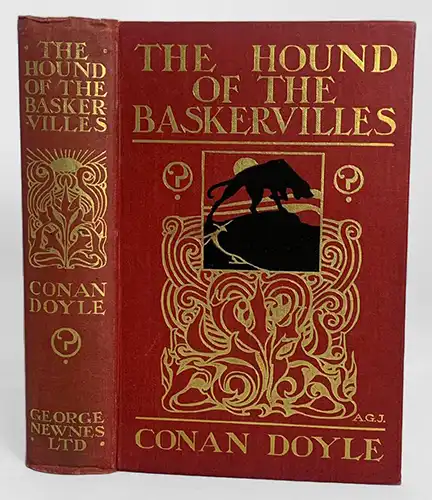
| 1902 | The Hound of the Baskervilles | London: George Newnes, 1902 | Scarlet cloth and titled in black and gilt, white endpapers. Grey dust-jacket and titled scarlet as on covers, with "6/=" in place of the question mark and circle on spine. Note: There are two errors which were never corrected: p. 13, line 3, has 'you' for 'your', and the illustration facing p. 76, which had been reversed in the Strand Magazine, is again reversed. Reissued in 1908 by Smith, Elder and Company with new preliminary pages as part of the uniform edition. ALSO: Longmans, Green and Co., 1902. First English edition, colonial issue. Light blue wrappers, titled in dark blue with Colonial Library design. Publisher's advertisements inside covers. ALSO: New York, McClure, Phillips & Co, 1902. First American edition. Four states, priority as listed:
|
| 1903 | Adventures of Gerard | London: George Newnes, [1903] | Dark blue cloth and titled gilt, white endpapers. Grey dust-jacket titled blue (6/-). "ARTHUR CONAN DOYLE. March, 1903." stated on © page. ALSO: New York: McClure, Phillips & Co., MCMIII. First American edition. Dark green decorated cloth. "Published, September, 1903" stated on © page. |
| 1905 | The Return of Sherlock Holmes | London: George Newnes, MCMV | Dark blue cloth titled gilt, white endpapers. Dark blue cloth titled gilt (A few copies were bound In light blue cloth). ALSO: First English edition, Colonial issue. As above. Issued in the uniform cloth and paper bindings of Longmans' Colonial Library. ALSO: New York: McClure, Phillips & Co., MCMV. First American edition. Two bindings, no priority: Black ribbed cloth and titled in yellow and rust-red, and dark blue ribbed cloth, spine and titled gilt, white endpapers. Pale blue dust-jacket titled dark blue; upper cover has publisher's name and device in frame, band of six drawings to illustrate the cases, blurb, and author's name. "Published February, 1905" stated on © page ($1.50). Note: In 1906 the publisher was in financial difficulty, sold the edition rights to Doubleday in 1909. Doubleday, Page and Company reprinted the book at their Garden City press, the imprint at the foot of the title-page being: DOUBLEDAY, PAGE & COMPANY | MCMVI [MCMVII, MCMX] ; the imprint at foot of p. 381 was removed; with p. [383] [publisher's device] | THE COUNTRY LIFE PRESS | GARDEN CITY, N.Y. The covers as before with the imprint at foot of spine changed to: DOUBLEDAY | PAGE & CO. The later issues have no illustrations, and the verso of the title-page is reset: COPYRIGHT, 1905, BY | DOUBLEDAY, PAGE & COMPANY | etc. |
| 1906 | Sir Nigel | London: Smith, Elder & Co., 1906 | Bright red cloth and titled gilt, white endpapers. "October, 1906 " stated on the © page. ALSO: New York: McClure, Phillips & Co., MCMVI. First American edition. Light blue-green ribbed cloth blocked in dark green and titled black, white endpapers. "Copyright, 1906, by | McCLURE, PHILLIPS & CO" stated on © page. |
| 1912 | The Lost World | Hodder & Stoughton, London [1912] | Two issues, no priority:
|
| 1912 | The Speckled Band | London: Samuel French, Ltd, 1912 | Light green wrappers. "Copyright 1912 by Samuel French, Ltd." stated on © page. Note: There was a second impression on thinner paper with dark green wrappers. |
| 1913 | The Poison Belt | Hodder & Stoughton, London [1913] | Light blue cloth blocked in black, titled black and gilt, white endpapers. Dust jacket. "Printed in 1913" stated on © page. Second impression 30 August 1913: 2,000 copies. Third impression 18 September 1913: 2,000 copies. Fourth impression 2 December 1913: 1,000 copies. The later impressions are designated as second, third, and fourth editions. ALSO: New York: George H. Doran Company, [1913]. First American edition. Bright red textured cloth and titled gilt, white endpapers. "COPYRIGHT, 1913 | BY A. CONAN DOYLE". Illustrated, with 16 tipped-in plates by Harry Rountree.($1.20) |
| 1915 | The Valley of Fear | London: Smith, Elder & Co., 1915 | Pink fine-diaper-grain cloth ruled in blind and titled gilt, white endpapers. White pictorial dust-jacket and titled yellow, red, and black. Also second impression 1915. ALSO: New York: George H. Doran. First American edition. Red cloth ruled and titled gilt, white endpapers. White pictorial dust-jacket, designed by W. L. Jacobs, and titled red, black, and gilt. Illustrated with 7 tipped-in plates by Arthur I. Keller. "COPYRIGHT, 1914, BY | ARTHUR CONAN DOYLE" stated on © page. ($1.25) |
| 1917 | His Last Bow | London: John Murray, 1917 | Pink fine-diaper grain cloth ruled in blind and titled gilt, white endpapers. White pictorial dust-jacket and titled in red and black ALSO: New York: George H. Doran, [1917]. First American edition. Light orange cloth ruled and titled black, white endpapers. White pictorial dust-jacket ($1.35). "COPYRIGHT, 1917, | BY GEORGE H. DORAN COMPANY" stated on © page. Note: A few copies were later bound in dark red cloth titled black; with spine: HIS | LAST | BOW || DORAN, omitting "DOYLE". |
| 1926 | The Land of Mist | London: Hutchinson & Co, [1926] | Dark green textured cloth and titled in light green, white endpapers. White pictorial dust-jacket (7/6). Also second impression 1926. Note:The book was reissued in cheaper binding in 1927. Bright red textured cloth ruled and titled black. Dust-jacket as above, with two reviews on upper cover; spine titled blue and pink with heavy rules and spotted design, etc.; publisher's advertisements on lower cover, (3/6). ALSO: New York: George H. Doran, [1926]. First American edition. Light green cloth titled black, white endpapers. Dust jacket ($2.00). "COPYRIGHT, 1926, | BY A. CONAN DOYLE" stated on © page. |
| 1927 | The Case-Book of Sherlock Holmes | London: John Murray, [1927] | Pink fine-diaper grain cloth titled gilt, white endpapers. White dust-jacket titled in red and black. "First Published 1927" stated on © page. ALSO: New York: George Doran Company, [1927]. First American edition. Textured tan cloth titled in dark red, white endpapers. White pictorial dust-jacket, titled in dark blue and pink ($2.50). "COPYRIGHT, 1927, | BY GEORGE H. DORAN COMPANY" stated on © page. Note: There were at least two further impressions. The first in grey textured cloth titled in dark red; the second in smooth red cloth titled black. The text is identical, though the colophon is removed from the verso of the title-page. The dust-jacket for the grey cloth edition has four reviews on the lower cover in place of the publisher's blurb. |
| 1929 | The Maracot Deep | London: J. Murray & Sons, [1929] | Pink fine-diaper-grain cloth titled gilt, white endpapers. White pictorial dust-jacket titled in red, blue and yellow. "First Edition .. . 1929 " stated on © page. (7/6). ALSO: New York: George Doran Company, 1929. First American edition. Smooth black cloth and titled yellow, white endpapers ($2.00). White pictorial dust-jacket titled in red, black, blue and yellow. "FIRST EDITION" stated on © page. |
Sir Arthur Conan Doyle – First Printing Dust Jackets Identification Guide
Gallery of First state Dust Jackets.


Reference:
- A Bibliography of A. Conan Doyle by Richard Lancelyn Green and John Michael Gibson, 1983