Camille Pissarro: The Artist Who Taught Cézanne How to See
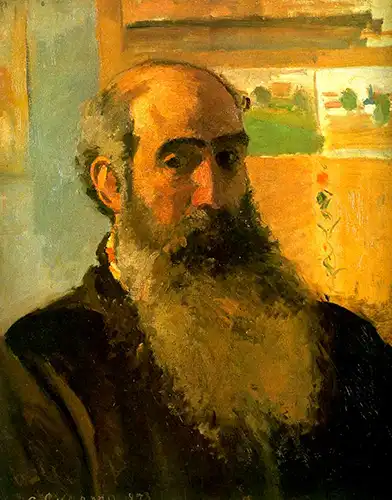
Camille Pissarro was born on July 10, 1830, on the island of St. Thomas in the Danish West Indies (now the U.S. Virgin Islands) . His parents were French-Jewish, and his early life on the Caribbean island shaped his temperament—quiet, observant, and deeply attuned to the rhythms of nature. At twelve, he was sent to boarding school in Paris, where his artistic inclinations first emerged. But it was only after abandoning the family business and fleeing to Caracas with the Danish painter Fritz Melbye that Pissarro committed himself fully to art.
Returning to Paris in 1855, Pissarro enrolled at the École des Beaux-Arts and studied under Camille Corot and Gustave Courbet. Corot, in particular, exerted a lasting influence, encouraging Pissarro to paint en plein air and to find his subjects in the ordinary landscapes of the French countryside. But Pissarro was no mere disciple. He absorbed the lessons of Corot and Courbet, then pushed beyond them, developing a style that was both more radical and more grounded.
Pissarro’s path intersected with nearly every major figure of the Impressionist movement. He befriended Claude Monet, Pierre-Auguste Renoir, and Alfred Sisley in the 1860s, and his insistence on painting outdoors—directly from nature—became a cornerstone of the Impressionist ethos . His relationship with Paul Cézanne was particularly significant. Pissarro mentored the younger artist in the 1870s, taking him into the countryside and teaching him to trust his eyes over his imagination. Cézanne later said, “As for Pissarro, he was a father to me. He was a man you could consult about anything and something like the good Lord”.
Pissarro was the only artist to exhibit in all eight Impressionist exhibitions between 1874 and 1886, and he served as a mediator and organizer, holding the disparate group together through his steady temperament . His paintings from this period—rural scenes of Pontoise and Louveciennes, markets and peasants, fields and orchards—embodied the Impressionist commitment to modern life and direct observation. Yet his work was always more structured than that of his peers, with a compositional rigor that earned him the reputation as the “most classical” of the Impressionists.
In the mid-1880s, Pissarro briefly experimented with Pointillism, collaborating with Georges Seurat and Paul Signac . Though he ultimately returned to a freer style, this period demonstrated his willingness to explore new directions, even at the cost of commercial success. His later works, painted from windows in Rouen, Paris, and Le Havre, captured the modern city with the same sensitivity he had brought to the countryside.
Pissarro’s influence extended far beyond his own generation. Through his teaching and example, he shaped the careers of Paul Cézanne, Paul Gauguin, and his own son Lucien, who carried Impressionism into the next century . He was, in the words of the art historian John Rewald, “the dean of the Impressionist painters, the one who more than any other remained true to the principles of the movement” .
Camille Pissarro died in Paris on November 13, 1903, at the age of seventy-three . He left behind over 1,600 paintings and a legacy as one of the most generous and principled figures in the history of art—a man who believed that painting was not merely a profession but a way of seeing the world, and who dedicated his life to teaching others to see it, too.