Ernest Hemingway: The Collector’s Guide to First Editions, Rare and Collectible Books

Early Life and Formative Experiences
Ernest Miller Hemingway was born on July 21, 1899, in Oak Park, Illinois, a prosperous and conservative suburb of Chicago. His father, Clarence Edmonds Hemingway, was a physician who instilled in young Ernest a passion for hunting, fishing, and the outdoors. His mother, Grace Hall-Hemingway, was an aspiring opera singer who dominated the household and insisted on a cultural education, including music lessons. This tension between his father’s rugged, masculine world and his mother’s domineering cultural aspirations would profoundly shape Hemingway’s personality and his fictional themes.
After graduating from high school, where he excelled in writing and sports, Hemingway rejected university and began his career as a cub reporter for The Kansas City Star. The newspaper’s strict style guide—mandating short sentences, vigorous English, and compression—became the foundation of his legendary prose style. His thirst for adventure, however, was insatiable. When the United States entered World War I, he volunteered as an ambulance driver for the Red Cross on the Italian front.
In July 1918, just weeks after his arrival, he was severely wounded by an Austrian mortar shell and machine-gun fire. This traumatic experience was a watershed moment. His recuperation in a Milan hospital and his romance with a nurse, Agnes von Kurowsky, provided raw material for his great war novel, A Farewell to Arms. He returned home a hero, but was psychologically scarred, grappling with the dissonance between the glory of war and its brutal reality—a central theme of the “Lost Generation” to which he belonged.
He married his first wife, Hadley Richardson, and in 1921, on the advice of Sherwood Anderson, they moved to Paris. There, as a foreign correspondent for the Toronto Star, he immersed himself in the expatriate literary community. Under the mentorship of modernists like Gertrude Stein and Ezra Pound, and alongside friends like F. Scott Fitzgerald, he honed his craft, moving from journalism to the short stories and novels that would make him famous.
The Ascendance of a Style: Major Works and the “Iceberg Principle”
The 1920s and 1930s marked Hemingway’s meteoric rise to literary fame. In Paris, he published the short story collection In Our Time (1925), which introduced his signature style to the world. This was followed by his first major novel, The Sun Also Rises (1926). A definitive portrait of the “Lost Generation”—American and British expatriates disillusioned by the war—the novel captured a mood of existential aimlessness and moral bankruptcy, countered only by a rigid code of stoicism and grace under pressure.
This period saw the full development of the “Hemingway Style,” a revolution in American prose. Influenced by his journalistic training and modernist peers, he pioneered a theory he called the “Iceberg Principle” (or theory of omission). He believed the deeper meaning of a story should shine through in its subtext, just as only one-eighth of an iceberg is visible above water. His writing was characterized by:
- Short, declarative sentences.
- Concrete, sensory language.
- Sparse dialogue and emotional restraint.
- A focus on action to reveal character.
His next major novels cemented his status as a literary titan. A Farewell to Arms (1929) is a stark, tragic love story set against the backdrop of the Italian retreat from Caporetto, a powerful indictment of the futility of war. For Whom the Bell Tolls (1940), inspired by his experiences as a journalist in the Spanish Civil War, expanded his scope to a political allegory about the interconnectedness of humanity, exploring sacrifice and idealism amidst conflict.
Hemingway’s life was as legendary as his fiction. He became a global celebrity, known for his passions for big-game hunting in Africa, deep-sea fishing in Florida and Cuba, and bullfighting in Spain—subjects that featured prominently in his work, most notably in Death in the Afternoon (a non-fiction study of bullfighting) and the classic short story “The Snows of Kilimanjaro.”
The Later Years: Nobel Prize and Personal Struggles
Following the immense success of For Whom the Bell Tolls, Hemingway entered a period of personal and creative difficulty. He worked as a war correspondent during World War II and was present at the D-Day landings and the liberation of Paris, but the publication of his next major novel, Across the River and Into the Trees (1950), was met with harsh criticism, dismissed as a self-parody.
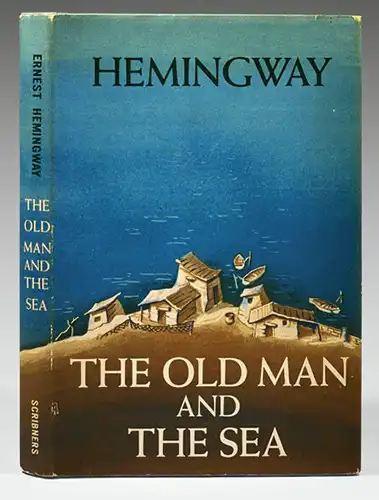
In a stunning comeback, he published The Old Man and the Sea in 1952. This short, powerful novella—a parable about an aging Cuban fisherman’s epic struggle with a giant marlin—was a universal tale of courage, endurance, and personal redemption. It single-handedly restored his literary reputation and was cited when he was awarded the Nobel Prize in Literature in 1954 “for his mastery of the art of narrative, most recently demonstrated in The Old Man and the Sea, and for the influence that he has exerted on contemporary style.”
Despite this ultimate accolade, Hemingway’s final years were marked by a steep decline. He suffered from deteriorating health, exacerbated by years of adventurous living and multiple serious accidents, including two plane crashes in Africa just before the Nobel announcement. He battled severe depression, paranoia, and was subjected to electroshock therapy. The once-vigorous proponent of courage and grace under pressure could no longer withstand his internal demons. On July 2, 1961, at his home in Ketchum, Idaho, Ernest Hemingway died by suicide, much like his father before him.
Influence and Legacy
Ernest Hemingway’s impact on 20th-century literature and culture is immeasurable. He fundamentally changed how writers write and how heroes are portrayed.
- Revolutionizing Prose Style: His lean, understated, and muscular prose was a radical departure from the ornate Victorian style that preceded it. He demonstrated that immense emotional power could be conveyed through what was left unsaid. This style became the standard for generations of novelists and journalists, influencing writers as diverse as Raymond Carver, Joan Didion, and Cormac McCarthy.
- The “Hemingway Hero”: He created a new archetype: the stoic, masculine individual who faces a chaotic, violent, and often meaningless world with courage, discipline, and a strict personal code. This figure—the soldier, the hunter, the fisherman—grapples with trauma and the threat of nihilism, finding meaning not in grand philosophies but in well-executed action. This archetype profoundly influenced American conceptions of masculinity and appears in the works of countless authors and filmmakers.
- The Cult of the Author: Hemingway was one of the first modern writers to become a global celebrity. His life of adventure—as war correspondent, hunter, and bon vivant—became inseparable from his work. He crafted a public persona of the author as a man of action, setting a template that still influences how writers are marketed and perceived.
- Limitations and Re-evaluation: In recent decades, his legacy has been re-examined. Critics point to the sometimes-limited roles of his female characters and the potentially toxic aspects of his hyper-masculine code. Yet, his best work continues to resonate because it explores universal human struggles: fear, courage, love, loss, and the search for meaning in a fractured world. Ernest Hemingway remains a towering, complex figure whose clean, direct sentences forever cleared the air for American writing.
Ernest Hemingway – First Editions Identification Guide
A Complete Bibliography of Ernest Hemingway: Novels, Rare Books & First Editions
| Year | Title | Publisher | First edition/printing identification points |
|---|---|---|---|
| 1952 | The Old Man and the Sea | Charles Scribner's Sons, 1952 | Boards. © page has an "A" and Scribner's Seal printed, ($2.50). Two variants Dust Jackets, no priority:
|
| 1924 | In Our Time | Paris: Three Mountain Press, 1924 | Boards. Limited edition of 170 copies. Issued without Dust Jacket. |
| 1926 | The Sun Also Rises | Charles Scribner's Sons, 1926 | Boards. © page has an "A" and Scribner's Seal printed, matches date on the title page.The word "stopped" is misspelled as "stoppped" on page 181, line 26, ($2.00). Dust jacket front says "IN OUR TIMES", which is corrected in later issues to "IN OUR TIME". |
| 1926 | The Torrents of Spring | Charles Scribner's Sons, 1926 | Boards. © page has an "A" and Scribner's Seal printed, matches date on the title page, ($1.50). Dust Jacket price $1.50, rear panel has a list of books starting with "Important Fiction" |
| 1927 | Men Without Women | Charles Scribner's Sons, 1927 | Boards. © page has an "A" and Scribner's Seal printed, matches the date on the title page, ($2.00). The first issue of the book has a perfect page number on page 3. The second issue has a slightly damaged "3" that can be found on later printings as well. The dust jacket front lacks review blurbs. |
| 1932 | Death in the Afternoon | Charles Scribner's Sons, 1932 | Boards. © page has an "A" and Scribner's Seal printed, matches the date 1932 on the title page ($3.50). Dust jacket features Toros painting by Roberto Domingo on front panel, and has a $3.50 printed price on the front flap. The back of the dust jacket has reviews for A Farewell to Arms, Men Without Women, The Sun Also Rises, The Torrents of Spring, and In Our Time. |
| 1933 | Winner Take Nothing | Charles Scribner's Sons, 1933 | Boards. © page has an "A" and Scribner's Seal printed, matches the date 1933 on the title page ($2.00). Dust Jacket price of $2.50, rear panel has ads for "Books by Ernest Hemingway", rear flap has ads for "Men Without Women" and "In Our Time." |
| 1935 | Green Hills of Africa | Charles Scribner's Sons, 1935 | Boards. © page has an "A" and Scribner's Seal printed, matches the date 1935 on the tiel page ($2.75). The Dust Jacket has a price of $2.75 on the front flap, a wide green band from spine to the rear cover. Later issue jackets has a smaller green band on the rear cover. |
| 1937 | To Have and Have Not | Charles Scribner's Sons, 1937 | Boards. © page has an "A" and Scribner's Seal printed ($2.50). The Dust Jacket has original price $2.50 on the front flap. |
| 1938 | The Fifth Column and the First Forty-Nine Stories | Charles Scribner's Sons, 1938 | Boards. © page has an "A" and Scribner's Seal printed ($2.75). The Dust Jacket has original price $2.75 on the front flap. |
| 1942 | Men at War: The Best War Stories of All Time | Charles Scribner's Sons, 1942 | Boards. © page has an "A" and Scribner's Seal printed, matches the date 1940 on the title page ($3.00). The Dust Jacket price $3.00. |
| 1950 | Across the River and into the Trees | Charles Scribner's Sons, 1950 | Boards. © page has an "A" and Scribner's Seal printed, ($3.00). The Dust Jacket has yellow spine lettering (later issue jackets have orange spine letering.) |
| 1964 | A Movable Feast | Charles Scribner's Sons, [1964] | Boards. Copyright page has Code A-3.64[H], ($4.50). Dust Jacket price of $4.50 on front flap. |
| 1925 | In Our Time | New York: Boni & Liveright, 1925 | Boards. "Copyright 1925 by Boni & Liveright, Inc.," with Boni & Liveright's Seal on copyright page, ($2.00). No mention of subsequent printings. |
| 1929 | A Farewell to Arms | Charles Scribner's Sons, 1929 | Boards. Two editions, no priority:
|
| 1940 | For Whom the Bell Tolls | Charles Scribner's Sons, 1940 | Boards. © page has an "A", matches the date 1940 on the title page ($2.50). The Dust Jacket lacks the photo credit on the reverse under the photo of Hemingway. |
Ernest Hemingway – First Printing Dust Jackets Identification Guide
Gallery of First state Dust Jackets of works.


Reference: