Marya Morevna: Ivan Bilibin’s Russian Wonderland
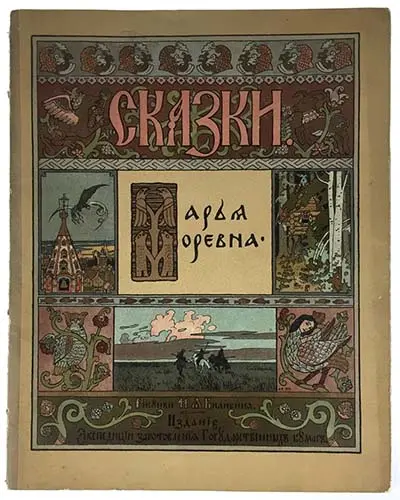
There are illustrated books that merely decorate a text, and then there are books where image and story become inseparable—where the very look of the letters, the shape of the borders, and the colors of the ink transport the reader into another world entirely. Ivan Bilibin’s edition of Marya Morevna and Other Russian Fairy Tales belongs to the second, rarer category. To open this book is not to read a story. It is to step inside a Russian folk painting, to wander through a realm of swirling patterns, fierce warriors, and enchanted forests where Baba Yaga’s hut waits on chicken legs.
The tales themselves are drawn from the collection of Alexander Afanasyev, the Russian equivalent of the Brothers Grimm. In the nineteenth century, Afanasyev traveled through the Russian countryside, recording the oral tales of peasants and villagers. Among the most powerful of these stories is Marya Morevna, a sweeping epic of love, betrayal, and supernatural warfare. The story follows the hero Ivan Tsarevich, his magical bride Marya Morevna (a warrior princess of astonishing strength), and the villainous Koschei the Deathless—a skeletal sorcerer whose soul is hidden inside a needle, inside an egg, inside a duck, inside a hare, inside an iron chest buried beneath a green oak tree. To defeat Koschei, Ivan must unravel this nesting doll of death. The tale is wild, bloody, and deeply strange, filled with flying carpets, talking wolves, and the kind of logic that belongs only to dream and folklore.
Ivan Bilibin was the perfect illustrator for this material. Born in 1876 near St. Petersburg, he came of age during a revival of interest in Russian folk art and national identity. He studied under Ilya Repin and was deeply influenced by the traditional lubok prints and peasant embroidery he collected on expeditions to the Russian north. Bilibin developed a style that was instantly recognizable: bold, black outlines; flat, decorative areas of color; and intricate borders inspired by the patterns of old Russian manuscripts and architecture. His illustrations never pretend to be realistic. They are proudly, joyfully two-dimensional—more like stained glass or icon painting than like photographs.
In Marya Morevna, Bilibin’s palette is rich and dramatic. He uses deep vermilions, forest greens, gold ochres, and stark blacks and whites. His Koschei the Deathless is a terrifying figure—gaunt, white-haired, with hollow eyes and claw-like fingers, dressed in flowing robes that seem to move even in stillness. His Marya Morevna is tall, stern, and beautiful, a warrior queen who looks as though she could command armies with a glance. His Ivan Tsarevich is brave but vulnerable, a hero who makes mistakes and must atone for them.
Perhaps most remarkable are Bilibin’s decorative borders and initials. Every page is framed with intricate patterns drawn from Russian folk art—interlocking geometric shapes, stylized flowers, fantastic birds. The first letter of each story becomes a small illustration in itself, often featuring a tiny dragon, a flowering vine, or a peasant in traditional dress. These borders do not merely frame the text; they immerse the reader in a complete visual world where no space is empty and every surface sings with pattern.
Marya Morevna is not a gentle book for sleepy bedtime reading. It is bold, fierce, and unapologetically Russian. Bilibin understood that fairy tales are not soft. They are sharp. They teach courage, warn of betrayal, and celebrate the strange, wild magic that lives just beyond the edge of the ordinary world. His illustrations give that magic a face, a color, and a pattern. To hold this book is to hold a piece of old Russia—a land of snow, fire, and stories that never die.
Recommended for collectors:
- The Tale of Tsar Saltan (1905), illustrated by Ivan Bilibin – Another Pushkin tale with iconic border work and vivid folkloric imagery.
- The Firebird and Other Russian Fairy Tales (1980), illustrated by Boris Zvorykin – A lush collection filled with color and mystical themes.
Ivan Bilibin – Maria Morevna Fairy Tales 1903