Limited Edition
A Decadent Vision: John Vassos’s The Harlot’s House
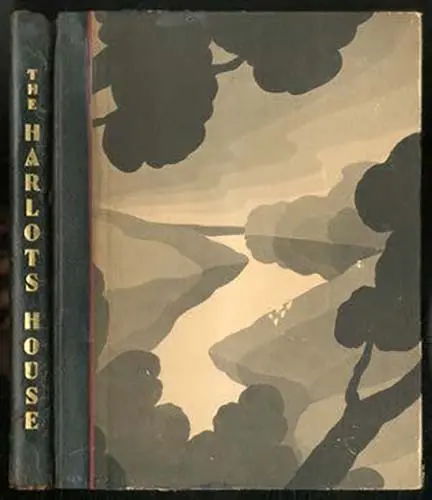
In the annals of illustrated books, few volumes are as singular—or as startling—as John Vassos’s 1928 edition of Oscar Wilde’s The Harlot’s House. This slender publication, issued in a limited run of just 1,100 copies by Macy-Masius in New York, stands as a landmark of Art Deco book design and a testament to the radical possibilities of the illustrated form. It is a work that captures the decadence, the disillusionment, and the dark glamour of the Jazz Age through the lens of Wilde’s fin-de-siècle vision.
Oscar Wilde’s The Harlot’s House, first published in 1885, is one of the poet’s most haunting works. Written in the shadow of his own emerging identity as a figure of aesthetic rebellion, the poem describes a couple walking past a house of ill repute, watching the ghostly figures within dance to a mechanical music. It is a meditation on love, corruption, and the soullessness of pleasure without meaning—themes that would recur throughout Wilde’s career and that resonated deeply with the post-World War I generation.
John Vassos (1898–1985) was a Romanian-born American artist whose career spanned illustration, industrial design, and advertising. Trained in Bucharest and Constantinople before emigrating to the United States in 1924, he brought to his work a European sophistication and a modernist sensibility that set him apart from the lingering traditions of the Golden Age. His style was defined by bold geometric forms, stark contrasts, and a psychological intensity that made his illustrations feel less like decorations and more like visual manifestations of the psyche.
The 1928 edition of The Harlot’s House is a masterpiece of Art Deco design. The volume, bound in black cloth with a stark geometric pattern stamped in silver, measures a modest octavo format, yet its visual impact is anything but small. Inside, Vassos’s illustrations unfold in a sequence of sixteen full-page drawings, each rendered in black, white, and shades of gray—a palette that mirrors the poem’s moral chiaroscuro.
What distinguishes Vassos’s work is its radical departure from the decorative traditions of book illustration. His figures are not graceful or idealized but angular, distorted, almost mechanical. The dancers in the harlot’s house are depicted as marionettes, their limbs jerking in artificial rhythms; the lovers on the street are rendered as ghostly presences, their faces masks of longing and alienation. The influence of German Expressionism is evident in the sharp angles and psychological distortion, as is the emerging language of Surrealism in the dreamlike disjunction of forms.
The limited nature of the edition—just 1,100 copies—reflected the publisher’s understanding that this was not a book for the mass market. It was a collector’s item from the moment of publication, a volume designed for those who appreciated the avant-garde and the daring. Each copy was signed by Vassos, and the illustrations were printed using techniques that preserved the subtle gradations of his drawings.
The critical response to Vassos’s The Harlot’s House was mixed—some reviewers praised its boldness, while others found its starkness unsettling. Yet its reputation has only grown over time. Today, it is recognized as a landmark of Art Deco illustration, a work that pushed the boundaries of what an illustrated book could be. It stands alongside Vassos’s other notable works of the period—his designs for the Phobia series, his industrial designs for Radio Corporation of America—as a testament to the breadth of his talent.
First editions of the 1928 Harlot’s House are highly prized by collectors. The black cloth binding, the silver stamping, the limited print run—all contribute to a volume that is both a literary artifact and a work of modern art. For those fortunate enough to own a copy, the book offers an experience that is both beautiful and disturbing—a journey into the heart of Wilde’s poem, illuminated by an artist who understood that the harlot’s house is not merely a place but a state of mind.
In Vassos’s illustrations, Wilde’s dancers still jerk to their mechanical music, the ghostly lovers still walk the empty street, and the line between pleasure and despair blurs into a vision of modernity that remains startlingly relevant. It is a book for those who understand that the greatest illustrated works are not those that comfort but those that challenge—and that the most enduring art is often the most unsettling.
Recommended for collectors and readers:
- Phobia (1931), illustrated by John Vassos – A powerful exploration of psychological fears through abstract, surreal illustrations.
- Contempo (1930), illustrated by John Vassos – A bold visual commentary on modern urban society and its contradictions.
- Salome (1894), illustrated by Aubrey Beardsley – Wilde’s controversial play paired with equally provocative Art Nouveau illustrations.
Art Gallery: John Vassos – The Harlot’s House and Other Poems 1929
![John Vassos - The Harlot's House [vassos-harlot01] (art, illustrations)](https://www.nocloo.com/wp-content/plugins/justified-image-grid/timthumb.php?src=https%3A%2F%2Fwww.nocloo.com%2Fart%2Fvassos-harlot%2Fvassos-harlot01.jpg&h=280&q=90&f=.jpg)
![John Vassos - The Harlot's House [vassos-harlot02] (art, illustrations)](https://www.nocloo.com/wp-content/plugins/justified-image-grid/timthumb.php?src=https%3A%2F%2Fwww.nocloo.com%2Fart%2Fvassos-harlot%2Fvassos-harlot02.jpg&h=280&q=90&f=.jpg)
![John Vassos - The Harlot's House [vassos-harlot03] (art, illustrations)](https://www.nocloo.com/wp-content/plugins/justified-image-grid/timthumb.php?src=https%3A%2F%2Fwww.nocloo.com%2Fart%2Fvassos-harlot%2Fvassos-harlot03.jpg&h=280&q=90&f=.jpg)
![John Vassos - The Harlot's House [vassos-harlot04] (art, illustrations)](https://www.nocloo.com/wp-content/plugins/justified-image-grid/timthumb.php?src=https%3A%2F%2Fwww.nocloo.com%2Fart%2Fvassos-harlot%2Fvassos-harlot04.jpg&h=280&q=90&f=.jpg)
![John Vassos - The Harlot's House [vassos-harlot05] (art, illustrations)](https://www.nocloo.com/wp-content/plugins/justified-image-grid/timthumb.php?src=https%3A%2F%2Fwww.nocloo.com%2Fart%2Fvassos-harlot%2Fvassos-harlot05.jpg&h=280&q=90&f=.jpg)
![John Vassos - The Harlot's House [vassos-harlot06] (art, illustrations)](https://www.nocloo.com/wp-content/plugins/justified-image-grid/timthumb.php?src=https%3A%2F%2Fwww.nocloo.com%2Fart%2Fvassos-harlot%2Fvassos-harlot06.jpg&h=280&q=90&f=.jpg)
![John Vassos - The Harlot's House [vassos-harlot07] (art, illustrations)](https://www.nocloo.com/wp-content/plugins/justified-image-grid/timthumb.php?src=https%3A%2F%2Fwww.nocloo.com%2Fart%2Fvassos-harlot%2Fvassos-harlot07.jpg&h=280&q=90&f=.jpg)
![John Vassos - The Harlot's House [vassos-harlot08] (art, illustrations)](https://www.nocloo.com/wp-content/plugins/justified-image-grid/timthumb.php?src=https%3A%2F%2Fwww.nocloo.com%2Fart%2Fvassos-harlot%2Fvassos-harlot08.jpg&h=280&q=90&f=.jpg)
![John Vassos - The Harlot's House [vassos-harlot09] (art, illustrations)](https://www.nocloo.com/wp-content/plugins/justified-image-grid/timthumb.php?src=https%3A%2F%2Fwww.nocloo.com%2Fart%2Fvassos-harlot%2Fvassos-harlot09.jpg&h=280&q=90&f=.jpg)
![John Vassos - The Harlot's House [vassos-harlot10] (art, illustrations)](https://www.nocloo.com/wp-content/plugins/justified-image-grid/timthumb.php?src=https%3A%2F%2Fwww.nocloo.com%2Fart%2Fvassos-harlot%2Fvassos-harlot10.jpg&h=280&q=90&f=.jpg)
![John Vassos - The Harlot's House [vassos-harlot11] (art, illustrations)](https://www.nocloo.com/wp-content/plugins/justified-image-grid/timthumb.php?src=https%3A%2F%2Fwww.nocloo.com%2Fart%2Fvassos-harlot%2Fvassos-harlot11.jpg&h=280&q=90&f=.jpg)
![John Vassos - The Harlot's House [vassos-harlot12] (art, illustrations)](https://www.nocloo.com/wp-content/plugins/justified-image-grid/timthumb.php?src=https%3A%2F%2Fwww.nocloo.com%2Fart%2Fvassos-harlot%2Fvassos-harlot12.jpg&h=280&q=90&f=.jpg)
![John Vassos - The Harlot's House [vassos-harlot13] (art, illustrations)](https://www.nocloo.com/wp-content/plugins/justified-image-grid/timthumb.php?src=https%3A%2F%2Fwww.nocloo.com%2Fart%2Fvassos-harlot%2Fvassos-harlot13.jpg&h=280&q=90&f=.jpg)
![John Vassos - The Harlot's House [vassos-harlot14] (art, illustrations)](https://www.nocloo.com/wp-content/plugins/justified-image-grid/timthumb.php?src=https%3A%2F%2Fwww.nocloo.com%2Fart%2Fvassos-harlot%2Fvassos-harlot14.jpg&h=280&q=90&f=.jpg)
![John Vassos - The Harlot's House [vassos-harlot15] (art, illustrations)](https://www.nocloo.com/wp-content/plugins/justified-image-grid/timthumb.php?src=https%3A%2F%2Fwww.nocloo.com%2Fart%2Fvassos-harlot%2Fvassos-harlot15.jpg&h=280&q=90&f=.jpg)
![John Vassos - The Harlot's House [vassos-harlot16] (art, illustrations)](https://www.nocloo.com/wp-content/plugins/justified-image-grid/timthumb.php?src=https%3A%2F%2Fwww.nocloo.com%2Fart%2Fvassos-harlot%2Fvassos-harlot16.jpg&h=280&q=90&f=.jpg)