Kurt Vonnegut: The Collector’s Guide to First Editions, Rare and Collectible Books
Early Life and the Crucible of War (1922-1945)
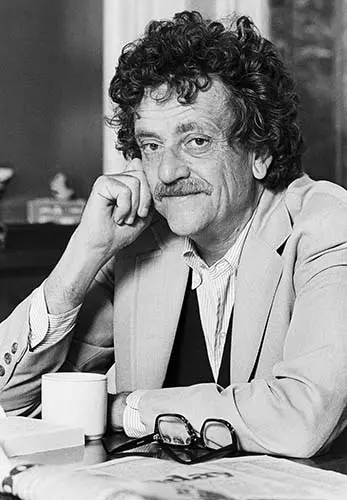
Kurt Vonnegut Jr. was born in 1922 into a prominent German-American family in Indianapolis, a city he would later romanticize as a symbol of American decency and sanity. His early life was marked by the gradual decline of his family’s fortune during the Great Depression, an experience that shaped his lifelong skepticism toward capitalism and the American Dream. He showed an early talent for writing, serving as an editor for his high school newspaper and later for the Cornell Daily Sun while briefly studying biochemistry at Cornell University.
Vonnegut’s life was irrevocably shaped by his experiences in World War II. Drafted into the army, he was captured during the Battle of the Bulge and imprisoned as a POW in Dresden, Germany. There, he survived the Allied firebombing of the city in February 1945 by taking shelter in an underground meat locker labeled “Slaughterhouse-Five.” This event, which incinerated a city of no military significance and killed an estimated 25,000 civilians, became the dark, gravitational center of his life and work. The absurdity and horror of surviving such a senseless atrocity would fuel his darkly comic, nihilistic, and profoundly humanistic worldview. After the war, he married and began a master’s degree in anthropology at the University of Chicago, which he never completed, though the university would later award him his degree on the strength of his novel Cat’s Cradle.
The Struggling Writer: Science Fiction and Satire (1950-1962)
Returning from the war, Vonnegut took a job in public relations for General Electric, an experience that solidified his distrust of large, dehumanizing corporations and unchecked technological progress. He began writing short stories for the burgeoning magazine market, often published in science fiction pulps like Galaxy and The Magazine of Fantasy and Science Fiction. While this categorization would later somewhat ghettoize him in the eyes of the literary establishment, it gave him a framework to explore his big ideas about technology, free will, and the future of humanity through allegory and satire.
His early novels, including Player Piano (1952), a dystopian critique of automation, and The Sirens of Titan (1959), a sprawling space opera that questions the meaning of life, were critically admired but commercially unsuccessful. During this period, he also published story collections like Canary in a Cat House (1961). He was a writer struggling to support his family, and his work, while brilliant, had not yet found its definitive voice or its audience. He was perfecting his craft, blending elements of science fiction, satire, and social commentary into a unique mixture that was not yet in vogue.
Breakthrough and Masterpiece: “Slaughterhouse-Five” (1963-1972)

The 1960s marked a turning point. The publication of Cat’s Cradle in 1963, with its invented religion of Bokononism and its deadly substance of ice-nine that could end the world, was a critical success and brought him a growing cult following. Its dark humor and fragmented structure captured the apocalyptic anxiety of the Cold War. However, it was the 1969 publication of Slaughterhouse-Five that catapulted him to international fame and cemented his legacy.
The novel was his direct, decades-in-the-making response to the Dresden bombing. It is not a traditional war story but an anti-war masterpiece that is simultaneously science fiction, autobiography, and historical fiction. Its famous refrain, “So it goes,” uttered after every mention of death, encapsulates a philosophy of fatalistic acceptance in the face of an absurd and violent universe. The story of Billy Pilgrim, who becomes “unstuck in time” and is abducted by aliens from the planet Tralfamadore, allowed Vonnegut to present the trauma of war in a non-linear, deeply personal, and darkly humorous way. The book became a massive bestseller, especially among the counterculture youth protesting the Vietnam War, who saw in Vonnegut a voice for their own disillusionment. It transformed him from a cult sci-fi author into a major American literary figure.
Later Career and Elder Statesman (1973-2007)
In the wake of his fame, Vonnegut entered a prolific period as a public intellectual and satirist. He published several significant novels, including Breakfast of Champions (1973), a metafictional romp where the author interacts with his own characters, and Jailbird (1979), a critique of American capitalism and politics. While his later novels, such as Deadeye Dick (1982) and Galápagos (1985), were sometimes seen as less cohesive, they continued to explore his core themes with his signature blend of pessimism and compassion.
He also became a popular essayist and speaker, with collections like Wampeters, Foma & Granfalloons (1974) and Palm Sunday (1981) showcasing his sharp, aphoristic wit on contemporary issues. His final novel, Timequake (1997), was a reflective, semi-autobiographical work that revisited his familiar motifs. In his later years, he was embraced as a beloved, grumpy, and profoundly humane moralist, a figure who had looked into the abyss of the 20th century and responded not with silence, but with a sad, knowing laugh. He died in 2007 from head injuries sustained in a fall.
Influence and Legacy
Kurt Vonnegut’s influence is vast and enduring. He broke down the barriers between genre and “literary” fiction, proving that science fiction could be a powerful vehicle for serious philosophical and social critique. His distinctive style—characterized by short chapters, simple prose, dark humor, recurring characters (like Kilgore Trout), and hand-drawn illustrations—has been widely imitated but never duplicated.
He is a foundational figure for generations of writers, from postmodernists to satirists and science fiction authors. His humanistic message, which championed kindness and decency in a cruel and irrational universe, resonates as strongly today as it did during the Vietnam War. Phrases like “So it goes,” “And so on,” and “Everything was beautiful and nothing hurt” have entered the cultural lexicon. More than just a writer, Vonnegut became a moral compass for many, a secular saint who used satire and science fiction to ask the most essential questions: How should we live? How can we remain human in an inhuman world? His legacy is that of the compassionate cynic, the man who taught us to laugh in the face of the void.
Kurt Vonnegut – First Editions Identification Guide
A Bibliography of Kurt Vonnegut: Novels, Rare Books & First Editions
Note: This list only includes works published prior to 1977.
| Year | Title | Publisher | First edition/printing identification points |
|---|---|---|---|
| 1972 | BETWEEN TIME AND TIMBUKTU | [New York]: Delacorte Press/Seymour Lawrence. [1972] | Boards with cloth shelf back. First printing-1972 on © page. |
| 1975 | BREAKFAST OF CHAMPIONS OR GOODBYE, BLUE MONDAY | [New York]: Delacorte Press/Seymour Lawrence. [1975] | First printing-1973 on © page. |
| 1961 | CANARY IN A CAT HOUSE | Greenwich, Conn.: Fawcett Publications, Inc., [1961] | Wrappers. First printing September 1961 on © page. Gold Medal Booksi 153 (35¢). Note: All but one of the stories in this collection, "Hal Irwin's Magic Lamp," later collected in WELCOME TO THE MONKEY HOUSE. |
| 1963 | CAT'S CRADLE | New York Chicago San Francisco: Holt, Rinehart and Winston, [1963] | First edition so stated on © page. |
| 1965 | GOD BLESS YOU, MR. ROSEWATER | New York Chicago San Francisco: Holt, Rinehart and Winston, [1965] | Boards with cloth shelf back. First edition so stated on © page. |
| 1971 | HAPPY BIRTHDAY, WANDA JUNE | New York: Delacorte Press, [1971] | First printing so stated on © page. ALSO: HAPPY BIRTHDAY, WANDA JUNE: A PLAY IN THREE ACTS. New York Hollywood London Toronto: Samuel French, Inc., [1974]. Wrappers. No statement of printing on © page. Drops author's note "About This Play." |
| 1962 | MOTHER NIGHT | Greenwich, Conn.: Fawcett Publications, Inc., [1962] | Wrappers. First printing February 1962 on © page. Gold Medal s1191 (35¢). ALSO: New York: Harper & Row, Publishers, [1966]. Boards with cloth shelf back. First edition so stated on © page. First hardcover edition. Adds introduction by Vonnegut. |
| 1952 | PLAYER PIANO | New York: Charles Scribner's Sons, 1952 | Boards. First printing has Scribner seal and A on © page. Reissued as UTOPIA 14. |
| 1959 | THE SIRENS OF TITAN | [New York]: A Dell First Edition, [1959] | Wrappers. First printing -- October, 1959 on © page. Dell First Edition B138 (35¢). ALSO: Boston: Houghton Mifflin Company, 1961. First printing so stated on © page. First hardcover edition. |
| 1976 | SLAPSTICK OR LONESOME NO MORE! | [New York]: Delacorte Press/Seymour Lawrence, [1976] | Two printings, priority as listed:
|
| 1969 | SLAUGHTERHOUSE-FIVE | [New York]: A Seymour Lawrence Book/Delacorte Press, [1969] | First printing so stated on © page. |
| 1954 | UTOPIA 14 | New York: Bantam Books, [1954] | Wrappers. 1st Printing ... October, 1954 on © page. A Bantam Giant A 1262 (35¢). Reissue of PLAYER PIANO. |
| 1968 | WELCOME TO THE MONKEY HOUSE | [New York]: A Seymour Lawrence Book Delacorte Press, [1968] | Boards with cloth shelf back. First Delacorte printing on © page. |
Kurt Vonnegut – First Printing Dust Jackets Identification Guide
Gallery of First state Dust Jackets of Vonnegut’s works.


Reference:
- L. W. Currey, Science Fiction and Fantasy Authors: A Bibliography of First Printings of Their Fiction and Selected Nonfiction.