A Masterpiece of American Art Nouveau: Will H. Bradley’s Fringilla
In the history of American book illustration, certain volumes stand as landmarks—works where the artist’s vision achieved such complete expression that the book itself became a work of art. Will H. Bradley’s 1895 edition of Fringilla, a collection of verse by the English novelist Richard Doddridge Blackmore, is one such landmark. Considered by many to be Bradley’s masterpiece, this volume represents the pinnacle of American Art Nouveau design and a defining achievement of the private press movement in the United States .
Will H. Bradley (1868–1962) was one of America’s most influential illustrators and graphic designers. Self-taught and extraordinarily prolific, he rose to prominence in the 1890s as a leading figure in the Arts and Crafts movement. His work drew deeply from British sources—the decorative ideals of William Morris’s Kelmscott Press, the sinuous lines of Aubrey Beardsley, and the tonal harmonies of James McNeill Whistler—yet Bradley transformed these influences into something distinctly American: bold, elegant, and commercially savvy .
The Fringilla project was an ambitious one. Published by The Burrows Brothers Company of Cleveland, the book was issued in a limited edition of just 600 copies on handmade paper, with a further 40 copies printed on Japan paper for the most discerning collectors . Bradley was given extraordinary creative control over the entire production. He designed the cover, the title page, the ornaments, and the illustrations. He selected the typeface (Jenson, a favorite of the Arts and Crafts movement), arranged the page layouts, and supervised the printing from start to finish . The result was a volume of exceptional unity—a total work of art in the tradition of Morris’s Kelmscott Press.
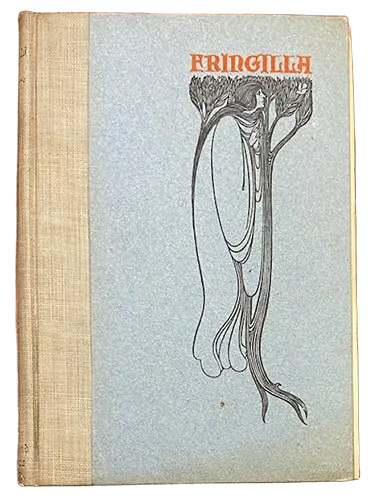
The book’s physical presence is striking. Printed in red and black throughout, Fringilla features decorative borders at chapter openings, elaborate initials, and numerous illustrations that blend seamlessly with the text . The cover design, with its stylized floral patterns and bold lettering, announces Bradley’s Art Nouveau sensibility from the first glance. Inside, the influence of William Morris is evident in the foliate borders and the careful attention to page composition, yet Bradley’s own voice emerges in the elegance of his line and the confident simplicity of his forms .
Yet Fringilla is also a book marked by a fascinating creative tension. While Bradley poured his artistry into the volume, the author himself was less than pleased with the result. Richard Doddridge Blackmore, best known for his novel Lorna Doone, had little appreciation for the decorative style that Bradley championed. In correspondence, he referred to Fringilla as “that miserable book, the most absurd and hideous thing ever seen” . He objected to Bradley’s “slate-scrawls for pictures” and, most vehemently, to the fact that Bradley’s layout had transformed his carefully structured verse into prose, destroying the rhythm of his stanzas . When the publisher requested that he sign fifty copies, Blackmore flatly refused, unwilling to appear “an accomplice in the two barbarities” .
This clash between author and artist only adds to the book’s historical interest. Blackmore’s objections remind us that the illustrated book is always a negotiation—a space where text and image, tradition and innovation, authorial intention and artistic interpretation, must find uneasy balance. For Bradley, Fringilla represented the culmination of his early style and a declaration of his artistic principles. Contemporary critics praised it as his “most complete and perfect production” to date . Today, it stands as a testament to the heights American book design could achieve in the 1890s, a jewel of the Art Nouveau movement and a prized treasure for collectors of illustrated books .
For those who encounter it, Fringilla offers a window into a remarkable moment—when an American artist, inspired by the great traditions of European design, created a work of singular beauty, even as the author looked on in dismay. In its pages, the tension between word and image, between Victorian tradition and modern design, finds expression in a volume that remains, more than a century later, utterly captivating.
Recommended for Collectors
- Le Morte D’Arthur (1893) illustrated by Aubrey Beardsley for comparable Art Nouveau treatment of literary classics
- The Chap-Book (1890s) featuring Bradley’s revolutionary poster designs
Art Gallery: Will H. Bradley – Fringilla 1895