Bringing Neverland to the Nursery: Alice B. Woodward’s The Peter Pan Picture Book
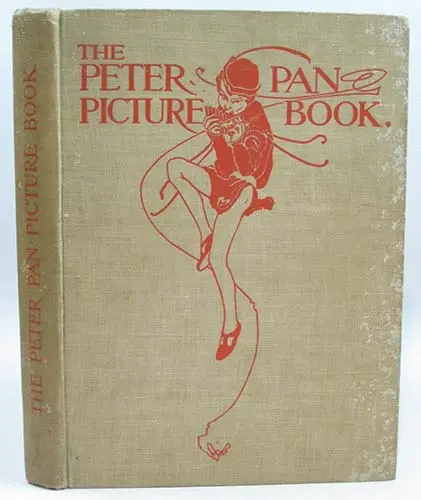
There are certain illustrated books that serve as a bridge—a way for the very youngest readers to step into a story before they are ready for the original text. Alice B. Woodward’s illustrations for The Peter Pan Picture Book, published in 1907, represent one of the most charming and historically significant of such bridges. This was the book that brought J.M. Barrie’s beloved play, then thrilling audiences in London’s West End, into the hands and hearts of children who could not yet attend the theatre.
The story of this edition begins with the phenomenal success of Barrie’s play Peter Pan, or The Boy Who Wouldn’t Grow Up, which had first been staged on December 27, 1904 . The demand for a children’s storybook based on the play was immediate and intense. With Barrie’s blessing, author Daniel O’Connor adapted the play into a simplified narrative, and the result was The Peter Pan Picture Book, published by G. Bell and Sons in London . It was intended, as one contemporary review noted, to “enable children to revive their memories” of the theatrical spectacle .
Alice B. Woodward, the artist entrusted with bringing this new version to life, was a prominent English illustrator whose work bridged the Victorian and Edwardian eras. Her style, characterized by fluid Art Nouveau lines and a keen sense of decorative composition, drew favorable comparisons to her contemporary, Arthur Rackham . For this commission, Woodward produced a remarkable suite of twenty-eight color plates, alongside numerous black-and-white illustrations that danced throughout the text .
What makes Woodward’s illustrations so distinctive is their combination of ethereal beauty with a robust sense of storytelling. Her Neverland is a place of elegant curves and soft, atmospheric colors—pale blues, muted greens, and warm golden tones that suggest both the magic of fairy flight and the cozy familiarity of a child’s imagination. Her figures possess a graceful, elongated quality typical of the period, yet they never feel stiff or remote. Peter Pan himself is rendered as a sprite-like figure, poised on the edge of motion, while the Darling children embody a sweet innocence that grounds the fantasy in recognizable emotion.
Contemporary reviews praised the volume effusively. An October 1908 notice in The Studio described the book as “conspicuous… by reason of its two dozen or more delightful illustrations in colour by Miss Alice Woodward,” noting that the text was printed in large clear type and the book “so nicely got up generally that it is bound to be welcomed in the nursery” . This was a book designed to be read aloud, to be held by small hands, to become a cherished companion.
The physical book itself was a handsome production, bound in cloth and featuring an oval Peter Pan motif on the front cover in some editions . It contained not only Woodward’s illustrations but also musical selections from the original stage score, allowing families to bring a touch of the theatrical experience into their homes . So successful was this edition that it remained in print for over sixty years, a testament to the enduring appeal of both Barrie’s story and Woodward’s vision .
Today, The Peter Pan Picture Book stands as a treasure of the illustrated book tradition. It captures a particular moment—the birth of a cultural icon—and presents it with a warmth and visual charm that continues to enchant. For those who grew up with Barrie’s tale, Woodward’s images evoke the wonder of first discovery. For those discovering it anew, they offer a glimpse into a Golden Age of illustration when artists like Woodward transformed beloved stories into enduring works of art.
For collectors of this edition, these related works may enchant:
• Peter Pan and Wendy (1911) illustrated by F.D. Bedford – the first novel edition
• The Peter Pan Alphabet (1907) illustrated by Woodward – her companion primer
• Peter Pan in Kensington Garden (1906) illustrated by Arthur Rackham – contemporary interpretation
Art Gallery: Alice B. Woodward – Peter Pan 1907