Dashiell Hammett: The Collector’s Guide to First Editions, Rare and Collectible Books
Dashiell Hammett: The Man Who Forged the Hardboiled Novel
Early Life and the Pinkerton Years
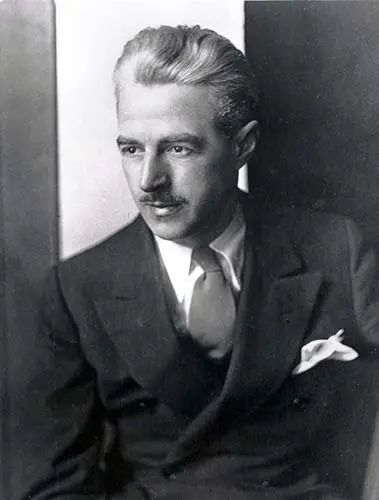
Samuel Dashiell Hammett was born on May 27, 1894, on a farm in St. Mary’s County, Maryland. His parents, Richard Thomas Hammett and Annie Bond Dashiell, came from old Maryland families, but they struggled financially, and the family moved frequently during Hammett’s childhood. He left school at thirteen and held a series of minor jobs before finding his true vocation by accident. In 1915, he joined the Pinkerton National Detective Agency as an operative. For nearly seven years, Hammett worked as a private detective in Baltimore, Philadelphia, and beyond. He tailed suspects, investigated fraud, handled strike-breaking assignments, and learned the gritty realities of the trade. This experience was his real education. The Pinkerton years gave him something no amount of formal schooling could provide: an intimate knowledge of criminal behavior, police corruption, and the moral gray zones where ordinary people crossed into crime. In 1918, during World War I, Hammett enlisted in the Army but was soon hospitalized with the Spanish flu, which damaged his lungs. He later contracted tuberculosis while serving as a sergeant in a military hospital. The disease would plague him for the rest of his life, forcing his discharge from the Pinkertons and eventually from any regular employment. Sick, broke, and living in San Francisco with his wife and young daughter, Hammett turned to writing as a last resort.
The Creation of Hard-Boiled Fiction
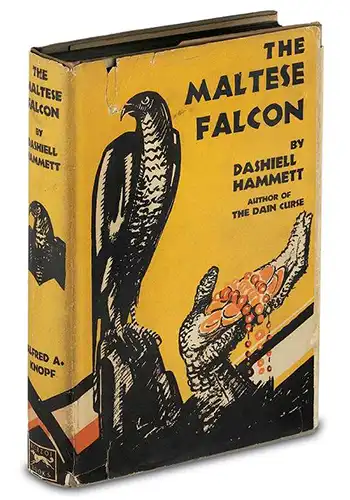
Hammett began publishing short stories in the pulp magazine Black Mask in the early 1920s. The editor, Joseph T. Shaw, encouraged a new kind of crime fiction: fast-paced, realistic, and written in a lean, stripped-down prose that rejected the flowery language of earlier detective stories. Hammett perfected this style. He introduced unnamed operatives and weary, morally ambiguous investigators who spoke in terse dialogue and acted without illusion. His first two novels, Red Harvest (1929) and The Dain Curse (1929), transformed the detective genre. Red Harvest depicted an entire city poisoned by corruption, with a Continental Op who cleanses the town not by solving one crime but by pitting criminals against each other in a bloody purge. The novel’s violence, cynicism, and social critique were unlike anything published before. Then came The Maltese Falcon (1930). Hammett introduced Sam Spade, a detective who is neither noble nor entirely corrupt, a man who can sleep with his partner’s wife and then calmly send her lover to prison. The novel’s plot—the search for a jewel-encrusted statue that turns out to be a fake—is almost irrelevant. What matters is Spade’s code: a private, unspoken set of rules about not letting the criminals win, even when there is no justice to be found. The book was a sensation. It made Hammett famous and established the template for the hard-boiled detective. His final major novel, The Thin Man (1934), introduced Nick and Nora Charles, a sophisticated, witty couple who drink their way through a murder investigation. It was lighter in tone but equally brilliant in its dialogue and character work.
Politics, Blacklisting, and Later Life
Hammett wrote no more novels after The Thin Man. He struggled with alcoholism, tuberculosis, and a creative block that never lifted. Instead, he moved to Hollywood, where he wrote screenplays and carried on a famously tumultuous affair with the playwright Lillian Hellman, who became his lifelong companion. In the 1930s, Hammett became deeply involved in left-wing politics. He joined the Communist Party and worked tirelessly for anti-fascist causes, including fundraising for the Spanish Civil War. His political commitments came at a steep price. In 1951, during the Red Scare, Hammett was called before Congress to testify about his Communist affiliations. He refused to name names, invoking the Fifth Amendment. He was sentenced to six months in federal prison for contempt of court. The imprisonment broke his health further, and the Internal Revenue Service hounded him for back taxes, leaving him nearly destitute. He spent his final years in a small cottage in Katonah, New York, cared for by Hellman. He died of lung cancer on January 10, 1961, at the age of sixty-six. His last wish was to be cremated and buried in Arlington National Cemetery as a veteran, but his political record barred him. His ashes were placed in a columbarium in New York.
Influence and Legacy
Dashiell Hammett effectively invented modern crime fiction. Before him, detective stories were dominated by the genteel tradition of Sherlock Holmes and the English country-house mystery. Hammett threw out the drawing rooms and introduced back alleys. He replaced the brilliant amateur with the weary professional. He stripped prose to its bones, creating a voice that sounded like nothing else in American letters. That voice became the foundation for an entire genre. Raymond Chandler, Hammett’s only rival in hard-boiled fiction, openly acknowledged his debt. Chandler wrote that Hammett “gave murder back to the kind of people that commit it for reasons, not just to provide a corpse.” Chandler took Hammett’s model and added his own poetic sensibility, but the structure and attitude were pure Hammett. Ross Macdonald, the third great figure of the hard-boiled school, built his psychological Lew Archer novels on the groundwork Hammett laid. Beyond crime fiction, Hammett’s influence spread into literary modernism. Ernest Hemingway admired Hammett’s spare, declarative sentences and his refusal of sentimentality. Hammett’s dialogue—quick, overlapping, full of implication—influenced everything from the screwball comedies of the 1930s to the film noirs of the 1940s and 1950s. John le Carré, the master of the spy novel, cited Hammett as an influence on his own cynical, morally complex protagonists. In contemporary fiction, James Ellroy (author of L.A. Confidential) has called Hammett the father of all noir, and his own hyper-kinetic, paranoid style owes a direct debt to Red Harvest. Hammett’s novels have never gone out of print. The Maltese Falcon has been adapted for film three times, most famously in John Huston’s 1941 version starring Humphrey Bogart. The Thin Man spawned a series of popular films. But Hammett’s real legacy is not in adaptations; it is in the DNA of every hard-boiled detective, every cynical antihero, and every lean, muscular sentence in modern crime fiction. He wrote only five novels, but those five changed American literature forever.
Dashiell Hammett – First Editions Identification Guide
A Complete Bibliography of Dashiell Hammett: Novels, Rare Books & First Editions
| Year | Title | Publisher | First edition/printing identification points |
|---|---|---|---|
| 1929 | Red Harvest | New York: Alfred A. Knopf, 1929 | First edition. "Copyright 1927, 1929" stated on © page. Deep red cloth, yellow skull stamped on front board, top edge stained green. Creamy Dust jacket, orange/black pictorial front, black lettering. Front flap: Ads for Borzoi Mysteries Stories; back flap: Detective Stories of J. S. Fletcher ends with 'The House in Tuesday Market'. Note: The second printing Dust jacket is similar to the first, except for the last title on the back flap 'The Matheson Formula'. |
| 1929 | The Dain Curse | New York: Alfred A. Knopf, 1930 | First edition." Copyright 1927, 1929" stated on © page. Medium yellow cloth, red skull stapmed on front board, top edge stained brown. Also variant binding in brown cloth. Creamy Dust jacket, red pictorial front, black letering. Front flap: Blurb for Red Harvest; back flap: ad for Detective Stories of J. S. Fletcher, ends with 'The Matheson Formula'. Price $2.00. |
| 1930 | The Maltese Falcon | New York: Alfred A. Knopf, 1930 | First edition. "Copyright 1929, 1930" stated on © page. Light gray cloth, dark grayish-blue falcon stamped on front board. Creamy Dust jacket, yellow pictorial front, black lettering. Ad for Red Harvest & The Dain Curse to rear panel, printed in red/black. Front flap: blurb for The Maltese Falcon, begins with 'Sam Spade' continues to back flap. Price $2.00. |
| 1931 | The Glass Key | London: Alfred A. Knopf, 1931 | First edition. "Pirinted in England for Alfred. A. Knopf" stated on © page. Blue cloth, white key stamped on upper right hand corner. White Dust jacket, pictorial front panel, black lettering. Rear panel: ad for Borzoi Novels, begins with 'Red Harvest', ends with 'Death in the Dusk. Front flap: blurb for The Glass Key; back flap: blank. Price 7s. 6d. ALSO: New York: Alfred A. Knopf, 1931. First American edition. "Copyright 1931 by Alfred A. Knopf" stated on © page. Light green cloth, dark green key stamped on front board, centered. Creamy Dust jacket, pictorial front, replicated to rear panel, green lettering. Front flap: Blurb for The Glass Key; back flap: ads for Dashiell Hammett novels. Note: The book was first published in England, before the American edition. The second printing Dust jacket is similar to the first, except for reviews for The Glass Key on front flap. |
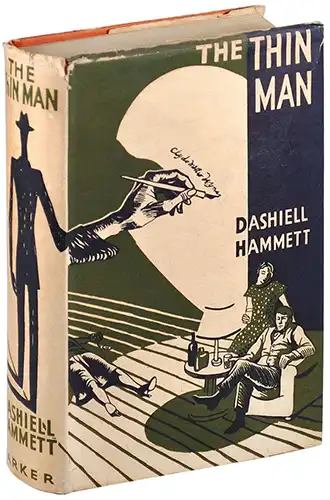
| 1934 | The Thin Man | New York: Alfred A. Knopf, Mcmxxxiv | First edition. "First edition" stated on © page. Grayish green cloth. Black mask stamped on front board, top edge stained burgundy. Creamy Dust jacket, two variants: red or green pictorial front, black/white lettering. Detective Stories of Dashiell on rear panel. Blurb for The Thin-Man on front flap, continues to back flap. Price $2.00. ALSO: London: Arthur Barker Ltd., [1934]. First English edition. "First printed 1934" stated on © page. Creamy white Dust jacket, green/black pictorial front. Publisher's logo on rear panel. Price 7/6. |
Dashiell Hammett – First Printing Dust Jackets Identification Guide
Gallery of First state Dust Jackets.


Reference:
- Richard Layman: Dashiell Hammett, A Descriptive Bibliography.