Florence Kate Upton: The Pioneer Who Gave America the Golliwogg
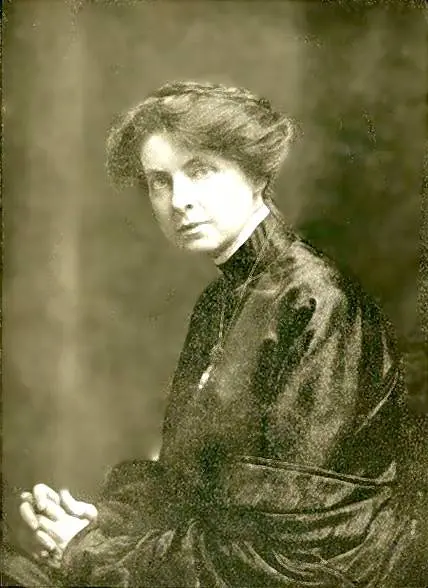
In the history of children’s illustration, few creators have had a career as brief, influential, and fraught with a problematic legacy as Florence Kate Upton (1873-1922). An American-born artist who found her greatest success in England, Upton is the inventor of the Golliwogg, a character who became a worldwide publishing phenomenon in the early 20th century, inspired a beloved children’s literary genre, and later became a potent and painful symbol of racist caricature. Her story is a complex tapestry of artistic innovation, commercial triumph, and unintended cultural consequence.
Born in Flushing, New York, Florence was the daughter of English parents who had emigrated to America. Her childhood was filled with drawing and storytelling, encouraged by her artistic mother, Bertha Upton, who would later become her crucial collaborator. In 1884, following her father’s death, the family moved permanently to England. As a young woman, Florence pursued a career as a professional illustrator, studying art in London and Paris. To fund her art education, she began drawing caricatures and comic sketches for periodicals, honing a lively, expressive style.
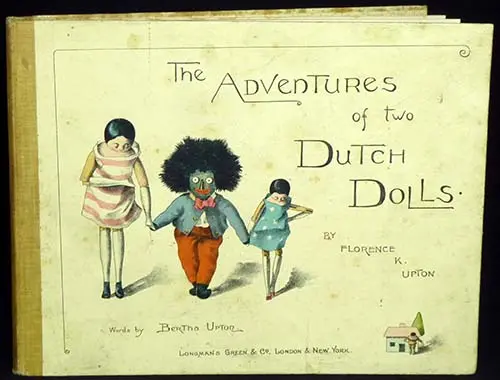
The genesis of her iconic—and infamous—creation occurred during a visit back to the United States in 1894. To amuse her young cousins, she drew a rag doll from her own childhood, a “blackface” minstrel doll popular in America at the time. She gave it distinctive, eccentric features: jet-black skin, bright red lips, wild hair, and a formal, brightly coloured suit. She named him the “Golliwogg.” The character was not born from malice, but from a nostalgic childhood memory, reinterpreted through Upton’s lively, cartoonish pen. Upon her return to London, her mother, Bertha, saw the drawings and wrote verses to accompany them. In 1895, they published The Adventures of Two Dutch Dolls and a Golliwogg.
The book was an instant, sensational success in Britain. The Golliwogg, with his mixture of formal attire and chaotic energy, was a novelty. He was brave, resourceful, endlessly optimistic, and the unmistakable leader of a band of Dutch dolls. Upton’s illustrations were dynamic and full of humor, a stark contrast to the more static, painterly illustrations of contemporaries like Walter Crane. The public adored him, and the Upton mother-daughter team produced twelve more Golliwogg books between 1895 and 1909. The series established the classic formula of the “toy-come-to-life” adventure, directly paving the way for Enid Blyton’s Noddy and, arguably, the world of Toy Story.
The Golliwogg’s popularity exploded beyond the books. He was immediately commercialized, becoming one of the first major licensing characters in history. Steiff manufactured Golliwogg stuffed dolls as early as 1908. His image appeared on postcards, jam jars (most famously by James Robertson & Sons), board games, and countless other products. He became a cultural fixture in Britain and beyond, synonymous with a certain kind of plucky, adventurous spirit.
However, Upton’s relationship with her creation was ambivalent. She grew weary of the series and, after her mother’s death in 1912, never wrote or illustrated another Golliwogg book. She turned her focus to portraiture, a more serious artistic pursuit, but achieved only modest success. Tragically, she died of complications from surgery in 1922 at the age of 49. She never married and left her entire estate to support a bed at a children’s hospital.
The legacy Florence Upton left behind is profoundly dualistic. On one hand, she was a groundbreaking female illustrator and entrepreneur who, with her mother, created a wildly successful publishing franchise and pioneered character merchandising. Her energetic artistic style influenced children’s book illustration for decades.
On the other hand, the Golliwogg’s visual design was inextricably rooted in the racist “blackface” minstrelsy of the 19th century. As the 20th century progressed and awareness of racial stereotyping grew, the character’s image became increasingly recognized as a deeply offensive caricature that perpetuated harmful tropes about Black people. While Upton’s narratives portrayed him as a hero, his appearance alone caused enduring pain and has led to his widespread retirement from public use.
Therefore, Florence Kate Upton’s biography is one of remarkable achievement shadowed by a problematic inheritance. She captured the playful, adventurous spirit of childhood and helped shape modern children’s literature, yet her most famous creation became a cultural relic that reflects the unexamined racial prejudices of her era. Her story forces a reckoning with how popular culture can simultaneously embody imaginative joy and perpetuate harmful stereotypes, a complex legacy for a pioneering artist who simply sought to bring a remembered rag doll to life.
Florence Kate Upton Bibliography
- The Adventures of Two Dutch Dolls and a Golliwogg, 1895
- The Golliwogg’s Bicycle Club, 1896
- The Golliwogg at the Sea-Side, 1898
- The Golliwogg in War, 1899
- The Golliwogg’s Polar Adventure, 1900
- The Golliwogg’s Auto-Go-Cart, 1901
- The Golliwogg’s Air-Ship, 1902
- The Golliwogg’s Circus, 1903
- The Golliwogg in Holland, 1904
- The Golliwogg’s Fox Hunt, 1905
- The Golliwogg’s Desert Island, 1906
- The Golliwogg’s Christmas, 1907
- Golliwogg in the African Jungle, 1909