Honor C. Appleton: A Life in Illustration
Honor Charlotte Appleton, one of the most prolific and beloved illustrators of the Golden Age of children’s book illustration, was born on February 4, 1879, in Brighton, on the south coast of England . The daughter of Georgina and John Hoblyn Appleton, she grew up in a creative household with two older sisters, Rachel and Alice Mary (known as “Sissy”), and a younger brother named John. Her mother encouraged the artistic pursuits of Honor and her sisters, nurturing the talent that would define her life’s work .
Artistic Formation
Appleton pursued formal art education with dedication and passion. She first attended the South Kensington School (now the Royal College of Art), followed by Frank Calderon’s School of Animal Painting in London—a specialized institution that equipped her with a keen understanding of animal anatomy and movement that would later enrich her illustrations . After a brief period at the studio of Sir Arthur Cope, RA, she and her sister Sissy enrolled at the Royal Academy Schools in January 1901, where she remained until 1906 .
Her artistic style developed under the influence of several contemporaries whose work she admired. The delicate watercolors of Kate Greenaway left a lasting impression, while the distinctive use of line and white space by Arthur Rackham and Heath Robinson also shaped her approach . These influences coalesced into a style characterized by delicate watercolor washes, graceful line work, and a tender sensitivity to childhood experience.
A Prolific Career
While still a student at the Royal Academy Schools, Appleton received her first professional commission. In 1902, Grant Richards published The Bad Mrs. Ginger as part of the Dumpy Books series, launching a career that would span nearly five decades . Her early achievement was all the more remarkable given that at the time, professional opportunities for women illustrators remained limited.
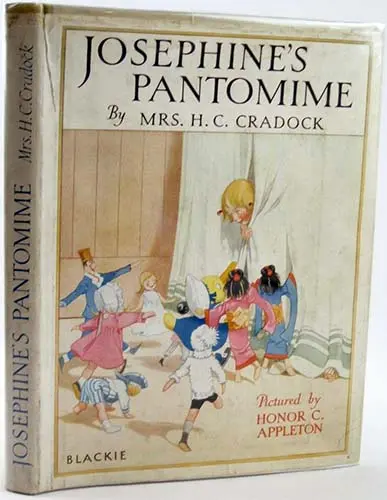
Following the success of her debut, Appleton’s career flourished. Between 1910 and 1940, she illustrated well over 150 books, the vast majority of them for children . Among her most celebrated works are the “Josephine” series, written by Mrs. H. C. Cradock and published by Blackie & Son. These books follow the adventures of an eight-year-old girl and her family of dolls, and the illustrations capture with remarkable charm the imaginative world of childhood play .
Her 1910 edition of William Blake’s Songs of Innocence is widely regarded as the finest example of her illustrative work, cementing her reputation as an artist of the first rank . She went on to illustrate fairy tale collections of enduring significance, including Charles Perrault’s Fairy Tales (1919) and the collected Stories of Hans Christian Andersen (1922) . Her edition of The Children’s Alice—a retold version of Lewis Carroll’s classic—further demonstrated her range .
As her career progressed through the 1930s and 1940s, Appleton shifted her focus increasingly toward literary classics, illustrating editions of Black Beauty, Aladdin, and collections of Welsh legends . This evolution reflected both her artistic maturity and the changing tastes of the publishing market.
Life and Legacy
Despite her professional success, Appleton remained rooted in her native Sussex. For most of her career, she lived at 3 Ventnor Villas in Hove, near Brighton, with her sister Sissy residing close by . She demonstrated her commitment to community service during the Second World War, serving as a nurse for the Civil Defence—a role for which she was later decorated .
Her watercolors were exhibited at the Royal Academy during her lifetime, and she was known to be sympathetic to the women’s suffrage movement, contributing humorous illustrations to the December 5, 1913, issue of Votes for Women to accompany a poem by Laurence Housman .
Honor C. Appleton died on December 30, 1951, at Brooklands Nursing Home in Haywards Heath, Sussex . In 1952, a memorial exhibition of her work was held at Hove Library, later touring galleries across the United Kingdom, allowing admirers to celebrate the delicate watercolors and drawings of an artist whose work had delighted generations of children . Today, her illustrations remain prized by collectors, with original watercolors appearing at auction and her books continuing to be republished for new audiences to discover and cherish .
Honor C. Appleton Bibliography
- The Bad Mrs Ginger (Grant Richards, 1902)
- Dumpy Proverbs (Grant Richards, 1903)
- Cradock, H. C. – Josephine, and her Dolls (Blackie, 1915)
- ____ Josephine’s Happy Family (Blackie, 1916)
- ____ Josephine is Busy (Blackie, 1918)
- ____ Big Book of Josephine (Blackie, [1919])
- ____ Josephine’s Birthday (Blackie 1919)
- ____ Where the Dolls Lived (S.P.C.K., [1919])
- Perrault, C. – Fairy Tales (Simpkin Marshall, 1919)
- Cradock, H. C. – Josephine, John and the Puppy (Blackie, 1920)
- Appleton, H. C. – Babies Three (Nelson, 1921)
- ____ Me and My Pussies (Nelson, 1924)
- Cradock, H. C. – Josephine Keeps School (Blackie, 1925)
- ____ The Bonny Book of Josephine (Blackie, [1926])
- ____ Josephine Goes Shopping (Blackie, 1926)
- Edgar, M. C. – A Treasury of Verse for School and Home (Harrap, 1926)
- Cradock, H. C. – Josephine’s Christmas Party (Blackie, 1927)
- ____ Josephine Keeps House (Blackie, 1931)
- Cruse, A. – The Golden Road in English Literature (Harrap, 1931)
- Southwold, S. – The Book of Animal Tales (Harrap, 1932)
- Cradock, H. C. – Josephine’s Pantomine (Blackie, 1939)
- ____ Josephine Goes Traveling (Blackie, 1940)
- Appleton, H. C. – Towlocks and his Wooden House (Chatto, n.d.)
- Tyrrell, E. – How I Trained the Wild Squirrels (Harrap, n.d.)
- The World’s Best Stories for Children (n.d.)