Kabumpo in Oz: A Royal Quest for Matrimonial Lineage
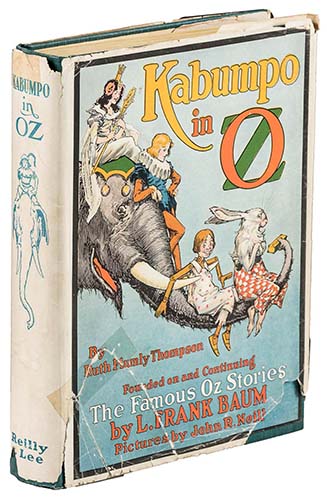
Kabumpo in Oz is the sixteenth book in the Oz series and the second written by Ruth Plumly Thompson, published in 1922. This story firmly establishes Thompson’s unique style—brisk, whimsical, and filled with delightful nonsense—while focusing on one of the series’ most beloved and opulent locales: the Gillikin Kingdom of Pumperdink, introduced in her previous book.
The plot is set in motion by a royal crisis. Young Prince Pompadore of Pumperdink discovers, on his eighteenth birthday, an ancient decree stating he must marry a “proper princess” by sunset or forfeit his throne. With no suitable princess in sight, the situation seems hopeless. Enter the kingdom’s beloved and wonderfully pompous Elegant Elephant, Kabumpo. Taking charge, Kabumpo uproots the palace drawing-room (with the Prince and his friend, the soldier Wag, inside) and embarks on a frantic journey across Oz to find a bride.
Their quest leads them into a series of brilliantly imagined Thompsonian territories, including the mischievous candy realm of the Bonbons and the sticky, confectionary-dominated land of the Candy Man. The search becomes entangled with the machinations of the villainous Gnome King, Ruggedo (a recurring foe from Baum’s books), who has stolen the magical “Only Silver” from a mysterious sleeping princess. This theft plunges the Valley of the Roses into an eternal, thorny slumber.
True to Thompson’s love for intertwining plots, the narrative weaves together the bridal quest with a larger magical mystery. Pompadore’s personal dilemma becomes key to breaking the enchantment on the sleeping valley and its princess, revealing clever twists of fate and identity. The story culminates in the grand Emerald City, involving familiar faces like Ozma and Dorothy, ensuring a satisfying resolution that reinforces the theme of destiny and true worth beyond royal decrees.
Kabumpo in Oz is celebrated for its charming, larger-than-life title character. Kabumpo’s blend of vanity, bravery, and heartfelt loyalty makes him an instant classic. The book is a quintessential Thompson adventure: fast-paced, packed with inventive creatures and landscapes, and centered on a comic quest that explores the often-absurd nature of fairy-tale traditions, all while warmly upholding the core values of friendship and cleverness that define the Oz universe.
Kabumpo in Oz | First Edition Identification Guide
Please refer to the gallery for detailed images of binding(s) and dust jackets.
| Year | Title | Publisher | First edition/printing identification points |
|---|---|---|---|
| 1922 | Kabumpo in Oz | The Reilly & Lee Co., [1922] | First edition. Illustrated by John R. Neill, 297 pages. Textual points: What are almost certainly the earliest copies have a half-title following the ownership leaf: an elephant with “KABUMPO | IN OZ” lettered on his robe (“OZ” is a stylized device with the “Z” within the “O”). A portrait of Princess Dorothy appears on page [299]. Pictorial self-endpapers in black and white. Color plates: 12 full-color inserts, some tipped in, some bound in: tipped-in plate facing title page; bound-in plates facing pages 57, 72, 105, 120, 153, 168, 217, 232, 249 and 264; tipped-in plate facing 288. The plates are coated only on the printed side. Binding: blue or blue-green cloth, with pictorial paper label in colors. Spine imprint reads: “Reilly | & Lee”. Size of leaf: 9 by 6 5/8 inches. Thickness of volume: 1 1/2 inches. An issue with the imprint of the Copp, Clark Co., Limited, of Toronto on the title page and the spine is known. It is otherwise identical with the American first state in blue-green cloth.
The half-title of later copies is at the end of the book, and the portrait of Dorothy follows the ownership leaf. The earliest reprint (ca. 1923) has been reported in green cloth and in a blue-green cloth which is greener than the first state, and it has a non-standard ampersand, &, instead of the usual & in the publisher’s imprint on the spine. Later states (again with the standard ampersand) have been noted in very dark blue and in medium-blue cloth, with plates coated only on the printed side. Still later copies in various colors of cloth and of varying thickness have plates coated on both sides. Around 1935, the color plates were discontinued. |
Kabumpo in Oz | First Edition Dust Jacket Identification
First edition binding(s) and various dust jacket printings.


References:
- Wikipedia
- Bibliographia Oziana – Haff, Greeme, Martin. 2002