The Royal Book of Oz: A New Author’s Quest for Roots in the Heart of Oz
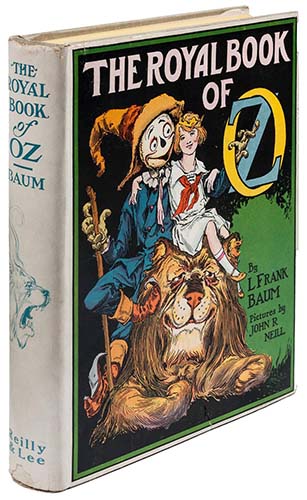
The Royal Book of Oz (1921) holds a pivotal place in the series as the fifteenth canonical volume and the first written entirely by Ruth Plumly Thompson following L. Frank Baum’s death. Published under Baum’s name to ensure its reception, the book masterfully honors the established world while introducing Thompson’s own distinct voice—characterized by faster-paced plots, pun-filled humor, and a parade of whimsical new kingdoms.
Thompson’s narrative cleverly builds upon Baum’s foundation by focusing on a beloved original character: the Scarecrow. His journey begins with a relatable, existential query born from the very soil of Baum’s first Oz book—his old cornfield in the Munchkin Country. Seeking his “roots,” he literally digs into the earth and tumbles into the unknown, echoing the exploratory spirit of earlier volumes. His destination, the elaborate underground empire of the Silver Islands, allows Thompson to engage in a classic Ozian theme: the absurdity of inherited titles and the search for identity.
Simultaneously, the plot directly connects to the lore and tools established in previous books. Dorothy Gale’s rescue mission is launched from the Emerald City, utilizing Ozma’s Magic Belt (a key artifact from Baum’s The Emerald City of Oz), and her journey with the Cowardly Lion takes them through strange borderlands reminiscent of the fairylands bordering Oz in Baum’s later works. This provides a comforting continuity for readers.
However, Thompson confidently expands the map. Dorothy’s side-quest introduces the kingdom of Pumperdink and its standout citizen, Sir Hokus of Pokes, a comically anachronistic knight who would become a signature character of her tenure. The split narrative—between the Scarecrow’s struggle with imperial duty and Dorothy’s chivalric adventure—showcases Thompson’s ambition to weave multiple threads of fairy-tale satire.
Ultimately, the book’s core theme is a heartfelt affirmation of Baum’s central values. The Scarecrow’s quest concludes not with a discovery of royal lineage, but with a powerful realization that his true family is the community of friends who risk everything to find him. The Royal Book of Oz thus succeeds as both a seamless continuation and a promising new chapter. It proved that Oz could thrive under a new historian, ensuring the series’ longevity by balancing respectful homage with inventive new magic.
The Royal Book of Oz | First Edition Identification Guide
Please refer to the gallery for detailed images of binding(s) and dust jackets.
| Year | Title | Publisher | First edition/printing identification points |
|---|---|---|---|
| 1921 | The Royal Book of Oz | Reilly & Lee Co., [1921] | First edition. Illustrated by John R. Neill, 303 pages. Textual points: Pictorial self-endpapers in black and white. Pages 305-312 contain publisher’s advertisements for the Oz series; these advertisements were retained in reprints of the book for many years. Color plates: 12 full-color inserts, some tipped in, some bound in. The plates are printed on stock coated only on the printed side. The plate facing the title page is tipped in; bound-in plates facing pages 30, 47, 78, 95, 126, 143, 174 , 191, 238 and 255; the final plate is tipped in facing page 286. The caption on the plate facing page 255 has a misprint: “Scarecorw’s” for “Scarecrows”. Binding: light-gray cloth, with pictorial paper label in colors. Spine imprint reads: “Reilly | & Lee”. Size of leaf: 9 by 6 1/2 inches. Thickness of volume: 1 3/8 inches. An issue with the imprint of the Copp, Clark Co., Limited, of Toronto on the title page and spine is known. It is otherwise identical with the American first state. Later Printings Subsequent color-plate printings correct the misprint on the plate facing page 255. The four plates facing pages 126, 143, 174, and 191 have been relocated so that they face pages 142, 159, 190, and 207. The earliest of the later printings is also bound in light-gray cloth with the plates printed on stock coated only on the printed side. Later states are bound in dark-gray, gray-green, or blue cloth. They have plates of stock coated on both sides. Around 1935, the color plates were discontinued. |
The Royal Book of Oz | First Edition Dust Jacket Identification
First edition binding(s) and various dust jacket printings.


References:
- Wikipedia
- Bibliographia Oziana – Haff, Greeme, Martin. 2002