The Yellow Knight of Oz was published in 1930 by Reilly & Lee Co. in Chicago as the twenty-fourth book in the Oz series and the tenth written by Ruth Plumly Thompson. John R. Neill provided twelve color plates and numerous black-and-white illustrations throughout the 283-page volume.
The book marked Thompson’s tenth anniversary as Royal Historian of Oz, having taken over the series after L. Frank Baum’s death in 1919. It introduced the character Sir Hokus of Pokes, a parody of the traditional knight errant, who would appear in later Thompson Oz books. A paperback reprint was published by Del Rey / Random House in 1985, and a facsimile hardcover edition was released by the International Wizard of Oz Club in 1990. Under current United States copyright laws, The Yellow Knight of Oz is scheduled to enter the public domain on January 1, 2026.
Summary
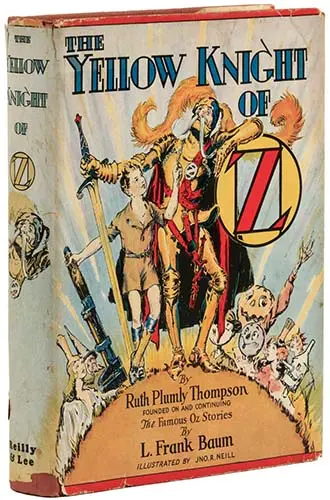
Sir Hokus of Pokes grows tired of the Emerald City, and he and the Comfortable Camel set out for some adventure. Sir Hokes wants to rescue a damsel in distress, or at least find a monster to fight. Sir Hokus visits Marshland and befriends Ploppa, a giant mud turtle. Ploppa would like to accompany Sir Hokus on his adventures, but cannot leave the swamp. Sir Hokus is joined by the Comfortable Camel.
Meanwhile, a boy named Speedy blasts his way to Oz in a homemade rocket ship, where he finds himself in the underground kingdom of Subterranea. At his touch, a golden statue of a beautiful girl comes to life. She is called Marygolden, and she accompanies Speedy on his further adventures. Sir Hokes and Speedy join forces and, using the power of a bag of magic dates, they counter the magic of the evil Sultan of Samandra and restore the Corumbian Kingdom, which the Sultan had conquered and enchanted. Sir Hokus learns his true identity: he is actually the young and handsome Yellow Knight of Corumbia, transformed into old, absent-minded Sir Hokus by the Sultan’s magic. Using the power of the magic dates, Sir Hokus regains his youthful form and vacates the Emerald City to rule as Prince of Corumbia.
The Yellow Knight of Oz | First Edition Identification Guide
Please refer to the gallery for detailed images of binding(s) and dust jackets.
| Year | Title | Publisher | First edition/printing identification points |
|---|---|---|---|
| 1930 | The Yellow Knight of Oz | Reilly & Lee Co., [1930] | First edition. Illustrated by John R. Neill, 275 pages. Textual points: 16-page gatherings except the penultimate, which has 24 pages. Pictorial self-endpapers in black and white. Color plates: 12 full-color inserts, tipped in facing the title page and pages 40, 68, 80, 104, 136, 148, 176, 200, 224, 240, 260. Plate stock is coated on both sides. Binding: the most frequently observed binding case is brick-red cloth, although copies have also been seen in rose (textured) and in mauve (textured) cloth. Pictorial paper label in colors. Spine imprint in boldface: “Reilly | & Lee”. SECONDARY BINDING: Brick-red cloth, with the publisher’s imprint in the semi-script, “fancy” letters (ca. 1934). Size of leaf: 9 by 6 5/8 inches. Thickness of volume: About 1 1/4 inches. An issue with the imprint of the Copp, Clark Co., Limited, of Toronto on the title page and spine is known. It is otherwise identical with the first American state in brick-red cloth.
All copies printed after 1935 have no color plates. |
The Yellow Knight of Oz | First Edition Dust Jacket Identification Guide
First edition binding(s) and various dust jacket printings identification.


References:
- Wikipedia
- Bibliographia Oziana – Haff, Greeme, Martin. 2002