The Magical Mimics in Oz: A Return to Classic Peril
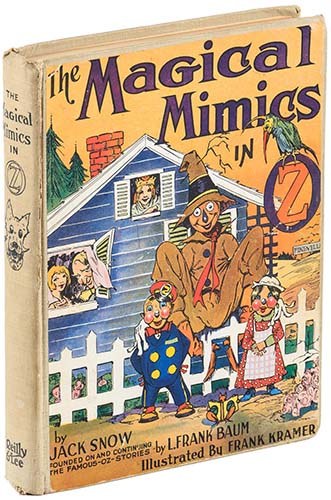
The Magical Mimics in Oz, published in 1946, is the thirty-seventh book in the vast Oz series and the second penned by author Jack Snow. It holds a distinctive place in the canon as a direct sequel to L. Frank Baum’s original fourteen novels, intentionally bypassing the stories of intervening writers to reconnect with the foundational tone and spirit of Oz.
The novel centers on a chilling and clever threat to Oz’s tranquility. From the gloomy, volcanic Mount Illuso, located just beyond the Deadly Desert, emerges a race of evil beings known as Mimics. Their power is uniquely sinister: with a mere touch, they can assume the perfect physical form of any person, simultaneously imprisoning the original in a cave of enchanted obsidian mirrors. Coveting the beauty of the Emerald City, their queen, Oxidia, launches an invasion not of armies, but of doppelgangers. Her primary targets are Oz’s two most powerful figures: the wise and beloved Princess Ozma and the sorceress Glinda the Good. Upon their capture, the Mimic usurpers take their places, beginning a covert campaign to dismantle the magical protections safeguarding the kingdom.
The heart of the story transforms into an engaging mystery. While the false Ozma and Glinda use their stolen authority to dismiss guardian dragons and scatter protective talismans, their impeccable disguises fool almost everyone. The heroes who rise to uncover the plot are not the usual mighty magic-wielders, but Dorothy Gale and the Wizard of Oz, who have just arrived for a visit. Their victory is one of perception and loyalty. Sensing an indefinable change in their friends, they become detectives in a fairyland. Their investigation, aided by clues from a worried Jellia Jamb and the truth-revealing waters of the Forbidden Fountain, confirms their fears and sets them on a dangerous path.
The narrative then escalates into a classic Ozian quest. After exposing the mimics in the Emerald City, Dorothy and the Wizard must venture into the enemy’s stronghold to rescue the real Ozma and Glinda. Within the eerie, crystalline caverns of Mount Illuso, they are aided by unexpected allies—a friendly Echo and the mysterious Little Man of the Mountain. The climax reinforces core Oz themes: cleverness and purity of heart triumph over dark sorcery. In a final confrontation, it is not a spell or weapon, but the inherent magic of Ozma’s love and compassion that ultimately destroys the Mimics’ power forever.
Snow’s novel is a deliberate return to Baum’s formula—a focused adventure where a small group of beloved characters confront a magical menace to their home. It successfully captures the feel of the early Oz books, emphasizing friendship, the value of true identity, and the enduring security of Oz as a utopian haven, making it a satisfying read for enthusiasts of the original series.
The Magical Mimics in Oz | First Edition Identification Guide
Please refer to the gallery for detailed images of binding(s) and dust jackets.
| Year | Title | Publisher | First edition/printing identification points |
|---|---|---|---|
| 1946 | The Magical Mimics in Oz | Reilly & Lee Co., [1946] | First edition. Illustrated by Frank Kramer, 242 pages. Textual points: 16-page gatherings. The text is printed on white stock. Inserted pictorial endpapers printed in green on pale-yellow stock. Binding: light-gray cloth, with a pictorial paper label in colors. Spine imprint is in semi-script, “fancy” letters. The dust jacket has, instead of a list of Oz books on the back flap, a long statement about Jack Snow, Frank Kramer, and Frank Baum’s literary importance. Size of leaf: 8 7/8 by 6 5/8 inches. Thickness of volume: Varies from 1 1/16 to 1 3/16 inches (text sheets including the free endpapers measure 15/16 to 1 1/16 inches thick from copy to copy). The height of the cover varies from 9 1/8 to 9 1/4 inches. (Copies have been seen bound in orange and in blue cloth, with the cover only 9 1/16 inches tall; they are probably later, perhaps around 1951.) NOTE: Why first-printing copies vary in thickness is indicated by an inscription from publisher to author in an unbound, advance copy of The Magical Mimics in Oz: “Jack, Thought you would like to have this No. 1 — Mimics —even though this particular book does have two weights of paper—through press room error. ” This copy is exactly 1 inch thick without covers. Both paper stocks are white.
All subsequent printings retain the 16-page gatherings, but they are printed on a light-gray stock which is thinner than the white stocks used on the first state: the volume is only 7/8 inch thick. Earlier reprints retain the pictorial label and the illustrated endpapers. In 1950, a “Popular Edition” appeared. It is printed on the light-gray paper stock and bound in light-brown paper- covered boards stamped in dark brown; there is no pictorial label (plate 101). The illustrated endpapers have been omitted, and the first page of the first gathering and the last page of the final gathering are pasted to the covers. |
The Magical Mimics in Oz | First Edition Dust Jacket Identification
First edition binding(s) and various dust jacket printings identification.


References:
- Wikipedia
- Bibliographia Oziana – Haff, Greeme, Martin. 2002