Lucky Bucky in Oz: A Blast to a Bizarre Oz
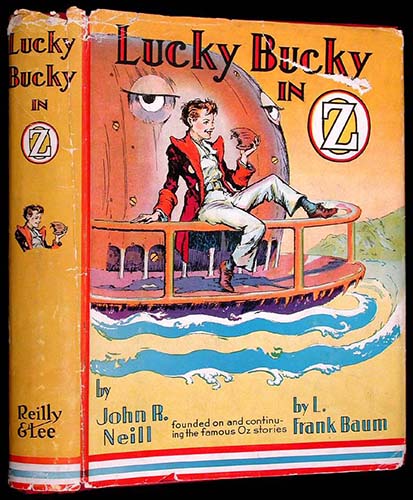
Lucky Bucky in Oz (1942) is the thirty-sixth book in the Oz series and the fourth and final Oz novel written by author-illustrator John R. Neill. True to his unique style, Neill crafts an adventure that is less a traditional quest narrative and more a picaresque journey through an Oz brimming with surreal inventions and eccentric characters, all sparked by a dramatic explosion.
The protagonist is a young American boy, Bucky, who is blown sky-high from a Hudson River ferryboat during a boiler explosion. He and his trusted companion, a wooden wooden davit named Jones (who served as the lifeboat pulley on the ferry), are miraculously transported to the outskirts of Oz. They land in the mysterious Ev, where they soon meet the formidable (and literal) iron giant, Johnny Dooit, a powerful inventor and fix-it man. Together, this unlikely trio embarks on a mission to reach the Emerald City, encountering a series of bizarre and imaginative realms along the way.
The journey is a hallmark of Neill’s storytelling, serving as a tour for his whimsical creations. Bucky and Jones navigate through a land of living vegetables ruled by Prince Pineapple, visit a castle made entirely of donated teeth (complete with a Tooth Monarch), and confront the comical villainy of the badger-like “Grand Gallipoot of the Gophers.” This antagonist, along with his subterranean army, has launched an invasion of the Emerald City itself, using magical “bad gas” to paralyze its citizens.
While Princess Ozma, the Tin Woodman, and the Scarecrow appear, they are largely sidelined by the gaseous attack, leaving the day to be saved by the newcomers. The resolution hinges on Johnny Dooit’s inventive prowess and Bucky’s straightforward American courage. The book concludes with a grand, celebratory banquet in the Emerald City, honoring Bucky and Jones, who choose to remain in Oz.
Lucky Bucky in Oz is a quintessential Neill adventure: high on concept and imaginative spectacle, but episodic and loose in plot. It functions as a tour of the author’s lively mind, prioritizing wonder and humor over tight narrative cohesion. It stands as a distinctive, if somewhat chaotic, capstone to Neill’s brief but memorable tenure as a chronicler of Oz.
Lucky Bucky in Oz | First Edition Identification Guide
Please refer to the gallery for detailed images of binding(s) and dust jackets.
| Year | Title | Publisher | First edition/printing identification points |
|---|---|---|---|
| 1942 | Lucky Bucky in Oz | Reilly & Lee, [1942] | First edition. Illustrated by John R. Neill, 289 pages. Textual points: 16-page gatherings. Inserted pictorial endpapers. Binding: various colors of cloth: tan, turquoise, light tannish-green, dark green, light green (textured and untextured), light gray, sky-blue, bright blue, orange, light orange-tan, yellow, and red have been reported. No priority is known. Size of leaf: 8 7/8 by 6 5/8 inches. Thickness of volume: 1 3/8 inches.
Several copies have been seen printed on thinner stock, measuring only one inch thick. They have 16-page gatherings and blank endpapers. All the printing on the spine is plain, unserifed square-cut capital letters with the “OZ” printed as a word in conventional style rather than as a device. This early printing, ca. 1944-1946, is bound in light-tan cloth. All subsequent printings are made up of 32-page gatherings and have the spine printing as on the first state described above. The earlier of these have pictorial endpapers; later copies have blank endpapers. A British edition was published by Hutchinson’s Books for Young People (London). It is a larger book: size of leaf is 9 3/4 by 7 5/8 inches. The type has been completely reset and some of the illustrations omitted, with the result that the book contains only 128 pages. Chapter 14 has been retitled from “Tea and Thunderbugs” to “Tea and Thunderbeetles” (and all references in chapters 14 and 15 altered accordingly) in keeping with modem British usage which does not recognize “bug” as a synonym for “insect.” The endpapers of the American edition are replaced by reproductions of two of the double-page illustrations. The cover is red cloth, without a pictorial label (plate 98). The book is undated but was published in 1945. |
Lucky Bucky in Oz | First Edition Dust Jacket
First edition binding(s) and various dust jacket printings identification.


References:
- Wikipedia
- Bibliographia Oziana – Haff, Greeme, Martin. 2002