Anne Anderson: The Unsung Virtuoso of the Golden Age of Illustration
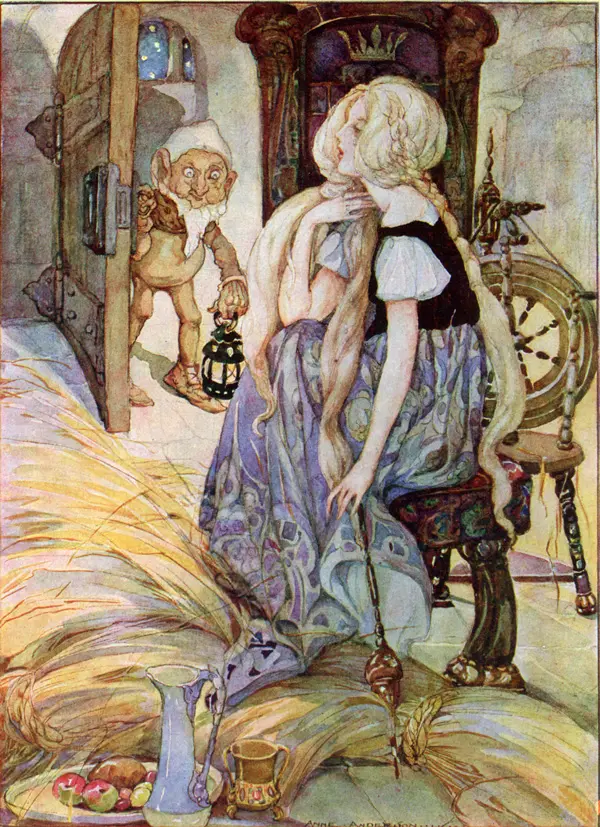
Anne Anderson (1874–1952) occupies a distinguished place in the history of early twentieth-century illustration, particularly within the flourishing tradition of British and European book art that bridged the late Victorian period and the golden age of illustration. Born in Scotland, Anderson showed artistic promise from an early age and received formal training at the Glasgow School of Art, an institution renowned for its progressive approach and its role in shaping the Glasgow Style. This education grounded her in strong draftsmanship while also exposing her to decorative design, pattern, and a sensitivity to line that would become hallmarks of her mature work.
Anderson is best remembered for her illustrations for children’s books, fairy tales, and gift books, many of which were published in Britain during the 1910s and 1920s. Her career coincided with a period when illustrated books were not merely reading material but prized objects, often given as presents and carefully designed to appeal visually as well as literarily. Anderson’s style was characterized by delicate line work, graceful figures, and a refined sense of ornament. Her compositions often emphasize elegance and restraint rather than drama, with softly modeled faces, flowing hair, and costumes that evoke an idealized past. She favored harmony and beauty, presenting fairy tales as lyrical, almost dreamlike visions rather than as sites of terror or moral conflict.
Among her most notable works are illustrations for traditional fairy tales such as Andersen’s Fairy Tales, The Water Babies, and collections of nursery rhymes. She also collaborated with her husband, the writer and illustrator Alan Wright, producing books that combined her visual sophistication with accessible storytelling. Anderson’s images are instantly recognizable for their lightness of touch and subtle color palettes, frequently employing pastels and muted tones that enhance the sense of gentleness and fantasy. Unlike some of her contemporaries, she rarely relied on heavy shadow or intense contrast, preferring clarity and balance.
Anne Anderson’s career unfolded alongside a remarkable generation of illustrators who collectively defined what is often called the “Golden Age of Illustration.” Among the most famous of these contemporaries was Arthur Rackham, whose work offered a striking contrast to Anderson’s. Rackham’s illustrations are darker, more fantastical, and sometimes grotesque, filled with gnarled trees, twisted figures, and dramatic chiaroscuro. Where Anderson sought grace and decorative charm, Rackham emphasized atmosphere and psychological depth. Both artists, however, shared a fascination with myth and fairy tale, and together they demonstrate the range of visual interpretations that traditional stories could inspire during this era.
Another important contemporary was Edmund Dulac, a French-born illustrator working in Britain, whose richly colored, exotic images were heavily influenced by Persian miniatures, Japanese prints, and other non-Western traditions. Dulac’s work, like Anderson’s, often emphasized beauty and elegance, but his compositions tend to be more opulent and painterly. While Anderson’s figures feel intimate and reserved, Dulac’s often appear theatrical and luxurious, reflecting a fascination with distant cultures and sumptuous design.
Kay Nielsen, the Danish illustrator active slightly later, also belongs to this constellation of artists. Nielsen’s illustrations are more stylized and elongated, with strong Art Nouveau influences and a bold use of negative space. Compared to Anderson’s softer realism, Nielsen’s work is more graphic and experimental, yet both share an interest in fairy tales as vehicles for visual poetry. Each artist interpreted the same narrative traditions through a distinct aesthetic lens, contributing to the richness of illustrated literature at the time.
Closer to Anderson in spirit and background was Jessie M. King, another Scottish artist associated with the Glasgow Style. King’s illustrations, like Anderson’s, emphasize decorative line and an almost musical rhythm of form. Both artists were influenced by the synthesis of fine art and design promoted by their training, and both played important roles in demonstrating that women illustrators could achieve professional success and artistic recognition in a field often dominated by men.
Anne Anderson’s legacy lies not in radical innovation but in refinement. Her work represents an ideal of beauty, clarity, and gentleness that resonated strongly with readers of her time and continues to attract collectors today. Through her illustrations, she helped shape a visual language of childhood and fairy tale that remains influential. When viewed alongside her contemporaries, Anderson’s art reveals the diversity and vitality of early twentieth-century illustration, a period when artists transformed familiar stories into enduring works of visual imagination.
Anne Anderson Bibliography
- E. Underdown: Aucassin and Nicolette (Nelson, 1911)
- The Gateway to Chaucer (Nelson, 1912)
- H. Mansion: Old Nursery Songs (Harrap, nd)
- Old French Nursery Songs (Harrap, nd)
- The Sleepy Song Book (Harrap, nd)
- E.W. Garrett: Rip (1919)
- Mrs. H. Strang: My Big Picture Book (with others) (OUP, 1920)
- E. Talbot: The Cosy-Comfy Book (Collins, 1920)
- E.C. Eliot: The House Above the Trees (Thornton Butterworth, 1921)
- M. Barnes: Fireside Stories (Blackie, 1922)
- A. Herbertson: Sing Song Stories (OUP, 1922)
- N. Joan: Cosy-Time Tales (Nelson, 1922)
- Grimm’s Fairy Tales (Collins, 1922)
- H.C. Andersen: Fairy Tales (Collins, 1924)
- E.W. Garrett: Wanda and the Garden of the Red House (OUP, 1924)
- C. Kingsley: The Water Babies (Jack, 1924)
- P. Morrison: Cosy Chair Stories (Collins, 1924)
- J. Spyri: Heidi (Harrap, 1924)
- Mrs. H. Strang: Little Rhymes for Little Folk (OUP, 1925)
- C. Reward: Mr. Pickles and the Party (Warne, 1926)
- The Old Mother Goose Nursery Rhyme Book (Nelson, 1926)
- S. Southwold: Once Upon a Time Stories (Collins, 1927)
- J.R. Crossland and J.M. Parrish: The Children’s Wonder Book (Odhams, 1933)
- My Big New Book (with others; Blackie, 1938).
Books written and illustrated include:
- The Busy Bunny Book (with A. Wright; Nelson, 1916)
- The Naughty Neddy Book (with A. Wright; Nelson, c.1918)
- Two Bold Sportsmen (with A. Wright; Nelson, 1918)
- The Patsy Book (Nelson, 1918)
- The Violet Book for Children (with A. Wright; OUP, 1920s?)
- The Jackie Jackdaw Book (Nelson, 1920); The Jacky Horner ABC (Dean, 1920); The Anne Anderson Fairy Tale Book (Nelson, 1923)
- The Cuddly Kitty and the Busy Bunny (with A. Wright; Nelson, 1926)
- The Podgy- Puppy (with A. Wright; Nelson, 1927)
- A Series of Fairy Tales {Nelson, 1928)
- The Fairy Tale Omnibus (Collins, 1929)
- Merry Folk (Collins, 1930); Playtime ABC (Collins, 1930)
- The Anne Anderson Picture Book (Collins, 1943)
- The Cosy Corner Book (Collins, 1943); Little Folk ABC (Collins, nd).
Contributor:
- Blackie’s Children’s Annual
- Cassell’s Children’s Annual
- Mrs. Strang’s Annuals; Playbox Annual
- Wonder Annual.