A Medieval Gateway: Anne Anderson’s Illustrated Chaucer
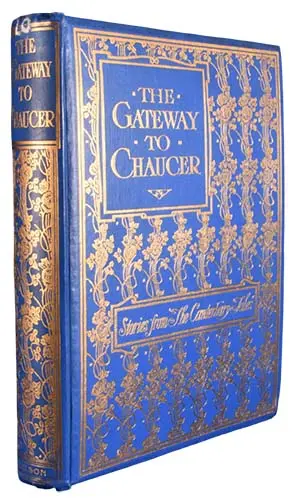
There are books that serve as introductions—gentle thresholds inviting young readers into worlds that might otherwise seem distant and daunting. Emily Underdown’s The Gateway to Chaucer, illustrated by Anne Anderson and published in 1912, is precisely such a work. This charming volume opens the door to Geoffrey Chaucer’s fourteenth-century masterpiece, transforming the Canterbury Tales into a delightful children’s introduction while preserving the spirit and richness of the original.
Anne Anderson (1874–1952) was a prolific Scottish illustrator whose career flourished in the early decades of the twentieth century . Her style, characterized by delicate watercolors, sinuous Art Nouveau lines, and a warm, inviting palette, made her a beloved figure in children’s book illustration . Influenced by contemporaries such as Charles Robinson and Jessie Marion King, Anderson developed a visual language that was at once elegant and accessible—a perfect match for a book designed to introduce young readers to medieval literature .
The Gateway to Chaucer was written by Emily Underdown, an English novelist known for popularizing classic works for younger audiences . The book retells the stories of Chaucer’s Canterbury pilgrims—the Knight, the Wife of Bath, the Miller, and others—in prose accessible to children while retaining the humor, humanity, and moral complexity of the originals. Published by Thomas Nelson and Sons in London, Edinburgh, Dublin, and New York, the first edition appeared in 1912 in a handsome quarto format measuring approximately 24 by 19 centimeters .
The volume was produced with the care befitting a gift book of the era. The publisher’s original full cloth binding, often in blue with gilt decoration, featured a design that hinted at the treasures within . Inside, readers discovered sixteen full-page color plates, each mounted on heavy paper and protected by captioned tissue guards, alongside numerous black-and-white in-text drawings that wove throughout the 270 pages . The quality of the paper, the richness of the color reproduction, and the careful attention to binding all spoke to a belief that children’s books deserved the same artistry as those for adults.
What makes Anderson’s illustrations for this volume so distinctive is her ability to evoke the medieval world without sacrificing warmth or approachability. Her palette is soft yet resonant—muted golds, gentle blues, warm earth tones, and touches of rosy red that suggest both the age of the tales and their enduring humanity . Her figures, rendered in the elegant, elongated style typical of Art Nouveau, possess a quiet dignity while remaining recognizably human. The Canterbury pilgrims come alive under her brush: the Knight in his armor, the Wife of Bath in her elaborate headdress, the Miller with his bagpipe—each rendered with personality and charm.
A surviving color lithograph from the edition, titled “He was the soul of hospitality,” captures a scene of medieval conviviality: pilgrims on horseback, a figure believed to be Chaucer himself, and the warm atmosphere of a tavern gathering . It is a scene that embodies the spirit of the book—a celebration of storytelling, of fellowship, and of the timeless appeal of Chaucer’s pilgrims.
Anderson’s illustrations also reflect her personal artistic journey. She had studied at the Slade School of Fine Art in London and was influenced early in her career by the Pre-Raphaelites before developing her distinctive style . By 1912, the year of this book’s publication, she had also recently married fellow illustrator Alan Wright, with whom she would collaborate on many projects . The warmth and partnership evident in her work during this period infuse her illustrations for The Gateway to Chaucer with a sense of joy and creative abundance.
Today, first editions of The Gateway to Chaucer are prized by collectors of Golden Age illustration. The book’s fragility—the delicate plates, the cloth binding—means that surviving copies in good condition are increasingly scarce . Copies with the original dust wrapper are especially rare and command premium prices . For collectors and admirers of Anne Anderson’s work, the volume represents a high point in her career—a work where her delicate, luminous style found perfect alignment with a text of literary significance and enduring charm.
In the pages of The Gateway to Chaucer, young readers of 1912 found a path into the world of medieval literature. Today, we find something more: a testament to the power of illustration to illuminate, to invite, and to enchant. Anne Anderson’s pilgrims still ride through her watercolor landscapes, still tell their tales, still welcome us into their company. It is a gateway that remains open, more than a century later, to all who enter.
Recommended for Collectors
- Chaucer for Children (1877) by Mary Haweis – An earlier illustrated adaptation with colorful medieval-style art
- The Canterbury Tales (1934) illustrated by Rockwell Kent – A bold, modernist take on Chaucer’s tales
- Stories from the Faerie Queene (1915) by Mary Macleod, illustrated by A.G. Walker – For another medieval-inspired literary adaptation
Art Gallery: Anne Anderson – Gateway to Chaucer 1912