A Garden in Bloom: Walter Crane’s Flora’s Feast
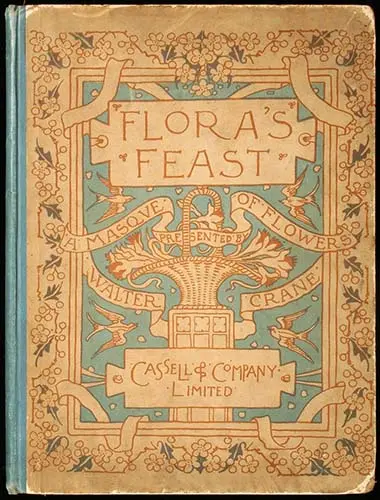
In the pantheon of Victorian illustration, few artists celebrated the natural world with such joy and decorative brilliance as Walter Crane. His 1889 masterpiece, Flora’s Feast: A Masque of Flowers, stands as one of the most enchanting creations of his long career—a volume that transforms the simple conceit of a floral pageant into a visual symphony of color, pattern, and whimsical charm.
Walter Crane (1845–1915) was a central figure in the Arts and Crafts movement and one of the most influential illustrators of his age. Trained as a wood engraver and influenced by the Pre-Raphaelites, he had developed a style characterized by bold outlines, flat planes of color, and intricate decorative borders. His toy books and nursery rhymes had delighted generations of children, but Flora’s Feast represented something more ambitious: a book conceived as a total work of art, from its verses to its illustrations to the very arrangement of each page.
The premise of Flora’s Feast is simple and charming. Flora, the goddess of flowers, summons her subjects to a grand celebration. Each flower—from the stately rose to the humble daisy, from the exotic lily to the cheerful marigold—appears in human form, dressed in costumes inspired by their botanical namesakes. They process, they dance, they present themselves before the goddess, and the result is a pageant of pure delight.
The 1889 edition, published by Cassell & Company in London, was a production of exceptional beauty. The volume was printed in quarto format, allowing Crane’s illustrations to command the page. Inside, readers discovered a series of full-page color illustrations, accompanied by verses that Crane wrote himself. Decorative borders, headpieces, and tailpieces transformed every page into a cohesive visual experience.
What distinguishes Flora’s Feast is the sheer exuberance of Crane’s vision. His flowers are not merely anthropomorphized but celebrated, each given a distinct personality through costume, posture, and expression. The rose appears as a courtly lady in layers of pink silk; the lily is a maiden in white, her head crowned with blossoms; the sunflower turns her face toward an unseen sun; the poppy reclines in sleepy indolence. Crane’s palette is rich and varied—deep reds, soft yellows, delicate pinks, and the vibrant greens of leaves and stems.
The decorative elements are equally remarkable. Crane’s borders weave around the text with the organic flow of climbing vines, incorporating flowers, leaves, and sometimes the tiny figures of fairies and insects. Each page is framed within these borders, creating the impression of a medieval manuscript rendered in the language of Victorian design. The influence of William Morris and the Arts and Crafts movement is evident throughout, yet Crane’s touch remains light and playful, never ponderous.
Flora’s Feast belongs to a tradition of floral illustration that flourished in the late nineteenth century, when the language of flowers was widely understood and the natural world was celebrated in art and literature. Yet Crane’s volume stands apart in its originality and its sheer visual abundance. It is a book that delights the eye on every opening, inviting the reader to linger over each flower, each costume, each decorative detail.
The critical reception of Flora’s Feast was warm, and the book found its audience among families who appreciated the combination of artistic merit and child-friendly charm. It has remained in print in various forms over the years, a testament to its enduring appeal. For collectors, the 1889 first edition is a prized possession—a volume that captures Walter Crane at the height of his powers, celebrating the natural world with all the decorative brilliance that made him one of the great illustrators of his age.
In the pages of this book, the flowers still dance in Flora’s honor. The rose curtsies, the lily bows, the sunflower turns her face to the light. And Walter Crane, with his brush and his pen, invites us to join the celebration—to see the garden not merely as a collection of plants but as a realm of personalities, a masque of beauty, a feast for the eyes and the imagination. It is a book that reminds us that the greatest art, like the greatest gardens, is a celebration of life in all its colors, and that every flower, no matter how humble, has its place in the pageant.
For collectors:
- The Baby’s Opera (1877), illustrated by Walter Crane – A charming early nursery rhyme collection with music and richly patterned illustrations.
- Queen Summer or The Journey of the Lily and the Rose (1891), illustrated by Walter Crane – A seasonal allegory and visual sequel to Flora’s Feast.
- The Language of Flowers by Kate Greenaway (1884) – A complementary Victorian floral illustration classic
Art Gallery: Walter Crane – Flora’s Feast: A Masque of Flowers 1889