William S. Burroughs: The Collector’s Guide to First Editions, Rare and Collectible Books
Early Life and the Burden of Privilege
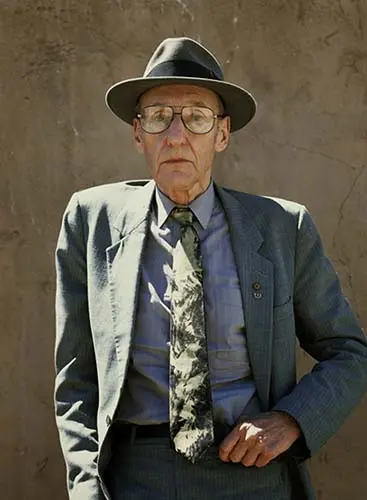
William Seward Burroughs II was born on February 5, 1914, in St. Louis, Missouri, into one of the wealthiest and most respected families in the American Midwest. His grandfather, also named William Seward Burroughs, had revolutionized business practices by inventing the first successful adding machine, founding the Burroughs Corporation, a company that would make millions. This legacy of mechanical precision and corporate success defined everything young William was expected to become. Instead, he became its opposite. Growing up in a grand Victorian mansion, young Burroughs was a quiet, bookish child with a growing revulsion for the world of commerce and respectability that surrounded him. He attended the prestigious John Burroughs School, then Harvard University, graduating in 1936. But the Ivy League education did not steer him toward a conventional path. After Harvard, he drifted across Europe, briefly studying medicine in Vienna and anthropology at Columbia University, never committing to any profession. The pull of a hidden, illicit world proved stronger. By the early 1940s, Burroughs had descended into New York’s underground of petty crime, gay subculture, and narcotics. His family’s wealth provided a permanent safety net, an allowance that allowed him to pursue addiction and artistic failure without the usual consequences. This strange combination—patrician inheritance and criminal self-destruction—would become the engine of his literary voice.
The Beat Years and the Shooting of Joan Vollmer
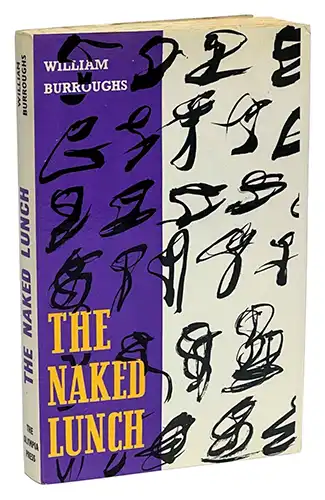
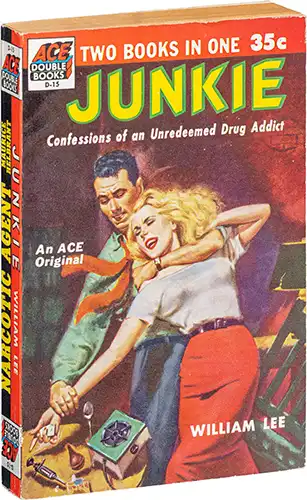
In 1943, Burroughs moved to an apartment at 419 West 115th Street in Manhattan, a space that became a revolving door for a new generation of restless young writers. Among them were two men who would define his place in literary history: a shy Columbia student named Allen Ginsberg and a football-playing former merchant mariner named Jack Kerouac. The three formed the core of what would later be called the Beat Generation. Burroughs, the oldest and most experienced in drugs and criminality, acted as a cynical mentor to the more romantic younger men. In 1947, he began a common-law marriage with Joan Vollmer, a brilliant, unstable woman who shared his appetites. They moved to Mexico City in 1949 to escape drug charges in the United States. On the night of September 6, 1951, in a drunken attempt to reenact the legend of William Tell, Burroughs shot Joan in the head with a pistol. She died instantly. The event shattered him. Mexican authorities ruled the death accidental after Burroughs bribed officials, but he never escaped the guilt. He later wrote that the shooting forced him to become a writer, exorcising his demon through art. “I am forced to the appalling conclusion,” he wrote decades later, “that I would never have become a writer but for Joan’s death.” This traumatic catalyst produced his first major publication, Junkie (1953), a stark, documentary-style account of heroin addiction published under the pseudonym William Lee. But his true masterpiece followed: Naked Lunch (1959), written during a drug-fueled stay in Tangier, Morocco. The novel abandoned all conventional narrative, presenting a fragmented, hallucinatory series of grotesque episodes involving bureaucratic nightmare, sexual horror, and black comedy. When published in the United States, it became the subject of a landmark obscenity trial that ultimately expanded the boundaries of free expression.
The Cut-Up Method and Later Experiments
Throughout the 1960s, Burroughs pushed further away from traditional storytelling. Collaborating with the artist Brion Gysin, he developed the cut-up technique: physically slicing pages of text into fragments and rearranging them at random. He believed this method bypassed the rational mind and revealed the hidden control systems embedded in language itself. Novels such as The Soft Machine (1961), The Ticket That Exploded (1962), and Nova Express (1964) applied this technique with relentless, often bewildering, energy. These works portrayed the universe as a vast conspiracy of control—media, government, addiction, language itself—that could only be broken by disrupting the programming. In his later decades, Burroughs softened. He moved to Lawrence, Kansas, where he lived quietly, tending a garden and caring for cats. The Red Night trilogy (1981–1987) returned to a more linear style, exploring his childhood and family history with a mix of nostalgia and horror. He became a reluctant celebrity, appearing in films, recording spoken-word albums with musicians including Kurt Cobain, and performing in a Nike commercial. He died on August 2, 1997, having outlived almost all his Beat contemporaries and transformed from a dangerous outlaw into an elder statesman of the avant-garde.
Influence and Legacy
William S. Burroughs’s legacy is perhaps larger and stranger than that of any other Beat writer, precisely because he rejected the Beats’ emotional openness and pioneered a cold, paranoid, intellectually brutal form of modernism. His first and most direct influence was on the generation of experimental writers who followed. J.G. Ballard, the British author of Crash and Empire of the Sun, explicitly acknowledged Burroughs as a primary model. Ballard adopted Burroughs’s vision of inner, psychological landscapes where technology and human desire fuse into a disturbing new reality. Ballard’s compressed, fragmented narratives owe a direct debt to the cut-up method. Thomas Pynchon, the reclusive author of Gravity’s Rainbow, absorbed Burroughs’s paranoid conspiracy aesthetics and his ability to blend lowbrow pulp genres with high modernist complexity. Pynchon’s sprawling novels, filled with bizarre characters and secret systems of control, would be unthinkable without Burroughs’s example. Kathy Acker, the radical feminist novelist, built her entire career on Burroughsian cut-ups, rewriting classic literature while mixing autobiography, pornography, and political rage. She called him her literary father. In science fiction, William Gibson, who invented the cyberpunk genre, has repeatedly cited Naked Lunch as a key text. Gibson’s Neuromancer is saturated with Burroughs’s imagery of addiction as information, bodies as commodities, and reality as a fragile simulation.
Beyond individual authors, Burroughs fundamentally changed how literature could approach addiction, sexuality, and violence. Before him, drug use in fiction was either romanticized or moralized. Burroughs presented it as a mechanical, biological system of control—bleak, unglamorous, and terrifying. He wrote openly about homosexuality at a time when it remained illegal and pathologized, refusing apology or explanation. He transformed the confession into a weapon. The obscenity trials surrounding Naked Lunch set legal precedents that protected later controversial works by authors ranging from Henry Miller to Bret Easton Ellis. Burroughs’s influence also extended far beyond the printed page. Punk rock bands, performance artists, experimental filmmakers, and even fashion designers have drawn from his imagery and methods. David Cronenberg’s 1991 film adaptation of Naked Lunch brought Burroughs’s vision to a new generation. Today, Burroughs stands as a patron saint of literary transgression. His work remains difficult, often repellent, and never comfortable. But he taught that the purpose of art is not to comfort but to break open perception, to expose the hidden wires of control, and to offer, in the midst of nightmare, a strange and exhilarating freedom.
William S. Burroughs – First Editions Identification Guide
A Complete Bibliography of William S. Burroughs: Novels, Rare Books & First Editions
| Year | Title | Publisher | First edition/printing identification points |
|---|---|---|---|
| 1953 | Junkie | Ace Books, [1953] | First edition. "Copyright, 1953, by, Ace Books" stated on © page. Stiff pictorial wrappers. Ace Double Books D-15. Bound and published together with Narcotic Agent by Maurice Helbrant, printed upside down on reverse side. Price $0.35c. ALSO: Digit Books, London, 1958. First English edition. "First publication in the United Kingdom" stated on © page. First separate edition. Stiff pictorial wrappers. ALSO: Ace Books, 1964, K-202. First American separate edition. Stiff pictorial wrappers, all edges orange. Price $0.50c. Reprinted 1970, 1972 wide code and price changed. ALSO: The Olympia Press, France, [1966]. Stiff olive-green wrappers. Reprinted in 1969 and 1972 with new covers. ALSO: David Bruce & Watson, London, 1973. First Hardcover edition. Black cloth, gilt lettering. Black Dust jacket, white lettering. 1500 copies printed. Note: There is also a variant binding in brown or olive-green, priority unknown. |
| 1959 | Naked Lunch | Olympia Press, Paris, 1959 | First edition. "Printed by ... in July 1959" stated on © page. Stiff olive-green wrappers. Decorated white Dust jacket, purple strip. Price 1,500 Francs. 5,000 copies printed. Notes: The book was issued without Dust jacket, it was added after a month or so. Book was soon after and again in 1965. Price changed to 15 Francs on rear cover, copyright page changed, ssued without Dust jacket. ALSO: Grove Press, New York, 1962. First American edition. "First Printing" stated on © page. Half black cloth and boards, top edge stained black. Pictorial Dust jacket w/ white & red lettering. Rear panel "Comments about Naked Lunch" Front flap blurb about Naked Lunch, continued to back flap. Price $6.00. 3,500 copies printed. ALSO: London: John Calder, 1964. First English edition. "First published in Great Britain 1964" stated on © page. Beige cloth, gilt lettering. White pictorial Dust jacket, rear panel "Naked Lunch" blurb. Rear flap photographer's credit. Price 42s/. |
| 1960 | Minutes to Go | Two Cities Edition, [1960] | First edition. "Acheve d'imprimer le 13 Avril 1960" stated on © page. Stiff light blue pictorial wrappers. Two issues, no priority:
|
| 1960 | The Exterminator | Auerhahn Press, 1960 | First edition. "Copyright 1960 by William Burroughs" stated on © page. Stiff white pictorial wrappers. 1000 copies printed. |
| 1961 | The Soft Machine | The Olympia Press, Paris, [1961] | First edition. "Imprimerie ... June 1961" stated on © page. Stiff olive-green wrappers. Grey black Dust jacket with calligraphic designs by Brion Gysin. Price New Francs 15. ALSO: Grove Press, 1967. First American edition. "First Printing" stated on © page. Dark red cloth, silver lettering. White Dust jacket, calligraphic design by WSB in black. Price $5.00. 18,000 copies printed. Note: Later reprints were bound in black cloth. |
| 1962 | The Ticket That Exploded | The Olympia Press, Paris, [1962] | First edition. "First edition: 1961" stated on © page. Stiff olive-green wrappers. Black & grey photocollage Dust jacket by Ian Sommerville. Price New Francs 18. ALSO: Grove Press, New York,, [1967]. First American edition. "First Printing" stated on © page. Orange cloth, black lettering. Pictorial white Dust jacket. Price $5.00. ALSO: Calder & Boyars, London, [1968]. First English edition. "First published in Great Britain in 1968" stated on © page. White pictorial collage Dust jacket. Price 42s. Note: The paperback version was published simultaneously with same design as the hardcover, priced at 15s. |
| 1963 | Dead Fingers Talk | John Calder, [1963] | First edition. "First published in Great Britain in 1963" stated on © page. Grey cloth, gilt lettering. Pictorial black & white Dust jacket. Price 25s. ALSO: Tandem Books Ltd, [1966]. "Tandem edition 1966" stated on © page. Pictorial wrappers. Price 3/6. |
| 1963 | The Yage Letters | City Lights Books, [1963] | First edition. "© 1963 by William S. Burroughs & Allen Ginsberg" stated on © page. Stiff B/W pictorial wrappers. Price $1.25. |
| 1964 | Nova Express | Grove Press, New York,, [1964] | First edition. "First Printing" stated on © page. Red-orange cloth, black lettering. White pictorial Dust jacket. Price $5.00. ALSO: Jonathan cape, London, [1966]. First English edition. "First published in Great Britain in 1966". Black cloth, gilt lettering. Red pictorial Dust jacket. Prie 25s. |
| 1965 | Time | C' Press, 1965 | First edition. "Copyright 1965 by William S. Burroughs" stated on the title page. Stapled bound, stiff pictorial grey wrappers. Three issues, no priority:
|
| 1965 | Health Bulletin: APO-33 | Fuck You Press, [1965] | First edition. "First Printing" stated on © page. Pamphlet of 27 single leaves, including cover. Printed on buff, grey and white paper. |
| 1970 | The Last Words of Dutch Schultz | Cape Goliard Press, 1970 | First edition, . Three issues, no priority:
|
| 1971 | Jack Kerouac | L'Herne, [1971] | First edition. "Copyright 1960 by William Burroughs" stated on © page. Stiff black pictorial wrappers, folded to make inside flaps. |
| 1971 | Ali's Smile | Unicorn Books, 1971 | First edition. Light brown buckram, light brown cardboard slipcase and a 12" LP . Limited edition of 99 copies, signed by the author. |
| 1971 | The Wild Boys | Grove Press, New York,, [1971] | First edition. "First Printing" stated on © page. Black cloth, gilt lettering on spine. Pictorial Dust jacket, price $ 6.95. ALSO: Calder & Boyars, London, [1972]. First English edition. "First published in Great Britain in 1972" stated on © page. Light red cloth, gilt lettering. White pictorial Dust jacket. Price £2.50. |
| 1971 | Electronic Revolution | Blackmoor Head Press, 1971 | First edition. Stiff white pictorial wrappers. Two issues, no priority:
|
| 1973 | Brion Gysin, Let me Mice In | Something Else Press, Inc. [1973] | First edition. Two issues, no priority:
|
| 1973 | Exterminator! | The Viking Press, Inc., [1973] | First edition. "First published in 1973" stated on © page. Bull brown cloth. White picrotial Dust jacket. Price $6.95. |
| 1973 | Port of Saints | Covent Garrden Press, London, 1973 | First edition. White cloth boards, black lettering. Pink & teal pictorial Dust jacket. ALSO: Blue Wind Press, 1980. Two issues, no priority:
|
| 1974 | White Subway | Aloes SeolA, London, [1974] | First edition. Stiff black & white pictorial wrappers. Limited edition of 1000 copies of which 25 were numbred and signed by the author. |
| 1981 | Cities of the Red Night | Holt, Rhinehart & Winston, New York, [1984] | First edition. "First edition" with complete printing number to starting at 1 stated on © page. Two issues, no priority:
|
| 1983 | The Place of Dead Roads | Holt, Rhinehart & Winston, New York, [1983] | First edition. "First edition" with complete printing number to starting at 1 stated on © page. Two issues, no priority:
|
| 1987 | The Western Lands | Viking Press, 1987 | First edition. "First published in 1987" stated on © page. Black paper boards with teal cloth spine, black & copper gilt lettering. Pictorial Dust jacket. |
| 1995 | My Education: A Book of Dreams | Viking Press, 1995 | First edition. "First published in 1995" and complete printing numbering starting at 1. Pictorials Dust jacket. |
William S. Burroughs – First Printing Dust Jackets Identification Guide
Gallery of First state Dust Jackets of Burroughs’s works.


Reference:
- Joe Maynard and Barry Miles: William S. Burroughs, A Bibliography, 1933-73