A French Wonderland: Adrienne Ségur’s Alice au Pays des Merveilles
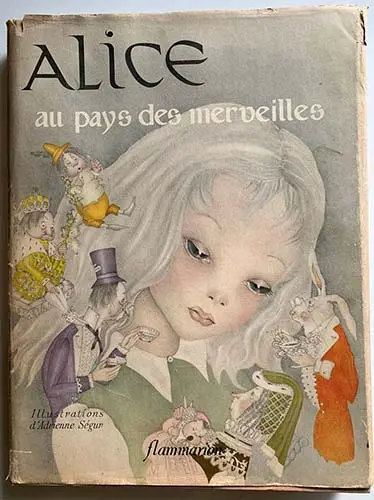
In the long history of illustrating Lewis Carroll’s Alice’s Adventures in Wonderland, most editions have been produced in England or America, reflecting the Anglophone roots of the classic. But one of the most enchanting interpretations emerged from France in the 1950s, the work of an artist whose delicate, dreamlike style transformed Carroll’s surreal world into something distinctly Gallic—a Wonderland of soft watercolors, elegant figures, and quiet magic. Adrienne Ségur’s 1952 edition of Alice au Pays des Merveilles remains a treasure of mid-century illustration, a volume that deserves to be known far beyond its native shores.
Adrienne Ségur (1901–1981) was a French illustrator whose career spanned five decades. Born in Paris, she studied at the École des Beaux-Arts and began illustrating children’s books in the 1930s. Her style was distinctive: soft watercolors, delicate line work, and a palette of muted, luminous colors that gave her illustrations a dreamlike quality. She worked in the tradition of the French illustrators who had followed in the footsteps of Edmund Dulac and Kay Nielsen, but her sensibility was entirely her own—gentler, more intimate, more attuned to the inner world of childhood.
The 1952 edition of Alice au Pays des Merveilles, published by Éditions Gautier-Languereau in Paris, was one of Ségur’s major commissions. The volume was a handsome production, bound in cloth with a color illustration on the front cover that promised the treasures within. Inside, readers discovered a wealth of visual delights: full-page color plates, smaller vignettes, decorative borders, and delicate drawings that wove throughout the text. Ségur’s illustrations were not merely decorative; they were an integral part of the reading experience, transforming each page into a window into her Wonderland.
What distinguishes Ségur’s Alice is its elegance. Her Alice is a proper French child—neatly dressed, composed, with a thoughtful expression that suggests she is taking the absurdities of Wonderland with the calm rationality that Carroll’s original Alice possessed. The creatures she encounters—the White Rabbit, the Cheshire Cat, the Mad Hatter—are rendered with a refinement that softens their strangeness. Ségur’s palette is dominated by soft pinks, pale blues, gentle greens, and touches of gold. Her compositions are carefully balanced, with a keen attention to the decorative possibilities of each scene.
The French text of Alice is itself a classic, translated by Henri Parisot, whose 1949 version is considered the definitive French edition. Parisot captured Carroll’s wordplay with remarkable fidelity, finding French equivalents for the puns and nonsense that make the original so challenging to translate. Ségur’s illustrations, created in close collaboration with the translator, reflect a deep understanding of both the English original and its French interpretation.
The 1952 edition appeared at a moment when French children’s book illustration was experiencing a remarkable flowering. The post-war years saw the emergence of artists like Ségur, along with Maurice Boutet de Monvel and others, who brought a new sophistication to the genre. Ségur’s Alice was recognized immediately as a classic; it was reprinted multiple times and remains in print in France today.
For collectors, the first edition of Ségur’s Alice is a treasure. The original binding, with its illustrated dust wrapper, was fragile, and the delicate plates were vulnerable to handling. Surviving copies in fine condition are increasingly scarce, particularly in the American market, where the book was never widely distributed. Yet for those who discover it, Ségur’s Wonderland offers a fresh perspective on a familiar classic—a reminder that Carroll’s masterpiece is capacious enough to accommodate many interpretations, and that some of the most beautiful are the ones least known.
In the pages of this book, Alice still falls down the rabbit hole, still grows and shrinks, still attends the Mad Hatter’s tea party. But she does so in a setting of French elegance, rendered with the soft watercolors and delicate line of Adrienne Ségur. It is a Wonderland that feels less like a descent into the strange and more like a journey into a dream—a place where the boundaries between the real and the imagined dissolve, and where an artist, working in the quiet of her Paris studio, created an interpretation that deserves to be celebrated alongside the more familiar English editions. For those who love Alice, for those who love French illustration, and for those who simply treasure beautiful books, Ségur’s Alice au Pays des Merveilles is a discovery waiting to be made.
Recommended for collectors:
- Les Contes de Perrault (1950), illustrated by Adrienne Ségur – A luxurious edition of Perrault’s tales with her signature enchanting visuals.
- La Belle au Bois Dormant (1951), illustrated by Adrienne Ségur – A singular retelling of Sleeping Beauty, filled with romantic elegance and expressive detail.
Art Gallery: Adrienne Segur – Alice au Pays des Merveilles 1949
![Adrienne Segur - Alice au Paus de Merveilles [segur-alice01] (art, illustrations)](https://www.nocloo.com/wp-content/plugins/justified-image-grid/timthumb.php?src=https%3A%2F%2Fwww.nocloo.com%2Fart%2Fsegur-alice%2Fsegur-alice01.jpg&h=280&q=90&f=.jpg)
![Adrienne Segur - Alice au Paus de Merveilles [segur-alice02] (art, illustrations)](https://www.nocloo.com/wp-content/plugins/justified-image-grid/timthumb.php?src=https%3A%2F%2Fwww.nocloo.com%2Fart%2Fsegur-alice%2Fsegur-alice02.jpg&h=280&q=90&f=.jpg)
![Adrienne Segur - Alice au Paus de Merveilles [segur-alice03] (art, illustrations)](https://www.nocloo.com/wp-content/plugins/justified-image-grid/timthumb.php?src=https%3A%2F%2Fwww.nocloo.com%2Fart%2Fsegur-alice%2Fsegur-alice03.jpg&h=280&q=90&f=.jpg)
![Adrienne Segur - Alice au Paus de Merveilles [segur-alice04] (art, illustrations)](https://www.nocloo.com/wp-content/plugins/justified-image-grid/timthumb.php?src=https%3A%2F%2Fwww.nocloo.com%2Fart%2Fsegur-alice%2Fsegur-alice04.jpg&h=280&q=90&f=.jpg)
![Adrienne Segur - Alice au Paus de Merveilles [segur-alice05] (art, illustrations)](https://www.nocloo.com/wp-content/plugins/justified-image-grid/timthumb.php?src=https%3A%2F%2Fwww.nocloo.com%2Fart%2Fsegur-alice%2Fsegur-alice05.jpg&h=280&q=90&f=.jpg)
![Adrienne Segur - Alice au Paus de Merveilles [segur-alice06] (art, illustrations)](https://www.nocloo.com/wp-content/plugins/justified-image-grid/timthumb.php?src=https%3A%2F%2Fwww.nocloo.com%2Fart%2Fsegur-alice%2Fsegur-alice06.jpg&h=280&q=90&f=.jpg)
![Adrienne Segur - Alice au Paus de Merveilles [segur-alice07] (art, illustrations)](https://www.nocloo.com/wp-content/plugins/justified-image-grid/timthumb.php?src=https%3A%2F%2Fwww.nocloo.com%2Fart%2Fsegur-alice%2Fsegur-alice07.jpg&h=280&q=90&f=.jpg)
![Adrienne Segur - Alice au Paus de Merveilles [segur-alice08] (art, illustrations)](https://www.nocloo.com/wp-content/plugins/justified-image-grid/timthumb.php?src=https%3A%2F%2Fwww.nocloo.com%2Fart%2Fsegur-alice%2Fsegur-alice08.jpg&h=280&q=90&f=.jpg)