A Dish of Apples: Arthur Rackham’s Bite-Sized Harvest of Whimsy
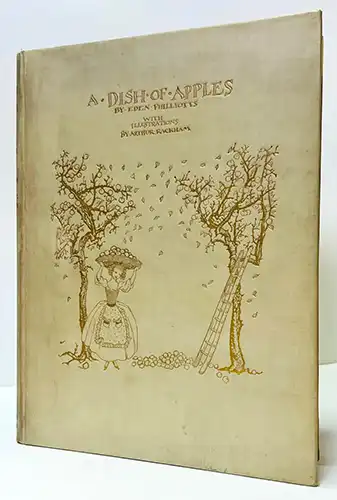
In the vast orchard of Arthur Rackham’s illustrated books, most readers reach first for the low-hanging fruit: Peter Pan, Alice in Wonderland, The Ring of the Nibelung. These are the grand, sprawling volumes that showcase Arthur Rackham at his most ambitious, his most dramatic, his most intensely detailed. But there is a smaller, rarer, and utterly charming volume that deserves equal attention: A Dish of Apples, a slender collection of garden poetry illustrated by Rackham and published in 1921. It is Rackham in miniature, Rackham at play, Rackham with his hair down—and it is absolutely delightful.
The book itself is modest in scale. The text consists of a selection of poems by various writers, all centered on the theme of apples, orchards, and the English countryside in autumn. There are verses from Shakespeare, Herrick, and Keats, as well as lesser-known poets who sang the praises of ripe fruit, cider presses, and the changing leaves. The poems are pleasant, occasionally lovely, but they are not the reason this book has endured. The reason, as always with Rackham, is the pictures.
By 1921, Rackham was at the height of his powers and his fame. He had already illustrated dozens of major gift books, and his style was instantly recognizable to readers on both sides of the Atlantic. But A Dish of Apples offered him something different: a chance to work small, to be playful, and to explore a subject that was far from his usual fairy-tale gloom. There are no goblins here, no trolls, no haunted forests. Instead, Rackham fills his pages with rosy-cheeked children climbing trees, plump farmers carrying baskets, and a cast of tiny, mischievous creatures that hover somewhere between fairies and insects.
These little beings are the true stars of A Dish of Apples. Rackham populates his orchards with a race of minuscule, winged or wingless folk who live among the branches, ride falling leaves like magic carpets, and peer out from behind windfall apples with expressions of curious amusement. They have the characteristic Rackham features—knobbly limbs, pointed ears, slightly impish faces—but they are rendered with a lighter touch than his usual goblins. They seem less malevolent and more merely mischievous, like the spirits of the orchard itself, neither good nor evil but simply present, watching the human harvesters with ancient, patient eyes.
Rackham’s palette in this volume is appropriately autumnal. He works in warm golds, russet browns, soft reds, and touches of faded green. His skies are hazy with the soft light of late September afternoons. His trees are gnarled but not sinister—old friends rather than lurking threats. The watercolor washes are lighter than in his darker books, with more paper left visible, giving the illustrations an airy, breezy quality that matches the poems perfectly.
A Dish of Apples is not a monumental book. It will not overwhelm you with its scale or ambition. It is, as its title suggests, a small offering—a handful of ripe fruit from a master illustrator who had nothing left to prove. But that is precisely its charm. Rackham made this book for the pure joy of it, and that joy is contagious. To read A Dish of Apples on an autumn afternoon, with a real apple in hand and the smell of fallen leaves in the air, is to understand that sometimes the smallest books contain the deepest pleasures. It is a dish of apples, nothing more, nothing less—and it is perfect.
Recommended for collectors:
- The Wind in the Willows (1940), illustrated by Arthur Rackham – A posthumously published classic featuring Rackham’s final illustrations.
- Rip Van Winkle (1905), illustrated by Arthur Rackham – One of Rackham’s early triumphs, full of rich fantasy and dark woodland atmosphere.
- The Allies’ Fairy Book (1916), illustrated by Arthur Rackham – A collection of international fairy tales supporting wartime unity, with Rackham’s varied interpretations.
Art Gallery: Arthur Rackham – A Dish of Apples 1921
![Arthur Rackham - A Dish of Apples [rackham-apple1] (art, illustrations)](https://www.nocloo.com/wp-content/plugins/justified-image-grid/timthumb.php?src=https%3A%2F%2Fwww.nocloo.com%2Fart%2Frackham-apple%2Frackham-apple1.jpg&h=280&q=90&f=.jpg "Arthur Rackham - Illustrations for A Dish of Apples 1921")
![Arthur Rackham - A Dish of Apples [rackham-apple2] (art, illustrations)](https://www.nocloo.com/wp-content/plugins/justified-image-grid/timthumb.php?src=https%3A%2F%2Fwww.nocloo.com%2Fart%2Frackham-apple%2Frackham-apple2.jpg&h=280&q=90&f=.jpg "Arthur Rackham - Illustrations for A Dish of Apples 1921")
![Arthur Rackham - A Dish of Apples [rackham-apple3] (art, illustrations)](https://www.nocloo.com/wp-content/plugins/justified-image-grid/timthumb.php?src=https%3A%2F%2Fwww.nocloo.com%2Fart%2Frackham-apple%2Frackham-apple3.jpg&h=280&q=90&f=.jpg "Arthur Rackham - Illustrations for A Dish of Apples 1921")