Rip Van Winkle (1905) – by Washington Irving, illustrated by Arthur Rackham
A Dreamer’s Return: Arthur Rackham’s Rip Van Winkle
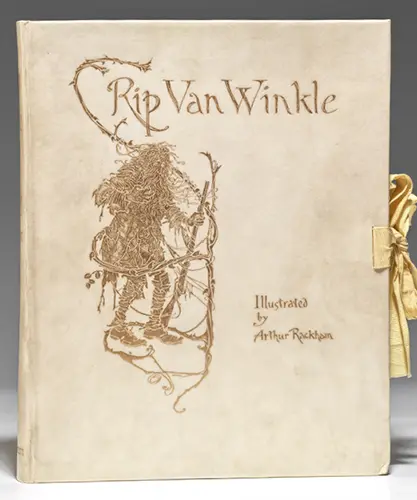
When Arthur Rackham’s edition of Rip Van Winkle appeared in 1905, it marked a turning point—not only in the career of the artist but in the very history of illustrated books. This was the volume that established Rackham as the preeminent illustrator of his generation, a work of such extraordinary beauty and imagination that it redefined what a gift book could be. More than a century later, Rackham’s Rip Van Winkle remains a touchstone—a masterpiece of the Golden Age of Illustration that continues to enchant with its blend of whimsy, melancholy, and sheer technical virtuosity.
Washington Irving’s tale of the Dutch-American villager who sleeps for twenty years in the Catskill Mountains was already a classic when Rackham turned his attention to it. Published originally in 1819, it had become one of the foundational stories of American literature—a meditation on change, memory, and the passage of time. Yet Rackham saw in it something more: an opportunity to explore the shadowy borderland between the familiar and the fantastic, the ordinary and the enchanted. His interpretation would become, for generations of readers, the definitive visual rendering of Irving’s tale.
The 1905 edition was published by William Heinemann in London and Doubleday, Page & Company in New York. It was a lavish production, issued in both a limited, signed edition of 250 copies bound in vellum and a larger trade edition that itself was exceptionally handsome. The volume contained fifty-one color plates, each mounted on heavy paper and protected by captioned tissue guards, alongside numerous black-and-white illustrations woven throughout the text. From the moment one opened the book, Rackham’s vision was inescapable—a total artistic immersion that left no page untouched.
What makes Rackham’s Rip Van Winkle so remarkable is its tonal range. The illustrations move effortlessly between the warmly domestic and the eerily supernatural. The scenes of Rip’s home life—his shrewish wife, his idle days in the village—are rendered with a gentle humor, the figures possessing the characteristic Rackham blend of realism and caricature. Yet when Rip ventures into the mountains, the atmosphere shifts dramatically. The illustrations depicting his encounter with the ghostly crew of Hendrick Hudson are among the most haunting in all of Rackham’s work—figures rendered in deep greens and browns, their faces gnarled and ancient, their movements frozen in a timeless game of ninepins.
Rackham’s palette in this work is particularly noteworthy. The muted earth tones, the soft greens and browns that dominate the mountain scenes, create a sense of ancient, undisturbed wilderness. The human figures are often dwarfed by their surroundings—trees that loom, mountains that stretch endlessly—emphasizing the story’s themes of mortality and the vast indifference of nature. Yet there is also warmth: the final illustrations of Rip’s return to the village, his discovery of a world changed, are bathed in a golden autumnal light that suggests both loss and the possibility of renewal.
The critical response to Rackham’s Rip Van Winkle was immediate and overwhelming. The book sold out rapidly and established Rackham as a commercial and artistic force. It also set a new standard for the illustrated gift book, demonstrating that a single artist’s vision could elevate a familiar text into something altogether new. For collectors, the limited edition remains one of the most coveted of all Rackham’s works—a testament to the heights that the art of illustration could achieve.
Today, Rackham’s Rip Van Winkle stands as a monument of its era. Yet its appeal transcends the historical. There is something in these illustrations—their melancholy, their mystery, their profound humanity—that speaks to readers across time. When we think of Rip Van Winkle, we think of Rackham’s Rip: the bemused dreamer wandering home to a world that has moved on without him. In that sense, the book itself becomes a kind of Rip Van Winkle—an artifact from a vanished age that still has the power to awaken our imaginations, to remind us of what we have lost, and to offer, in its beauty, a kind of consolation.collectible today.
Recommended for Collectors
- The Legend of Sleepy Hollow (1928) by Washington Irving, also illustrated by Rackham
- Fairy Tales of the Brothers Grimm (1909) featuring Rackham’s iconic interpretations
- Peter Pan in Kensington Gardens (1906) showcasing Rackham’s magical style
Other Arthur Rackham’s illustrated works available in our gallery: Rip Van Winkle, Tales of Mystery and Imagination, Book of Pictures, The Night Before Christmas, The Pied Piper of Hamelin, Midsummer’s Night Dream, Undine, Alice’s Adventures in Wonderland, Peter Pan in Kensington Garden, The Ingoldsby Legends, Grimm’s Fairy Tales.
Art Gallery: Arthur Rackham – Rip Van Winkle 1905
![Arthur Rackham - Rip Van Winkle [rackham-winkle01] (art, illustrations)](https://www.nocloo.com/wp-content/plugins/justified-image-grid/timthumb.php?src=https%3A%2F%2Fwww.nocloo.com%2Fart%2Frackham-rip-van-winkle%2Frackham-winkle01.jpg&h=280&q=90&f=.jpg)
![Arthur Rackham - Rip Van Winkle [rackham-winkle02] (art, illustrations)](https://www.nocloo.com/wp-content/plugins/justified-image-grid/timthumb.php?src=https%3A%2F%2Fwww.nocloo.com%2Fart%2Frackham-rip-van-winkle%2Frackham-winkle02.jpg&h=280&q=90&f=.jpg)
![Arthur Rackham - Rip Van Winkle [rackham-winkle03] (art, illustrations)](https://www.nocloo.com/wp-content/plugins/justified-image-grid/timthumb.php?src=https%3A%2F%2Fwww.nocloo.com%2Fart%2Frackham-rip-van-winkle%2Frackham-winkle03.jpg&h=280&q=90&f=.jpg)
![Arthur Rackham - Rip Van Winkle [rackham-winkle04] (art, illustrations)](https://www.nocloo.com/wp-content/plugins/justified-image-grid/timthumb.php?src=https%3A%2F%2Fwww.nocloo.com%2Fart%2Frackham-rip-van-winkle%2Frackham-winkle04.jpg&h=280&q=90&f=.jpg)
![Arthur Rackham - Rip Van Winkle [rackham-winkle05] (art, illustrations)](https://www.nocloo.com/wp-content/plugins/justified-image-grid/timthumb.php?src=https%3A%2F%2Fwww.nocloo.com%2Fart%2Frackham-rip-van-winkle%2Frackham-winkle05.jpg&h=280&q=90&f=.jpg)
![Arthur Rackham - Rip Van Winkle [rackham-winkle06] (art, illustrations)](https://www.nocloo.com/wp-content/plugins/justified-image-grid/timthumb.php?src=https%3A%2F%2Fwww.nocloo.com%2Fart%2Frackham-rip-van-winkle%2Frackham-winkle06.jpg&h=280&q=90&f=.jpg)
![Arthur Rackham - Rip Van Winkle [rackham-winkle07] (art, illustrations)](https://www.nocloo.com/wp-content/plugins/justified-image-grid/timthumb.php?src=https%3A%2F%2Fwww.nocloo.com%2Fart%2Frackham-rip-van-winkle%2Frackham-winkle07.jpg&h=280&q=90&f=.jpg)
![Arthur Rackham - Rip Van Winkle [rackham-winkle08] (art, illustrations)](https://www.nocloo.com/wp-content/plugins/justified-image-grid/timthumb.php?src=https%3A%2F%2Fwww.nocloo.com%2Fart%2Frackham-rip-van-winkle%2Frackham-winkle08.jpg&h=280&q=90&f=.jpg)
![Arthur Rackham - Rip Van Winkle [rackham-winkle09] (art, illustrations)](https://www.nocloo.com/wp-content/plugins/justified-image-grid/timthumb.php?src=https%3A%2F%2Fwww.nocloo.com%2Fart%2Frackham-rip-van-winkle%2Frackham-winkle09.jpg&h=280&q=90&f=.jpg)
![Arthur Rackham - Rip Van Winkle [rackham-winkle10] (art, illustrations)](https://www.nocloo.com/wp-content/plugins/justified-image-grid/timthumb.php?src=https%3A%2F%2Fwww.nocloo.com%2Fart%2Frackham-rip-van-winkle%2Frackham-winkle10.jpg&h=280&q=90&f=.jpg)
![Arthur Rackham - Rip Van Winkle [rackham-winkle11] (art, illustrations)](https://www.nocloo.com/wp-content/plugins/justified-image-grid/timthumb.php?src=https%3A%2F%2Fwww.nocloo.com%2Fart%2Frackham-rip-van-winkle%2Frackham-winkle11.jpg&h=280&q=90&f=.jpg)
![Arthur Rackham - Rip Van Winkle [rackham-winkle12] (art, illustrations)](https://www.nocloo.com/wp-content/plugins/justified-image-grid/timthumb.php?src=https%3A%2F%2Fwww.nocloo.com%2Fart%2Frackham-rip-van-winkle%2Frackham-winkle12.jpg&h=280&q=90&f=.jpg)
![Arthur Rackham - Rip Van Winkle [rackham-winkle13] (art, illustrations)](https://www.nocloo.com/wp-content/plugins/justified-image-grid/timthumb.php?src=https%3A%2F%2Fwww.nocloo.com%2Fart%2Frackham-rip-van-winkle%2Frackham-winkle13.jpg&h=280&q=90&f=.jpg)
![Arthur Rackham - Rip Van Winkle [rackham-winkle14] (art, illustrations)](https://www.nocloo.com/wp-content/plugins/justified-image-grid/timthumb.php?src=https%3A%2F%2Fwww.nocloo.com%2Fart%2Frackham-rip-van-winkle%2Frackham-winkle14.jpg&h=280&q=90&f=.jpg)
![Arthur Rackham - Rip Van Winkle [rackham-winkle15] (art, illustrations)](https://www.nocloo.com/wp-content/plugins/justified-image-grid/timthumb.php?src=https%3A%2F%2Fwww.nocloo.com%2Fart%2Frackham-rip-van-winkle%2Frackham-winkle15.jpg&h=280&q=90&f=.jpg)
![Arthur Rackham - Rip Van Winkle [rackham-winkle16] (art, illustrations)](https://www.nocloo.com/wp-content/plugins/justified-image-grid/timthumb.php?src=https%3A%2F%2Fwww.nocloo.com%2Fart%2Frackham-rip-van-winkle%2Frackham-winkle16.jpg&h=280&q=90&f=.jpg)
![Arthur Rackham - Rip Van Winkle [rackham-winkle17] (art, illustrations)](https://www.nocloo.com/wp-content/plugins/justified-image-grid/timthumb.php?src=https%3A%2F%2Fwww.nocloo.com%2Fart%2Frackham-rip-van-winkle%2Frackham-winkle17.jpg&h=280&q=90&f=.jpg)
![Arthur Rackham - Rip Van Winkle [rackham-winkle18] (art, illustrations)](https://www.nocloo.com/wp-content/plugins/justified-image-grid/timthumb.php?src=https%3A%2F%2Fwww.nocloo.com%2Fart%2Frackham-rip-van-winkle%2Frackham-winkle18.jpg&h=280&q=90&f=.jpg)
![Arthur Rackham - Rip Van Winkle [rackham-winkle19] (art, illustrations)](https://www.nocloo.com/wp-content/plugins/justified-image-grid/timthumb.php?src=https%3A%2F%2Fwww.nocloo.com%2Fart%2Frackham-rip-van-winkle%2Frackham-winkle19.jpg&h=280&q=90&f=.jpg)
![Arthur Rackham - Rip Van Winkle [rackham-winkle20] (art, illustrations)](https://www.nocloo.com/wp-content/plugins/justified-image-grid/timthumb.php?src=https%3A%2F%2Fwww.nocloo.com%2Fart%2Frackham-rip-van-winkle%2Frackham-winkle20.jpg&h=280&q=90&f=.jpg)
![Arthur Rackham - Rip Van Winkle [rackham-winkle21] (art, illustrations)](https://www.nocloo.com/wp-content/plugins/justified-image-grid/timthumb.php?src=https%3A%2F%2Fwww.nocloo.com%2Fart%2Frackham-rip-van-winkle%2Frackham-winkle21.jpg&h=280&q=90&f=.jpg)
![Arthur Rackham - Rip Van Winkle [rackham-winkle22] (art, illustrations)](https://www.nocloo.com/wp-content/plugins/justified-image-grid/timthumb.php?src=https%3A%2F%2Fwww.nocloo.com%2Fart%2Frackham-rip-van-winkle%2Frackham-winkle22.jpg&h=280&q=90&f=.jpg)
![Arthur Rackham - Rip Van Winkle [rackham-winkle23] (art, illustrations)](https://www.nocloo.com/wp-content/plugins/justified-image-grid/timthumb.php?src=https%3A%2F%2Fwww.nocloo.com%2Fart%2Frackham-rip-van-winkle%2Frackham-winkle23.jpg&h=280&q=90&f=.jpg)
![Arthur Rackham - Rip Van Winkle [rackham-winkle24] (art, illustrations)](https://www.nocloo.com/wp-content/plugins/justified-image-grid/timthumb.php?src=https%3A%2F%2Fwww.nocloo.com%2Fart%2Frackham-rip-van-winkle%2Frackham-winkle24.jpg&h=280&q=90&f=.jpg)
![Arthur Rackham - Rip Van Winkle [rackham-winkle25] (art, illustrations)](https://www.nocloo.com/wp-content/plugins/justified-image-grid/timthumb.php?src=https%3A%2F%2Fwww.nocloo.com%2Fart%2Frackham-rip-van-winkle%2Frackham-winkle25.jpg&h=280&q=90&f=.jpg)
![Arthur Rackham - Rip Van Winkle [rackham-winkle26] (art, illustrations)](https://www.nocloo.com/wp-content/plugins/justified-image-grid/timthumb.php?src=https%3A%2F%2Fwww.nocloo.com%2Fart%2Frackham-rip-van-winkle%2Frackham-winkle26.jpg&h=280&q=90&f=.jpg)
![Arthur Rackham - Rip Van Winkle [rackham-winkle27] (art, illustrations)](https://www.nocloo.com/wp-content/plugins/justified-image-grid/timthumb.php?src=https%3A%2F%2Fwww.nocloo.com%2Fart%2Frackham-rip-van-winkle%2Frackham-winkle27.jpg&h=280&q=90&f=.jpg)
![Arthur Rackham - Rip Van Winkle [rackham-winkle28] (art, illustrations)](https://www.nocloo.com/wp-content/plugins/justified-image-grid/timthumb.php?src=https%3A%2F%2Fwww.nocloo.com%2Fart%2Frackham-rip-van-winkle%2Frackham-winkle28.jpg&h=280&q=90&f=.jpg)
![Arthur Rackham - Rip Van Winkle [rackham-winkle29] (art, illustrations)](https://www.nocloo.com/wp-content/plugins/justified-image-grid/timthumb.php?src=https%3A%2F%2Fwww.nocloo.com%2Fart%2Frackham-rip-van-winkle%2Frackham-winkle29.jpg&h=280&q=90&f=.jpg)
![Arthur Rackham - Rip Van Winkle [rackham-winkle30] (art, illustrations)](https://www.nocloo.com/wp-content/plugins/justified-image-grid/timthumb.php?src=https%3A%2F%2Fwww.nocloo.com%2Fart%2Frackham-rip-van-winkle%2Frackham-winkle30.jpg&h=280&q=90&f=.jpg)
![Arthur Rackham - Rip Van Winkle [rackham-winkle31] (art, illustrations)](https://www.nocloo.com/wp-content/plugins/justified-image-grid/timthumb.php?src=https%3A%2F%2Fwww.nocloo.com%2Fart%2Frackham-rip-van-winkle%2Frackham-winkle31.jpg&h=280&q=90&f=.jpg)
![Arthur Rackham - Rip Van Winkle [rackham-winkle32] (art, illustrations)](https://www.nocloo.com/wp-content/plugins/justified-image-grid/timthumb.php?src=https%3A%2F%2Fwww.nocloo.com%2Fart%2Frackham-rip-van-winkle%2Frackham-winkle32.jpg&h=280&q=90&f=.jpg)
![Arthur Rackham - Rip Van Winkle [rackham-winkle33] (art, illustrations)](https://www.nocloo.com/wp-content/plugins/justified-image-grid/timthumb.php?src=https%3A%2F%2Fwww.nocloo.com%2Fart%2Frackham-rip-van-winkle%2Frackham-winkle33.jpg&h=280&q=90&f=.jpg)
![Arthur Rackham - Rip Van Winkle [rackham-winkle34] (art, illustrations)](https://www.nocloo.com/wp-content/plugins/justified-image-grid/timthumb.php?src=https%3A%2F%2Fwww.nocloo.com%2Fart%2Frackham-rip-van-winkle%2Frackham-winkle34.jpg&h=280&q=90&f=.jpg)
![Arthur Rackham - Rip Van Winkle [rackham-winkle35] (art, illustrations)](https://www.nocloo.com/wp-content/plugins/justified-image-grid/timthumb.php?src=https%3A%2F%2Fwww.nocloo.com%2Fart%2Frackham-rip-van-winkle%2Frackham-winkle35.jpg&h=280&q=90&f=.jpg)
![Arthur Rackham - Rip Van Winkle [rackham-winkle36] (art, illustrations)](https://www.nocloo.com/wp-content/plugins/justified-image-grid/timthumb.php?src=https%3A%2F%2Fwww.nocloo.com%2Fart%2Frackham-rip-van-winkle%2Frackham-winkle36.jpg&h=280&q=90&f=.jpg)
![Arthur Rackham - Rip Van Winkle [rackham-winkle37] (art, illustrations)](https://www.nocloo.com/wp-content/plugins/justified-image-grid/timthumb.php?src=https%3A%2F%2Fwww.nocloo.com%2Fart%2Frackham-rip-van-winkle%2Frackham-winkle37.jpg&h=280&q=90&f=.jpg)
![Arthur Rackham - Rip Van Winkle [rackham-winkle38] (art, illustrations)](https://www.nocloo.com/wp-content/plugins/justified-image-grid/timthumb.php?src=https%3A%2F%2Fwww.nocloo.com%2Fart%2Frackham-rip-van-winkle%2Frackham-winkle38.jpg&h=280&q=90&f=.jpg)
![Arthur Rackham - Rip Van Winkle [rackham-winkle39] (art, illustrations)](https://www.nocloo.com/wp-content/plugins/justified-image-grid/timthumb.php?src=https%3A%2F%2Fwww.nocloo.com%2Fart%2Frackham-rip-van-winkle%2Frackham-winkle39.jpg&h=280&q=90&f=.jpg)
![Arthur Rackham - Rip Van Winkle [rackham-winkle40] (art, illustrations)](https://www.nocloo.com/wp-content/plugins/justified-image-grid/timthumb.php?src=https%3A%2F%2Fwww.nocloo.com%2Fart%2Frackham-rip-van-winkle%2Frackham-winkle40.jpg&h=280&q=90&f=.jpg)
![Arthur Rackham - Rip Van Winkle [rackham-winkle41] (art, illustrations)](https://www.nocloo.com/wp-content/plugins/justified-image-grid/timthumb.php?src=https%3A%2F%2Fwww.nocloo.com%2Fart%2Frackham-rip-van-winkle%2Frackham-winkle41.jpg&h=280&q=90&f=.jpg)
![Arthur Rackham - Rip Van Winkle [rackham-winkle42] (art, illustrations)](https://www.nocloo.com/wp-content/plugins/justified-image-grid/timthumb.php?src=https%3A%2F%2Fwww.nocloo.com%2Fart%2Frackham-rip-van-winkle%2Frackham-winkle42.jpg&h=280&q=90&f=.jpg)
![Arthur Rackham - Rip Van Winkle [rackham-winkle43] (art, illustrations)](https://www.nocloo.com/wp-content/plugins/justified-image-grid/timthumb.php?src=https%3A%2F%2Fwww.nocloo.com%2Fart%2Frackham-rip-van-winkle%2Frackham-winkle43.jpg&h=280&q=90&f=.jpg)
![Arthur Rackham - Rip Van Winkle [rackham-winkle44] (art, illustrations)](https://www.nocloo.com/wp-content/plugins/justified-image-grid/timthumb.php?src=https%3A%2F%2Fwww.nocloo.com%2Fart%2Frackham-rip-van-winkle%2Frackham-winkle44.jpg&h=280&q=90&f=.jpg)
![Arthur Rackham - Rip Van Winkle [rackham-winkle45] (art, illustrations)](https://www.nocloo.com/wp-content/plugins/justified-image-grid/timthumb.php?src=https%3A%2F%2Fwww.nocloo.com%2Fart%2Frackham-rip-van-winkle%2Frackham-winkle45.jpg&h=280&q=90&f=.jpg)
![Arthur Rackham - Rip Van Winkle [rackham-winkle46] (art, illustrations)](https://www.nocloo.com/wp-content/plugins/justified-image-grid/timthumb.php?src=https%3A%2F%2Fwww.nocloo.com%2Fart%2Frackham-rip-van-winkle%2Frackham-winkle46.jpg&h=280&q=90&f=.jpg)
![Arthur Rackham - Rip Van Winkle [rackham-winkle47] (art, illustrations)](https://www.nocloo.com/wp-content/plugins/justified-image-grid/timthumb.php?src=https%3A%2F%2Fwww.nocloo.com%2Fart%2Frackham-rip-van-winkle%2Frackham-winkle47.jpg&h=280&q=90&f=.jpg)
![Arthur Rackham - Rip Van Winkle [rackham-winkle48] (art, illustrations)](https://www.nocloo.com/wp-content/plugins/justified-image-grid/timthumb.php?src=https%3A%2F%2Fwww.nocloo.com%2Fart%2Frackham-rip-van-winkle%2Frackham-winkle48.jpg&h=280&q=90&f=.jpg)
![Arthur Rackham - Rip Van Winkle [rackham-winkle49] (art, illustrations)](https://www.nocloo.com/wp-content/plugins/justified-image-grid/timthumb.php?src=https%3A%2F%2Fwww.nocloo.com%2Fart%2Frackham-rip-van-winkle%2Frackham-winkle49.jpg&h=280&q=90&f=.jpg)
![Arthur Rackham - Rip Van Winkle [rackham-winkle50] (art, illustrations)](https://www.nocloo.com/wp-content/plugins/justified-image-grid/timthumb.php?src=https%3A%2F%2Fwww.nocloo.com%2Fart%2Frackham-rip-van-winkle%2Frackham-winkle50.jpg&h=280&q=90&f=.jpg)
![Arthur Rackham - Rip Van Winkle [rackham-winkle51] (art, illustrations)](https://www.nocloo.com/wp-content/plugins/justified-image-grid/timthumb.php?src=https%3A%2F%2Fwww.nocloo.com%2Fart%2Frackham-rip-van-winkle%2Frackham-winkle51.jpg&h=280&q=90&f=.jpg)