In the long and storied history of illustrating Lewis Carroll’s Alice’s Adventures in Wonderland, no single edition before or since has provoked such a fascinating blend of controversy and acclaim as the one that appeared in 1907, featuring the artistry of Arthur Rackham. This was the year the novel’s initial copyright expired, unleashing a flurry of new editions onto the market. Yet, amidst this sudden competition, Rackham’s interpretation rose to become the definitive artistic response of the Edwardian era—a work that dared to reimagine a cultural icon and, in doing so, created a Wonderland that was entirely his own: darker, more ethereally beautiful, and steeped in a haunting sense of dreamlike mystery .
To understand the audacity of this project, one must appreciate the shadow of John Tenniel, whose original 1865 illustrations had, for over forty years, been considered inseparable from Carroll’s text. For many critics and readers, Tenniel’s precise, wood-engraved visions of a stiff, often prim Alice and the grotesque denizens of Wonderland were the story. When Rackham embarked on his commission, he was well aware that his work would inevitably be compared to these iconic images, a challenge one contemporary described as “the most controversial of his whole career” . However, Rackham possessed two significant advantages that allowed him to step out of Tenniel’s shadow. The first was technology: he was not bound by the limitations of wood engraving. Instead, he could work directly with watercolor and pen, utilizing new mechanical reproduction techniques that preserved the subtlety of his original drawings and, most importantly, introduced color to Wonderland for the first time .
The result was a Wonderland rendered in a palette dominated by moody browns, muted golds, and spectral greens . It is an atmosphere more akin to a half-remembered dream than a simple fairy tale. His thirteen color plates, tipped into the book and often protected by captioned tissue guards, are masterpieces of the Golden Age of Illustration . Rackham’s Alice, modeled after a real Edwardian child named Doris Dormett, was a significant departure from her Victorian predecessor . She appears older, more contemplative, with “a tender, flickering light of imagination in her eyes” as one critic noted, a flesh-and-blood child whose courtesy carried an undercurrent of quiet, insistent argument . She is not merely a passive observer but an active, questioning presence in a world that is rendered with a new psychological depth.
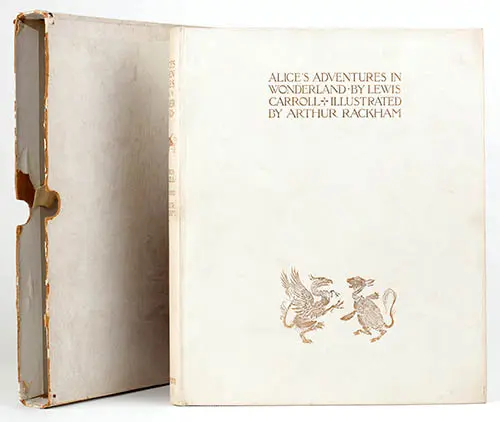
Rackham’s illustrative genius extended to every facet of the book’s design. The influence of Art Nouveau is unmistakable, visible in the sinuous, organic lines that define his figures and the intricate, curling branches of his forest scenes . His grotesques—the grinning Cheshire Cat, the pompous caterpillar, the frantic White Rabbit—are drawn with a meticulous line that owes as much to the Northern European graphic tradition as it does to contemporary fashion, creating creatures that are at once whimsical and genuinely unsettling . The book was published in two formats: a lavish, large-paper deluxe edition of 1,130 copies bound in white buckram with gilt stamping, and a more widely available trade edition bound in olive-green cloth . Both formats included not only the plates but also numerous subtle black-and-white line drawings woven throughout the text, creating a seamless visual experience from cover to cover.
The publication was greeted with a critical firestorm. The Times gave a notably unfavorable review, accusing Rackham of derivative humor and a lack of true imaginative instinct, so wedded was the critic to Tenniel’s vision . Yet, this criticism was immediately met with public and critical pushback. The Daily Telegraph came to Rackham’s defense, praising his “inexhaustible imagination” and his ability to infuse the story with “uncanny, dreamlike mystery,” ultimately arguing that Carroll’s masterpiece could not have found a “less inspired interpreter” . This debate, played out in the pages of the leading newspapers, only cemented the book’s place in the public consciousness.
Today, the 1907 Rackham Alice is recognized as a landmark. It was a pivotal work for Rackham himself, arriving on the heels of his breakthrough success with Rip Van Winkle and Peter Pan in Kensington Gardens, solidifying his reputation as the leading decorative illustrator of the Edwardian period . More than that, it paved the way for a century of artistic reinterpretations of Carroll’s tale, proving that the world of Wonderland was vast enough to contain multiple, equally valid artistic visions . The limited editions are now highly sought-after treasures, prized for their beauty, their historical significance, and their status as the moment one of the world’s most beloved stories was reborn through the eyes of a true master.
For devotees of this edition, these companion works may enchant:
• Alice’s Advencures in Wonderland (1910), illustrated by Mabel Lucie Attwell – a notable cheerful Alice, in Attwell’s iconic style
• Alice’s Adventures Under Ground (1886) illustrated by Carroll – the author’s original version
• The Nursery “Alice” (1890) illustrated by John Tenniel – the first color adaptation
Other Arthur Rackham’s illustrated works available in our gallery: Rip Van Winkle, Tales of Mystery and Imagination, Book of Pictures, The Night Before Christmas, The Pied Piper of Hamelin, Midsummer’s Night Dream, Undine, Peter Pan in Kensington Garden, The Ingoldsby Legends, Grimm’s Fairy Tales.
Art Gallery: Arthur Rackham – Alice’s Adventures in Wonderland 1907