A Fairy Realm Reimagined: Arthur Rackham’s A Midsummer Night’s Dream
Limited Edition
There are certain works of literature that seem to invite illustration, and then there are those that demand it—where the visual imagination is so integral to the text that the two become inseparable. Shakespeare’s A Midsummer Night’s Dream is such a work, and Arthur Rackham’s 1908 edition stands as perhaps the most magnificent interpretation the play has ever received. This was the book that cemented Rackham’s reputation as the preeminent fairy artist of his age, a work of such imaginative power that it reshaped how generations of readers would envision the enchanted forest of Athens.
The collaboration was, in many ways, inevitable. Rackham had already established himself as the artist of the fairy realm with his 1905 Rip Van Winkle and his 1907 Alice’s Adventures in Wonderland. Yet A Midsummer Night’s Dream offered something different: Shakespeare’s wood near Athens was not merely a setting but a character in itself, a place where the boundaries between the human and the otherworldly dissolved in moonlight and mischief. Rackham’s sensibility—his ability to evoke both the whimsical and the eerie, the beautiful and the unsettling—was perfectly attuned to the play’s shifting moods.
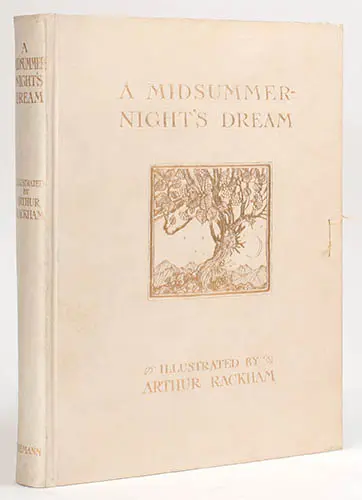
The 1908 edition was published by William Heinemann in London and Doubleday, Page & Company in New York. It was a lavish production, issued in a limited, signed edition of 1,000 copies bound in vellum and a trade edition that itself was exceptionally handsome. The volume contained forty color plates, each mounted on heavy paper and protected by captioned tissue guards, alongside numerous black-and-white illustrations and decorative elements woven throughout the text. It was, by any measure, a monumental undertaking—and it established a new standard for the illustrated gift book.
What makes Rackham’s A Midsummer Night’s Dream so extraordinary is its tonal range. The illustrations move effortlessly between the comic and the ethereal, the human and the fairy. The mechanicals—Bottom, Quince, Flute, and the rest—are rendered with a gentle, knowing humor, their rustic dignity and theatrical pretensions captured in every line. Yet when Rackham turns his attention to the fairy realm, the mood shifts dramatically. His Titania, Oberon, and Puck inhabit a world of gossamer wings and shadowed glades, rendered in a palette of deep greens, moonlit blues, and touches of luminous gold.
Rackham’s fairies are not the delicate, benign creatures of Victorian illustration. They are older, stranger, closer to the ambiguous spirits of folklore. Some are beautiful, some grotesque, and many exist in a space between—figures half-glimpsed in the twilight, their forms merging with the leaves and branches of the forest. This ambiguity is precisely what makes them so effective. Rackham understood that Shakespeare’s fairies are not merely whimsical but also dangerous, capable of both blessing and mischief, and his illustrations capture that duality with remarkable subtlety.
The color plates are among the most celebrated of Rackham’s career. The scene of Titania embracing Bottom with his ass’s head is rendered with a strange, dreamlike beauty—the fairy queen’s luminous figure contrasted with the comic yet oddly touching figure of the transformed weaver. Oberon’s confrontation with Puck, the lovers lost in the wood, the fairy procession through the moonlit glade—each plate is a masterpiece of composition and atmosphere.
The critical and commercial success of the edition was immediate and overwhelming. The limited edition sold out rapidly, and the trade edition went through multiple printings. Rackham’s Dream became one of the most celebrated illustrated books of the Edwardian era, and its influence extended beyond publishing into theater, design, and popular culture. For many, Rackham’s vision became the definitive visual interpretation of Shakespeare’s play—the way they would forever imagine the forest outside Athens.
Today, first editions of Rackham’s A Midsummer Night’s Dream remain among the most coveted of all illustrated books. The combination of Shakespeare’s timeless text, Rackham’s peerless artistry, and the exceptional production quality creates a volume that transcends its historical moment. It is a book that invites us into a world of moonlight and magic, where fairies dance and lovers wander and the boundaries between dream and reality dissolve. More than a century after its publication, Rackham’s Dream continues to cast its spell—a testament to the enduring power of an artist who, like Shakespeare himself, understood that the truest magic lies in the imagination.
Recommended for Collectors
- The Tempest (1908) illustrated by Edmund Dulac – Another magical Shakespeare play with exquisite illustrations
- Peter Pan in Kensington Gardens (1906) by J.M. Barrie, illustrated by Rackham – Featuring similar fairy imagery
- The Arthur Rackham Book of Pictures (1913) – Showcasing the artist’s range in fairy tale illustration
Other Arthur Rackham’s illustrated works available in our gallery: Rip Van Winkle, Tales of Mystery and Imagination, Book of Pictures, The Night Before Christmas, The Pied Piper of Hamelin, Undine, Alice’s Adventures in Wonderland, Peter Pan in Kensington Garden, The Ingoldsby Legends, Grimm’s Fairy Tales.
Art Gallery: Arthur Rackham – Midsummer’s Night Dream 1908
![Arthur Rackham - A Midsummer-Night's Dream [rackham-midsummer01] (art, illustrations)](https://www.nocloo.com/wp-content/plugins/justified-image-grid/timthumb.php?src=https%3A%2F%2Fwww.nocloo.com%2Fart%2Frackham-midsummer%2Frackham-midsummer01.jpg&h=280&q=90&f=.jpg)
![Arthur Rackham - A Midsummer-Night's Dream [rackham-midsummer02] (art, illustrations)](https://www.nocloo.com/wp-content/plugins/justified-image-grid/timthumb.php?src=https%3A%2F%2Fwww.nocloo.com%2Fart%2Frackham-midsummer%2Frackham-midsummer02.jpg&h=280&q=90&f=.jpg)
![Arthur Rackham - A Midsummer-Night's Dream [rackham-midsummer03] (art, illustrations)](https://www.nocloo.com/wp-content/plugins/justified-image-grid/timthumb.php?src=https%3A%2F%2Fwww.nocloo.com%2Fart%2Frackham-midsummer%2Frackham-midsummer03.jpg&h=280&q=90&f=.jpg)
![Arthur Rackham - A Midsummer-Night's Dream [rackham-midsummer04] (art, illustrations)](https://www.nocloo.com/wp-content/plugins/justified-image-grid/timthumb.php?src=https%3A%2F%2Fwww.nocloo.com%2Fart%2Frackham-midsummer%2Frackham-midsummer04.jpg&h=280&q=90&f=.jpg)
![Arthur Rackham - A Midsummer-Night's Dream [rackham-midsummer05] (art, illustrations)](https://www.nocloo.com/wp-content/plugins/justified-image-grid/timthumb.php?src=https%3A%2F%2Fwww.nocloo.com%2Fart%2Frackham-midsummer%2Frackham-midsummer05.jpg&h=280&q=90&f=.jpg)
![Arthur Rackham - A Midsummer-Night's Dream [rackham-midsummer06] (art, illustrations)](https://www.nocloo.com/wp-content/plugins/justified-image-grid/timthumb.php?src=https%3A%2F%2Fwww.nocloo.com%2Fart%2Frackham-midsummer%2Frackham-midsummer06.jpg&h=280&q=90&f=.jpg)
![Arthur Rackham - A Midsummer-Night's Dream [rackham-midsummer07] (art, illustrations)](https://www.nocloo.com/wp-content/plugins/justified-image-grid/timthumb.php?src=https%3A%2F%2Fwww.nocloo.com%2Fart%2Frackham-midsummer%2Frackham-midsummer07.jpg&h=280&q=90&f=.jpg)
![Arthur Rackham - A Midsummer-Night's Dream [rackham-midsummer08] (art, illustrations)](https://www.nocloo.com/wp-content/plugins/justified-image-grid/timthumb.php?src=https%3A%2F%2Fwww.nocloo.com%2Fart%2Frackham-midsummer%2Frackham-midsummer08.jpg&h=280&q=90&f=.jpg)
![Arthur Rackham - A Midsummer-Night's Dream [rackham-midsummer09] (art, illustrations)](https://www.nocloo.com/wp-content/plugins/justified-image-grid/timthumb.php?src=https%3A%2F%2Fwww.nocloo.com%2Fart%2Frackham-midsummer%2Frackham-midsummer09.jpg&h=280&q=90&f=.jpg)
![Arthur Rackham - A Midsummer-Night's Dream [rackham-midsummer10] (art, illustrations)](https://www.nocloo.com/wp-content/plugins/justified-image-grid/timthumb.php?src=https%3A%2F%2Fwww.nocloo.com%2Fart%2Frackham-midsummer%2Frackham-midsummer10.jpg&h=280&q=90&f=.jpg)
![Arthur Rackham - A Midsummer-Night's Dream [rackham-midsummer11] (art, illustrations)](https://www.nocloo.com/wp-content/plugins/justified-image-grid/timthumb.php?src=https%3A%2F%2Fwww.nocloo.com%2Fart%2Frackham-midsummer%2Frackham-midsummer11.jpg&h=280&q=90&f=.jpg)
![Arthur Rackham - A Midsummer-Night's Dream [rackham-midsummer12] (art, illustrations)](https://www.nocloo.com/wp-content/plugins/justified-image-grid/timthumb.php?src=https%3A%2F%2Fwww.nocloo.com%2Fart%2Frackham-midsummer%2Frackham-midsummer12.jpg&h=280&q=90&f=.jpg)
![Arthur Rackham - A Midsummer-Night's Dream [rackham-midsummer13] (art, illustrations)](https://www.nocloo.com/wp-content/plugins/justified-image-grid/timthumb.php?src=https%3A%2F%2Fwww.nocloo.com%2Fart%2Frackham-midsummer%2Frackham-midsummer13.jpg&h=280&q=90&f=.jpg)
![Arthur Rackham - A Midsummer-Night's Dream [rackham-midsummer14] (art, illustrations)](https://www.nocloo.com/wp-content/plugins/justified-image-grid/timthumb.php?src=https%3A%2F%2Fwww.nocloo.com%2Fart%2Frackham-midsummer%2Frackham-midsummer14.jpg&h=280&q=90&f=.jpg)
![Arthur Rackham - A Midsummer-Night's Dream [rackham-midsummer15] (art, illustrations)](https://www.nocloo.com/wp-content/plugins/justified-image-grid/timthumb.php?src=https%3A%2F%2Fwww.nocloo.com%2Fart%2Frackham-midsummer%2Frackham-midsummer15.jpg&h=280&q=90&f=.jpg)
![Arthur Rackham - A Midsummer-Night's Dream [rackham-midsummer16] (art, illustrations)](https://www.nocloo.com/wp-content/plugins/justified-image-grid/timthumb.php?src=https%3A%2F%2Fwww.nocloo.com%2Fart%2Frackham-midsummer%2Frackham-midsummer16.jpg&h=280&q=90&f=.jpg)
![Arthur Rackham - A Midsummer-Night's Dream [rackham-midsummer17] (art, illustrations)](https://www.nocloo.com/wp-content/plugins/justified-image-grid/timthumb.php?src=https%3A%2F%2Fwww.nocloo.com%2Fart%2Frackham-midsummer%2Frackham-midsummer17.jpg&h=280&q=90&f=.jpg)
![Arthur Rackham - A Midsummer-Night's Dream [rackham-midsummer18] (art, illustrations)](https://www.nocloo.com/wp-content/plugins/justified-image-grid/timthumb.php?src=https%3A%2F%2Fwww.nocloo.com%2Fart%2Frackham-midsummer%2Frackham-midsummer18.jpg&h=280&q=90&f=.jpg)
![Arthur Rackham - A Midsummer-Night's Dream [rackham-midsummer19] (art, illustrations)](https://www.nocloo.com/wp-content/plugins/justified-image-grid/timthumb.php?src=https%3A%2F%2Fwww.nocloo.com%2Fart%2Frackham-midsummer%2Frackham-midsummer19.jpg&h=280&q=90&f=.jpg)
![Arthur Rackham - A Midsummer-Night's Dream [rackham-midsummer20] (art, illustrations)](https://www.nocloo.com/wp-content/plugins/justified-image-grid/timthumb.php?src=https%3A%2F%2Fwww.nocloo.com%2Fart%2Frackham-midsummer%2Frackham-midsummer20.jpg&h=280&q=90&f=.jpg)
![Arthur Rackham - A Midsummer-Night's Dream [rackham-midsummer21] (art, illustrations)](https://www.nocloo.com/wp-content/plugins/justified-image-grid/timthumb.php?src=https%3A%2F%2Fwww.nocloo.com%2Fart%2Frackham-midsummer%2Frackham-midsummer21.jpg&h=280&q=90&f=.jpg)
![Arthur Rackham - A Midsummer-Night's Dream [rackham-midsummer22] (art, illustrations)](https://www.nocloo.com/wp-content/plugins/justified-image-grid/timthumb.php?src=https%3A%2F%2Fwww.nocloo.com%2Fart%2Frackham-midsummer%2Frackham-midsummer22.jpg&h=280&q=90&f=.jpg)
![Arthur Rackham - A Midsummer-Night's Dream [rackham-midsummer23] (art, illustrations)](https://www.nocloo.com/wp-content/plugins/justified-image-grid/timthumb.php?src=https%3A%2F%2Fwww.nocloo.com%2Fart%2Frackham-midsummer%2Frackham-midsummer23.jpg&h=280&q=90&f=.jpg)
![Arthur Rackham - A Midsummer-Night's Dream [rackham-midsummer24] (art, illustrations)](https://www.nocloo.com/wp-content/plugins/justified-image-grid/timthumb.php?src=https%3A%2F%2Fwww.nocloo.com%2Fart%2Frackham-midsummer%2Frackham-midsummer24.jpg&h=280&q=90&f=.jpg)
![Arthur Rackham - A Midsummer-Night's Dream [rackham-midsummer25] (art, illustrations)](https://www.nocloo.com/wp-content/plugins/justified-image-grid/timthumb.php?src=https%3A%2F%2Fwww.nocloo.com%2Fart%2Frackham-midsummer%2Frackham-midsummer25.jpg&h=280&q=90&f=.jpg)
![Arthur Rackham - A Midsummer-Night's Dream [rackham-midsummer26] (art, illustrations)](https://www.nocloo.com/wp-content/plugins/justified-image-grid/timthumb.php?src=https%3A%2F%2Fwww.nocloo.com%2Fart%2Frackham-midsummer%2Frackham-midsummer26.jpg&h=280&q=90&f=.jpg)
![Arthur Rackham - A Midsummer-Night's Dream [rackham-midsummer27] (art, illustrations)](https://www.nocloo.com/wp-content/plugins/justified-image-grid/timthumb.php?src=https%3A%2F%2Fwww.nocloo.com%2Fart%2Frackham-midsummer%2Frackham-midsummer27.jpg&h=280&q=90&f=.jpg)
![Arthur Rackham - A Midsummer-Night's Dream [rackham-midsummer28] (art, illustrations)](https://www.nocloo.com/wp-content/plugins/justified-image-grid/timthumb.php?src=https%3A%2F%2Fwww.nocloo.com%2Fart%2Frackham-midsummer%2Frackham-midsummer28.jpg&h=280&q=90&f=.jpg)
![Arthur Rackham - A Midsummer-Night's Dream [rackham-midsummer29] (art, illustrations)](https://www.nocloo.com/wp-content/plugins/justified-image-grid/timthumb.php?src=https%3A%2F%2Fwww.nocloo.com%2Fart%2Frackham-midsummer%2Frackham-midsummer29.jpg&h=280&q=90&f=.jpg)
![Arthur Rackham - A Midsummer-Night's Dream [rackham-midsummer30] (art, illustrations)](https://www.nocloo.com/wp-content/plugins/justified-image-grid/timthumb.php?src=https%3A%2F%2Fwww.nocloo.com%2Fart%2Frackham-midsummer%2Frackham-midsummer30.jpg&h=280&q=90&f=.jpg)
![Arthur Rackham - A Midsummer-Night's Dream [rackham-midsummer31] (art, illustrations)](https://www.nocloo.com/wp-content/plugins/justified-image-grid/timthumb.php?src=https%3A%2F%2Fwww.nocloo.com%2Fart%2Frackham-midsummer%2Frackham-midsummer31.jpg&h=280&q=90&f=.jpg)
![Arthur Rackham - A Midsummer-Night's Dream [rackham-midsummer32] (art, illustrations)](https://www.nocloo.com/wp-content/plugins/justified-image-grid/timthumb.php?src=https%3A%2F%2Fwww.nocloo.com%2Fart%2Frackham-midsummer%2Frackham-midsummer32.jpg&h=280&q=90&f=.jpg)
![Arthur Rackham - A Midsummer-Night's Dream [rackham-midsummer33] (art, illustrations)](https://www.nocloo.com/wp-content/plugins/justified-image-grid/timthumb.php?src=https%3A%2F%2Fwww.nocloo.com%2Fart%2Frackham-midsummer%2Frackham-midsummer33.jpg&h=280&q=90&f=.jpg)
![Arthur Rackham - A Midsummer-Night's Dream [rackham-midsummer34] (art, illustrations)](https://www.nocloo.com/wp-content/plugins/justified-image-grid/timthumb.php?src=https%3A%2F%2Fwww.nocloo.com%2Fart%2Frackham-midsummer%2Frackham-midsummer34.jpg&h=280&q=90&f=.jpg)
![Arthur Rackham - A Midsummer-Night's Dream [rackham-midsummer35] (art, illustrations)](https://www.nocloo.com/wp-content/plugins/justified-image-grid/timthumb.php?src=https%3A%2F%2Fwww.nocloo.com%2Fart%2Frackham-midsummer%2Frackham-midsummer35.jpg&h=280&q=90&f=.jpg)
![Arthur Rackham - A Midsummer-Night's Dream [rackham-midsummer36] (art, illustrations)](https://www.nocloo.com/wp-content/plugins/justified-image-grid/timthumb.php?src=https%3A%2F%2Fwww.nocloo.com%2Fart%2Frackham-midsummer%2Frackham-midsummer36.jpg&h=280&q=90&f=.jpg)
![Arthur Rackham - A Midsummer-Night's Dream [rackham-midsummer37] (art, illustrations)](https://www.nocloo.com/wp-content/plugins/justified-image-grid/timthumb.php?src=https%3A%2F%2Fwww.nocloo.com%2Fart%2Frackham-midsummer%2Frackham-midsummer37.jpg&h=280&q=90&f=.jpg)
![Arthur Rackham - A Midsummer-Night's Dream [rackham-midsummer38] (art, illustrations)](https://www.nocloo.com/wp-content/plugins/justified-image-grid/timthumb.php?src=https%3A%2F%2Fwww.nocloo.com%2Fart%2Frackham-midsummer%2Frackham-midsummer38.jpg&h=280&q=90&f=.jpg)
![Arthur Rackham - A Midsummer-Night's Dream [rackham-midsummer39] (art, illustrations)](https://www.nocloo.com/wp-content/plugins/justified-image-grid/timthumb.php?src=https%3A%2F%2Fwww.nocloo.com%2Fart%2Frackham-midsummer%2Frackham-midsummer39.jpg&h=280&q=90&f=.jpg)
![Arthur Rackham - A Midsummer-Night's Dream [rackham-midsummer40] (art, illustrations)](https://www.nocloo.com/wp-content/plugins/justified-image-grid/timthumb.php?src=https%3A%2F%2Fwww.nocloo.com%2Fart%2Frackham-midsummer%2Frackham-midsummer40.jpg&h=280&q=90&f=.jpg)