A Golden Age Masterpiece: Sterrett’s Tanglewood Tales
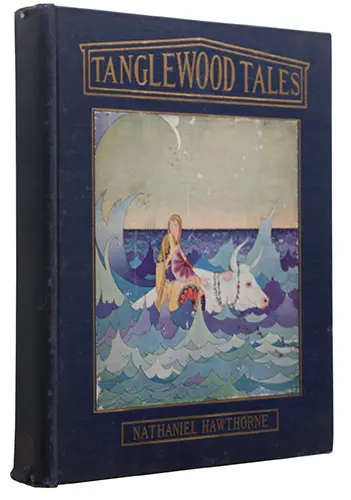
Nathaniel Hawthorne’s Tanglewood Tales for Girls and Boys, first published in 1853, found its most visually enchanting expression in the 1921 edition illustrated by Virginia Frances Sterrett. This volume, published by The Penn Publishing Company in Philadelphia, represents a singular moment in the history of illustrated children’s literature—a convergence of classic American storytelling with the tragically brief but brilliant career of one of the Golden Age’s most gifted artists.
The text itself stands as Hawthorne’s masterful retelling of six classic Greek myths, serving as a sequel to his earlier A Wonder-Book for Girls and Boys . Written with the psychological depth and moral insight for which Hawthorne is renowned, the collection presents the stories of “The Minotaur,” “The Pygmies,” “The Dragon’s Teeth,” “Circe’s Palace,” “The Pomegranate Seeds,” and “The Golden Fleece” . The framing narrative of A Wonder-Book—in which a college student named Eustace Bright recounts the tales to a group of children at Tanglewood—is largely abandoned in this sequel, allowing the myths to stand alone in their retold splendor.
Virginia Frances Sterrett’s illustrations elevate this edition to the status of a collector’s treasure. The volume features ten full-page color plates and numerous black-and-white drawings, including an illustrated frontispiece depicting Cadmus beholding a “female figure, wonderfully beautiful” . Sterrett’s artistic style is unmistakable: delicate yet powerful, her illustrations blend elements of Art Nouveau and Art Deco with clear influences from classical antiquity, rendered in light washes of color and sinuous black lines . This distinctive approach sets her work apart from contemporaries such as Arthur Rackham and Edmund Dulac, offering a vision of Greek mythology that is simultaneously ethereal and grounded.
The circumstances of Sterrett’s life lend her work a poignant dimension. Born in 1900, she completed only three illustrated books before her early death from tuberculosis at the age of thirty-one. Tanglewood Tales (1921) followed her debut Old French Fairy Tales (1920) and preceded Arabian Nights (1928), forming a small but luminous body of work that has ensured her lasting reputation. Her illustrations for Tanglewood Tales are often cited as among the finest of the Golden Age of Illustration—a period of unparalleled excellence in book art .
The first edition is a handsome production: bound in dark blue cloth with gilt stamping to the spine and front cover, featuring an illustrated pastedown on the front board and decorative illustrated endpapers . Measuring approximately 29 centimeters in height, the quarto volume contains 261 pages printed on quality paper, with the color plates spreading in throughout the text.
Today, Sterrett’s Tanglewood Tales is highly sought after by collectors of illustrated books, cherished not only for the beauty of its artwork but also as a testament to an artist whose career was tragically cut short. The images she created for Hawthorne’s myths—from Theseus confronting the Minotaur to Medea’s magical interventions—remain among the most evocative interpretations of these ancient tales, ensuring that both the stories and their illustrator are remembered and celebrated across generations .
Recommended for collectors:
- Old French Fairy Tales (1920), illustrated by Virginia Frances Sterrett – A gorgeously illustrated collection of fairy tales with delicate, romantic visuals.
- The Arabian Nights (1928), illustrated by Virginia Frances Sterrett – Richly atmospheric and intricately composed, it showcases her mature artistic style.
- A Wonder-Book for Girls and Boys (originally 1851) by Nathaniel Hawthorne – The companion volume to Tanglewood Tales, also reimagining classical myths.
Virginia Frances Sterrett – Tanglewood Tales
![Virginia Frances Sterrett - Tanglewood Tales [sterrett-tanglewood01] (art, illustrations)](https://www.nocloo.com/wp-content/plugins/justified-image-grid/timthumb.php?src=https%3A%2F%2Fwww.nocloo.com%2Fart%2Fsterrett-tanglewood%2Fsterrett-tanglewood01.jpg&h=280&q=90&f=.jpg "Virginia Frances Sterrett - Illustrations for Tanglewood Tales 1921")
![Virginia Frances Sterrett - Tanglewood Tales [sterrett-tanglewood02] (art, illustrations)](https://www.nocloo.com/wp-content/plugins/justified-image-grid/timthumb.php?src=https%3A%2F%2Fwww.nocloo.com%2Fart%2Fsterrett-tanglewood%2Fsterrett-tanglewood02.jpg&h=280&q=90&f=.jpg "Virginia Frances Sterrett - Illustrations for Tanglewood Tales 1921")
![Virginia Frances Sterrett - Tanglewood Tales [sterrett-tanglewood03] (art, illustrations)](https://www.nocloo.com/wp-content/plugins/justified-image-grid/timthumb.php?src=https%3A%2F%2Fwww.nocloo.com%2Fart%2Fsterrett-tanglewood%2Fsterrett-tanglewood03.jpg&h=280&q=90&f=.jpg "Virginia Frances Sterrett - Illustrations for Tanglewood Tales 1921")
![Virginia Frances Sterrett - Tanglewood Tales [sterrett-tanglewood04] (art, illustrations)](https://www.nocloo.com/wp-content/plugins/justified-image-grid/timthumb.php?src=https%3A%2F%2Fwww.nocloo.com%2Fart%2Fsterrett-tanglewood%2Fsterrett-tanglewood04.jpg&h=280&q=90&f=.jpg "Virginia Frances Sterrett - Illustrations for Tanglewood Tales 1921")
![Virginia Frances Sterrett - Tanglewood Tales [sterrett-tanglewood05] (art, illustrations)](https://www.nocloo.com/wp-content/plugins/justified-image-grid/timthumb.php?src=https%3A%2F%2Fwww.nocloo.com%2Fart%2Fsterrett-tanglewood%2Fsterrett-tanglewood05.jpg&h=280&q=90&f=.jpg "Virginia Frances Sterrett - Illustrations for Tanglewood Tales 1921")
![Virginia Frances Sterrett - Tanglewood Tales [sterrett-tanglewood06] (art, illustrations)](https://www.nocloo.com/wp-content/plugins/justified-image-grid/timthumb.php?src=https%3A%2F%2Fwww.nocloo.com%2Fart%2Fsterrett-tanglewood%2Fsterrett-tanglewood06.jpg&h=280&q=90&f=.jpg "Virginia Frances Sterrett - Illustrations for Tanglewood Tales 1921")
![Virginia Frances Sterrett - Tanglewood Tales [sterrett-tanglewood07] (art, illustrations)](https://www.nocloo.com/wp-content/plugins/justified-image-grid/timthumb.php?src=https%3A%2F%2Fwww.nocloo.com%2Fart%2Fsterrett-tanglewood%2Fsterrett-tanglewood07.jpg&h=280&q=90&f=.jpg "Virginia Frances Sterrett - Illustrations for Tanglewood Tales 1921")
![Virginia Frances Sterrett - Tanglewood Tales [sterrett-tanglewood08] (art, illustrations)](https://www.nocloo.com/wp-content/plugins/justified-image-grid/timthumb.php?src=https%3A%2F%2Fwww.nocloo.com%2Fart%2Fsterrett-tanglewood%2Fsterrett-tanglewood08.jpg&h=280&q=90&f=.jpg "Virginia Frances Sterrett - Illustrations for Tanglewood Tales 1921")
![Virginia Frances Sterrett - Tanglewood Tales [sterrett-tanglewood09] (art, illustrations)](https://www.nocloo.com/wp-content/plugins/justified-image-grid/timthumb.php?src=https%3A%2F%2Fwww.nocloo.com%2Fart%2Fsterrett-tanglewood%2Fsterrett-tanglewood09.jpg&h=280&q=90&f=.jpg "Virginia Frances Sterrett - Illustrations for Tanglewood Tales 1921")
![Virginia Frances Sterrett - Tanglewood Tales [sterrett-tanglewood10] (art, illustrations)](https://www.nocloo.com/wp-content/plugins/justified-image-grid/timthumb.php?src=https%3A%2F%2Fwww.nocloo.com%2Fart%2Fsterrett-tanglewood%2Fsterrett-tanglewood10.jpg&h=280&q=90&f=.jpg "Virginia Frances Sterrett - Illustrations for Tanglewood Tales 1921")