An Enchanted Vision: Virginia Frances Sterrett’s Arabian Nights
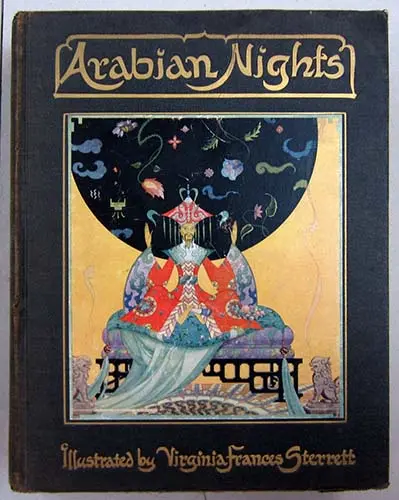
There are artists whose careers burn with a brief, brilliant intensity—whose work, created in the face of extraordinary adversity, carries a poignancy that deepens its beauty. Virginia Frances Sterrett’s 1928 edition of The Arabian Nights is such a work. It stands as one of the most exquisite illustrated books of the early twentieth century, a testament to a singular talent whose time was tragically short.
Virginia Frances Sterrett (1900–1931) was an American illustrator whose career, though brief, left an indelible mark on the Golden Age of Illustration. Born in Chicago, she showed artistic promise from an early age, but her path was shadowed by illness. She was diagnosed with tuberculosis in her teens, a condition that would plague her throughout her life. Yet despite frequent hospitalizations and periods of decline, she produced a body of work of extraordinary delicacy and imagination.
Sterrett’s first major commission came in 1920, when the Penn Publishing Company asked her to illustrate a new edition of Old French Fairy Tales. She was just nineteen years old. The resulting illustrations were hailed as masterpieces, drawing comparisons to the great Edmund Dulac. Yet it was her second major work—the 1928 edition of The Arabian Nights—that would become her magnum opus.
The 1928 Arabian Nights, published by Penn Publishing Company in Philadelphia, was a lavish production befitting its subject. The volume contained twelve full-page color plates, each mounted on heavy paper and protected by captioned tissue guards, alongside numerous black-and-white illustrations and decorative elements woven throughout the text. The binding was typically in pictorial cloth, with an illustration by Sterrett on the front cover that promised the treasures within.
What distinguishes Sterrett’s illustrations is their extraordinary delicacy and their fusion of artistic influences. Her style drew upon Persian miniature painting, Art Nouveau, and the Symbolist movement, yet it was unmistakably her own. Her palette is soft yet luminous—pale pinks, dusty blues, muted golds, and touches of deep crimson—creating an atmosphere of dreamlike enchantment. Her figures possess an elegant, elongated grace, their costumes rendered with meticulous attention to pattern and texture.
Sterrett’s scenes for The Arabian Nights are compositions of exquisite balance. She had a gift for filling the page without overwhelming it, her intricate decorative borders and detailed backgrounds creating worlds that invite sustained contemplation. Yet there is also a sense of intimacy to her work. Her characters—Scheherazade, Aladdin, Sinbad—are rendered with a quiet dignity, their emotions conveyed through subtle gestures and expressions rather than grand theatricality.
The poignancy of Sterrett’s achievement is heightened by the circumstances of its creation. She worked on the Arabian Nights illustrations while battling tuberculosis, often from her sickbed or during stays in sanitariums. The fragility that marked her health seems to have found its way into her art—not as weakness, but as a heightened sensitivity, a tenderness that infuses every brushstroke. One critic, comparing her to Dulac, noted that Sterrett’s work possessed “a softness, a gentle mystery” that was entirely her own.
The critical response to the 1928 Arabian Nights was enthusiastic. Reviewers praised Sterrett’s “rare gifts of color and design” and her ability to capture “the magic and mystery of the Orient.” The book sold well and quickly became a collector’s treasure. Yet Sterrett would not live to enjoy her success. She died in 1931 at the age of thirty, having completed only a handful of illustrated books.
Today, Virginia Frances Sterrett’s Arabian Nights stands as a jewel of the illustrated book tradition. First editions in good condition are increasingly scarce and highly prized by collectors. For those fortunate enough to own a copy, the book offers something rare: a vision of the Arabian Nights filtered through an artist whose own life was a testament to the power of imagination in the face of suffering.
In Sterrett’s illustrations, Scheherazade’s tales find a visual counterpart of extraordinary beauty—a world of magic carpets and flying horses, of sultans and princesses, rendered with a delicacy that seems to exist on the edge of vanishing. It is a fitting legacy for an artist whose time was brief, but whose vision endures. In the pages of her Arabian Nights, Virginia Frances Sterrett conjured a realm of enchantment that, like the tales themselves, continues to captivate more than a century later.
Recommended for Collectors
- Tanglewood Tales (1921) illustrated by Sterrett – Her earlier work on Nathaniel Hawthorne’s myths
- Old French Fairy Tales (1928) by Comtesse de Ségur, illustrated by Sterrett – Her final, unfinished masterpiece
- Stories from the Arabian Nights (1907) illustrated by Edmund Dulac – A complementary jewel-toned interpretation
Art Gallery: Virginia Frances Sterrett – The Arabian Nights 1928
![Virginia Frances Sterrett - Arabian Nights [sterrett-arabian01] (art, illustrations)](https://www.nocloo.com/wp-content/plugins/justified-image-grid/timthumb.php?src=https%3A%2F%2Fwww.nocloo.com%2Fart%2Fsterrett-arabian%2Fsterrett-arabian01.jpg&h=280&q=90&f=.jpg "Virginia Frances Sterrett - Illustrations for Arabian Nights 1928")
![Virginia Frances Sterrett - Arabian Nights [sterrett-arabian02] (art, illustrations)](https://www.nocloo.com/wp-content/plugins/justified-image-grid/timthumb.php?src=https%3A%2F%2Fwww.nocloo.com%2Fart%2Fsterrett-arabian%2Fsterrett-arabian02.jpg&h=280&q=90&f=.jpg "Virginia Frances Sterrett - Illustrations for Arabian Nights 1928")
![Virginia Frances Sterrett - Arabian Nights [sterrett-arabian03] (art, illustrations)](https://www.nocloo.com/wp-content/plugins/justified-image-grid/timthumb.php?src=https%3A%2F%2Fwww.nocloo.com%2Fart%2Fsterrett-arabian%2Fsterrett-arabian03.jpg&h=280&q=90&f=.jpg "Virginia Frances Sterrett - Illustrations for Arabian Nights 1928")
![Virginia Frances Sterrett - Arabian Nights [sterrett-arabian04] (art, illustrations)](https://www.nocloo.com/wp-content/plugins/justified-image-grid/timthumb.php?src=https%3A%2F%2Fwww.nocloo.com%2Fart%2Fsterrett-arabian%2Fsterrett-arabian04.jpg&h=280&q=90&f=.jpg "Virginia Frances Sterrett - Illustrations for Arabian Nights 1928")
![Virginia Frances Sterrett - Arabian Nights [sterrett-arabian05] (art, illustrations)](https://www.nocloo.com/wp-content/plugins/justified-image-grid/timthumb.php?src=https%3A%2F%2Fwww.nocloo.com%2Fart%2Fsterrett-arabian%2Fsterrett-arabian05.jpg&h=280&q=90&f=.jpg "Virginia Frances Sterrett - Illustrations for Arabian Nights 1928")
![Virginia Frances Sterrett - Arabian Nights [sterrett-arabian06] (art, illustrations)](https://www.nocloo.com/wp-content/plugins/justified-image-grid/timthumb.php?src=https%3A%2F%2Fwww.nocloo.com%2Fart%2Fsterrett-arabian%2Fsterrett-arabian06.jpg&h=280&q=90&f=.jpg "Virginia Frances Sterrett - Illustrations for Arabian Nights 1928")
![Virginia Frances Sterrett - Arabian Nights [sterrett-arabian07] (art, illustrations)](https://www.nocloo.com/wp-content/plugins/justified-image-grid/timthumb.php?src=https%3A%2F%2Fwww.nocloo.com%2Fart%2Fsterrett-arabian%2Fsterrett-arabian07.jpg&h=280&q=90&f=.jpg "Virginia Frances Sterrett - Illustrations for Arabian Nights 1928")
![Virginia Frances Sterrett - Arabian Nights [sterrett-arabian08] (art, illustrations)](https://www.nocloo.com/wp-content/plugins/justified-image-grid/timthumb.php?src=https%3A%2F%2Fwww.nocloo.com%2Fart%2Fsterrett-arabian%2Fsterrett-arabian08.jpg&h=280&q=90&f=.jpg "Virginia Frances Sterrett - Illustrations for Arabian Nights 1928")
![Virginia Frances Sterrett - Arabian Nights [sterrett-arabian09] (art, illustrations)](https://www.nocloo.com/wp-content/plugins/justified-image-grid/timthumb.php?src=https%3A%2F%2Fwww.nocloo.com%2Fart%2Fsterrett-arabian%2Fsterrett-arabian09.jpg&h=280&q=90&f=.jpg "Virginia Frances Sterrett - Illustrations for Arabian Nights 1928")
![Virginia Frances Sterrett - Arabian Nights [sterrett-arabian10] (art, illustrations)](https://www.nocloo.com/wp-content/plugins/justified-image-grid/timthumb.php?src=https%3A%2F%2Fwww.nocloo.com%2Fart%2Fsterrett-arabian%2Fsterrett-arabian10.jpg&h=280&q=90&f=.jpg "Virginia Frances Sterrett - Illustrations for Arabian Nights 1928")
![Virginia Frances Sterrett - Arabian Nights [sterrett-arabian11] (art, illustrations)](https://www.nocloo.com/wp-content/plugins/justified-image-grid/timthumb.php?src=https%3A%2F%2Fwww.nocloo.com%2Fart%2Fsterrett-arabian%2Fsterrett-arabian11.jpg&h=280&q=90&f=.jpg "Virginia Frances Sterrett - Illustrations for Arabian Nights 1928")
![Virginia Frances Sterrett - Arabian Nights [sterrett-arabian12] (art, illustrations)](https://www.nocloo.com/wp-content/plugins/justified-image-grid/timthumb.php?src=https%3A%2F%2Fwww.nocloo.com%2Fart%2Fsterrett-arabian%2Fsterrett-arabian12.jpg&h=280&q=90&f=.jpg "Virginia Frances Sterrett - Illustrations for Arabian Nights 1928")
![Virginia Frances Sterrett - Arabian Nights [sterrett-arabian13] (art, illustrations)](https://www.nocloo.com/wp-content/plugins/justified-image-grid/timthumb.php?src=https%3A%2F%2Fwww.nocloo.com%2Fart%2Fsterrett-arabian%2Fsterrett-arabian13.jpg&h=280&q=90&f=.jpg "Virginia Frances Sterrett - Illustrations for Arabian Nights 1928")
![Virginia Frances Sterrett - Arabian Nights [sterrett-arabian14] (art, illustrations)](https://www.nocloo.com/wp-content/plugins/justified-image-grid/timthumb.php?src=https%3A%2F%2Fwww.nocloo.com%2Fart%2Fsterrett-arabian%2Fsterrett-arabian14.jpg&h=280&q=90&f=.jpg "Virginia Frances Sterrett - Illustrations for Arabian Nights 1928")
![Virginia Frances Sterrett - Arabian Nights [sterrett-arabian15] (art, illustrations)](https://www.nocloo.com/wp-content/plugins/justified-image-grid/timthumb.php?src=https%3A%2F%2Fwww.nocloo.com%2Fart%2Fsterrett-arabian%2Fsterrett-arabian15.jpg&h=280&q=90&f=.jpg "Virginia Frances Sterrett - Illustrations for Arabian Nights 1928")
![Virginia Frances Sterrett - Arabian Nights [sterrett-arabian16] (art, illustrations)](https://www.nocloo.com/wp-content/plugins/justified-image-grid/timthumb.php?src=https%3A%2F%2Fwww.nocloo.com%2Fart%2Fsterrett-arabian%2Fsterrett-arabian16.jpg&h=280&q=90&f=.jpg "Virginia Frances Sterrett - Illustrations for Arabian Nights 1928")