Ruskin’s Moral Tale Realized: Rackham’s The King of the Golden River
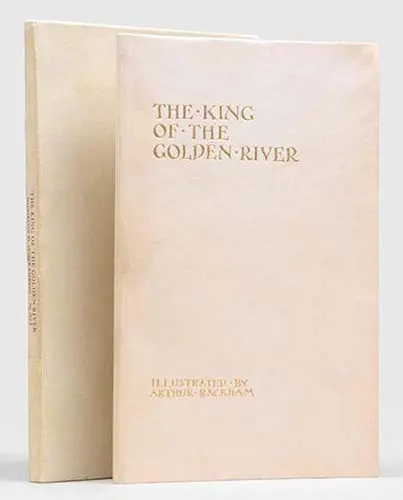
Arthur Rackham’s illustrated edition of John Ruskin’s The King of the Golden River stands as a distinctive and cherished work in the artist’s celebrated career. Published in 1932 by George G. Harrap & Co. in London, this volume appeared late in Rackham’s life—just seven years before his death—yet it demonstrates the full maturity of his artistic powers and his enduring affinity for the realms of fairy tale and moral allegory.
The Tale and Its Significance
The King of the Golden River, subtitled A Legend of Styria, holds a unique place in literary history as the only fairy tale ever written by the great Victorian art critic and social thinker John Ruskin. Composed in 1841 when Ruskin was just twenty-two years old, the story was written for Euphemia “Effie” Gray, the young woman who would later become his wife. The tale remained unpublished until 1851, when it appeared as a gift book illustrated by Richard Doyle. Its enduring popularity established it as a classic of Victorian children’s literature.
The narrative unfolds as a moral fable in the tradition of the Brothers Grimm. Two wealthy but cruel brothers, Hans and Schwartz, inherit their late father’s property and treat their younger brother Gluck with contempt. When the South-West Wind, personified as a mysterious old man, arrives at their door seeking shelter, the brothers drive him away with cruelty. In punishment, their farm is destroyed, and their property transformed into a barren wilderness. The brothers set out to find the source of the Golden River, which legend holds will turn to gold any man who throws three drops of holy water into its current. Their greed leads to their undoing, while Gluck, through kindness and selflessness, succeeds where his brothers failed and restores prosperity to the valley.
Rackham’s Visual Interpretation
Rackham’s contribution to the 1932 edition comprises four full-page color plates, tipped onto gray paper and protected by captioned tissue guards, alongside numerous pen-and-ink drawings dispersed throughout the text. Though modest in the number of color illustrations compared to his grander productions such as The Ingoldsby Legends or The Arthur Rackham Fairy Book, the plates reveal Rackham’s mature style at its most refined.
The frontispiece depicts the dramatic moment when Gluck, having journeyed to the source of the Golden River, prepares to cast the three drops of water that will fulfill the prophecy. The landscape is rendered with Rackham’s characteristic attention to atmosphere—craggy peaks shrouded in mist, the river flowing through a rocky gorge, the diminutive figure of Gluck standing at the threshold of his trial. The South-West Wind appears as a formidable old man with swirling robes, his form suggesting the elemental forces of nature that Ruskin so admired.
The pen-and-ink drawings scattered throughout demonstrate Rackham’s extraordinary facility with line. These smaller illustrations capture the tale’s moments of humor and pathos with equal skill—the cruel brothers counting their gold, Gluck tending to his humble garden, the transformation of the brothers into black stones upon the mountainside. Each drawing extends the visual narrative, creating a seamless integration of image and text.
Production and Legacy
The first edition reflects the high production values associated with Harrap’s deluxe illustrated volumes of the period. The trade edition was bound in green cloth with gilt stamping to the spine and front cover, while a limited edition of 250 copies was signed by Rackham and issued on larger paper with the plates mounted on art paper and bound in vellum.
The King of the Golden River holds a special place in Rackham’s bibliography as one of his final illustrated works, a testament to his lifelong engagement with the fairy tale tradition. Together, Ruskin’s moral fable and Rackham’s masterful images create a volume of enduring beauty—a fitting collaboration between two artists who shared a profound appreciation for the power of imagination to illuminate the human heart.
Recommended for collectors:
- Undine (1909), illustrated by Arthur Rackham – A water spirit’s tragic romance, filled with Rackham’s mystical undersea imagery.
- The Pied Piper of Hamelin (1934), illustrated by Arthur Rackham – A darkly whimsical take on the folk tale, showcasing Rackham’s flair for drama.
- The Water-Babies (1909), illustrated by Warwick Goble – Another Victorian moral tale with stunning visual interpretations of the fantastical.
Arthur Rackham – King of the Golden River
![Arthur Rackham - The King of the Golden River [rackham-golden01] (art, illustrations)](https://www.nocloo.com/wp-content/plugins/justified-image-grid/timthumb.php?src=https%3A%2F%2Fwww.nocloo.com%2Fart%2Frackham-golden%2Frackham-golden01.jpg&h=280&q=90&f=.jpg "Arthur Rackham - Illustrations for King of the Golden River 1932")
![Arthur Rackham - The King of the Golden River [rackham-golden02] (art, illustrations)](https://www.nocloo.com/wp-content/plugins/justified-image-grid/timthumb.php?src=https%3A%2F%2Fwww.nocloo.com%2Fart%2Frackham-golden%2Frackham-golden02.jpg&h=280&q=90&f=.jpg "Arthur Rackham - Illustrations for King of the Golden River 1932")
![Arthur Rackham - The King of the Golden River [rackham-golden03] (art, illustrations)](https://www.nocloo.com/wp-content/plugins/justified-image-grid/timthumb.php?src=https%3A%2F%2Fwww.nocloo.com%2Fart%2Frackham-golden%2Frackham-golden03.jpg&h=280&q=90&f=.jpg "Arthur Rackham - Illustrations for King of the Golden River 1932")
![Arthur Rackham - The King of the Golden River [rackham-golden04] (art, illustrations)](https://www.nocloo.com/wp-content/plugins/justified-image-grid/timthumb.php?src=https%3A%2F%2Fwww.nocloo.com%2Fart%2Frackham-golden%2Frackham-golden04.jpg&h=280&q=90&f=.jpg "Arthur Rackham - Illustrations for King of the Golden River 1932")