A Tale of Shadows: Arthur Rackham’s The Pied Piper of Hamelin
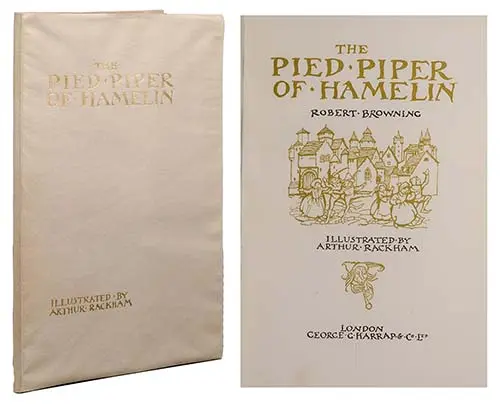
There are stories that linger in the imagination not because of their happy endings, but because of their mysteries—the questions they leave unanswered, the shadows they cast. Robert Browning’s The Pied Piper of Hamelin is such a tale, and Arthur Rackham’s 1914 edition stands as one of the most haunting and beautiful interpretations ever created. It is a work that captures not only the whimsy of the story but its darkness, its ambiguity, and its profound sense of loss.
Arthur Rackham (1867–1939) was at the height of his powers when he turned his attention to Browning’s classic poem. Already celebrated for his editions of Rip Van Winkle, Alice in Wonderland, and A Midsummer Night’s Dream, he had established himself as the preeminent illustrator of the Edwardian era. His style—characterized by delicate line work, muted watercolors, and a deep sensitivity to atmosphere—was perfectly suited to a tale that moves from brightly colored medieval pageantry to the eerie silence of a mountain cave.
The 1934 edition, published by George G. Harrap & Co. in London, was a lavish production. The volume contained four color plates, alongside numerous black-and-white illustrations and decorative elements woven throughout the text. The binding was in cloth with gilt stamping, and the book was issued in both trade and limited, signed editions—the latter bound in vellum and highly prized by collectors.
What distinguishes Rackham’s Pied Piper is its tonal range. The early illustrations capture the bustling life of medieval Hamelin with warmth and humor. Rats swarm through the streets in compositions of controlled chaos; the befuddled mayor and his councilors scheme and fret; children play in the market square. Rackham’s palette here is rich and varied—deep reds, warm browns, touches of gold that evoke the prosperity and complacency of the town.
Yet as the story turns, so do the illustrations. The Piper’s first appearance is rendered with a subtle otherworldliness—his parti-colored coat rendered in patterns that seem to shift, his face both handsome and unsettling. When he leads the rats to their destruction in the Weser River, the scene is one of dark enchantment: the creatures pour from windows and doors, flowing toward the water like a living tide, the Piper’s pipe the only constant in the swirling chaos.
But it is the final sequence—the Piper’s revenge—that reveals Rackham’s genius most fully. The illustrations depicting the children’s procession through the mountain are among the most haunting in all of Rackham’s work. The Piper leads, his figure silhouetted against a landscape of shadowed hills and pale moonlight. The children follow in a winding line, their faces rendered with a strange mixture of joy and trance. One girl looks back over her shoulder at the viewer, her expression unreadable. The colors fade to muted grays and blues, the world of Hamelin receding behind the viewer.
The final image—the lame boy, left behind, standing alone at the gate—is a masterwork of emotional restraint. The boy’s crutch, the closed mountain, the distant parents silhouetted against the sunset—Rackham captures the story’s unresolved sorrow without sentimentality. It is an ending that offers no comfort, only the recognition of loss.
The critical reception of Rackham’s Pied Piper was enthusiastic. Reviewers praised his ability to capture “the spirit of old Germany” and his “wonderful sense of the grotesque and the beautiful.” The book sold well and has remained in print in various forms ever since. For collectors, the limited edition remains one of the most coveted of all Rackham’s works.
Today, Rackham’s Pied Piper stands as a monument of the illustrated book tradition. It reminds us that the greatest illustrators do not merely decorate stories but interpret them—finding in familiar tales new depths of meaning, new shades of emotion. In Rackham’s hands, Browning’s poem becomes something more: a meditation on promises broken, on the cost of greed, and on the mysteries that lie just beyond the edge of our world, waiting for a piper to call us home. And always, in the shadows, children follow.
Recommended for Collectors
- A Midsummer-Night’s Dream (1908) illustrated by Rackham – For his iconic Shakespearean fantasy work
- Goblin Market (1933) by Christina Rossetti, illustrated by Rackham – A similarly eerie poetic tale
- The Ratcatcher (1982) illustrated by Drahos Zak – A modern, darker take on the Pied Piper legend
Other Arthur Rackham’s illustrated books available in our gallery: Rip Van Winkle, Tales of Mystery and Imagination, Book of Pictures, The Night Before Christmas, Midsummer’s Night Dream, Undine, Alice’s Adventures in Wonderland, Peter Pan in Kensington Garden, The Ingoldsby Legends, Grimm’s Fairy Tales.
Art Gallery: Arthur Rackham – The Pied Piper of Hamelin 1934
![Arthur Rackham - The Pied Piper of Hamelin [rackham-hamelin01] (art, illustrations)](https://www.nocloo.com/wp-content/plugins/justified-image-grid/timthumb.php?src=https%3A%2F%2Fwww.nocloo.com%2Fart%2Frackham-hamelin%2Frackham-hamelin01.jpg&h=280&q=90&f=.jpg)
![Arthur Rackham - The Pied Piper of Hamelin [rackham-hamelin02] (art, illustrations)](https://www.nocloo.com/wp-content/plugins/justified-image-grid/timthumb.php?src=https%3A%2F%2Fwww.nocloo.com%2Fart%2Frackham-hamelin%2Frackham-hamelin02.jpg&h=280&q=90&f=.jpg)
![Arthur Rackham - The Pied Piper of Hamelin [rackham-hamelin03] (art, illustrations)](https://www.nocloo.com/wp-content/plugins/justified-image-grid/timthumb.php?src=https%3A%2F%2Fwww.nocloo.com%2Fart%2Frackham-hamelin%2Frackham-hamelin03.jpg&h=280&q=90&f=.jpg)
![Arthur Rackham - The Pied Piper of Hamelin [rackham-hamelin04] (art, illustrations)](https://www.nocloo.com/wp-content/plugins/justified-image-grid/timthumb.php?src=https%3A%2F%2Fwww.nocloo.com%2Fart%2Frackham-hamelin%2Frackham-hamelin04.jpg&h=280&q=90&f=.jpg)