The Water Spirit’s Lament: Arthur Rackham’s Undine
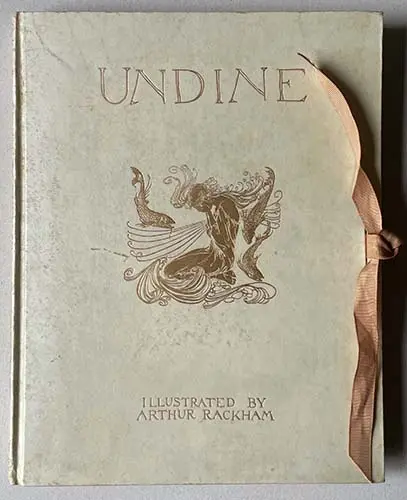
In the long and luminous career of Arthur Rackham, certain books stand as milestones—works where the artist’s vision achieved something beyond mere illustration, rising instead to a profound symbiosis with the text. His 1909 edition of Undine is one such book. This collaboration with the German author Friedrich de la Motte Fouqué, translated into English by W. L. Courtney, represents Rackham at the height of his powers: a master of mood, a conjurer of melancholy beauty, and an artist unafraid to explore the darker currents that flow beneath the surface of fairy tale.
Undine tells the story of a water spirit who gains a human soul through marriage to a mortal knight, only to face betrayal, tragedy, and the inexorable demands of the elemental world from which she came. It is a tale of love and loss, of the tension between the spiritual and the physical, and of the price paid for crossing boundaries. First published in 1811, Fouqué’s novella had already inspired composers, poets, and artists across Europe. Yet Rackham’s interpretation would become the definitive visual rendering of this haunting romance.
The 1909 edition was published by William Heinemann in London and Doubleday, Page & Company in New York. It was a lavish production, issued in a limited, signed edition of 1,000 copies for the United States and a similar number for the United Kingdom, alongside a trade edition that itself was exceptionally handsome. The volume contained fifteen color plates, each mounted on heavy paper and protected by captioned tissue guards, alongside numerous black-and-white illustrations woven throughout the text. The plates represent some of the most exquisite watercolors Rackham ever produced.
What distinguishes Rackham’s Undine is its tonal range and emotional depth. His palette moves fluidly between the ethereal and the somber. The early scenes of Undine’s life in the fisherman’s hut are bathed in warm, golden light—a domestic warmth that contrasts sharply with the cold, watery blues and greens that dominate her elemental existence. The illustrations depicting the water spirits in their natural habitat possess an otherworldly luminosity, figures half-glimpsed through veils of spray and shadow.
Yet it is in the darker passages that Rackham’s genius truly asserts itself. The knight Huldbrand’s betrayal, Undine’s return to the water, the appearance of the spectral uncle Kühleborn—these moments are rendered with a Gothic intensity that few illustrators of the period could match. Rackham understood that Undine is not merely a fairy tale but a tragedy, and his illustrations carry the weight of that understanding. The faces of his characters convey complex emotions: Undine’s longing, Huldbrand’s conflicted desire, the implacable justice of the elemental world.
The physical production of the book matched the ambition of its art. The large quarto format allowed Rackham’s illustrations to command the page, while the careful printing ensured that the subtle gradations of his watercolors were faithfully reproduced. The limited edition, bound in white buckram with gilt stamping, remains one of the most sought-after of all Rackham’s works—a testament to the enduring appeal of this particular collaboration.
Critical reception at the time was enthusiastic, and the book quickly sold out. For many collectors and critics, Undine represents Rackham at his most sophisticated—a work that transcends the category of children’s illustration and enters the realm of fine art. The influence of the book extended beyond publishing; Rackham’s images for Undine would later inspire productions of the opera based on the tale, confirming the visual power of his interpretations.
Today, Undine stands as one of the jewels of Rackham’s bibliography. Its illustrations continue to captivate, their colors as fresh and their emotional resonance as powerful as when they first appeared. In the story of a water spirit who longs for a soul, Rackham found a subject perfectly suited to his gifts—a tale of longing, transformation, and the beauty that exists at the boundaries of the human and the otherworldly. More than a century after its publication, it remains a masterpiece of the illustrated book, a work that invites us to dive beneath the surface and discover, in the depths of Rackham’s vision, a world of enduring enchantment.
Recommended for Collectors
- The Rhinegold and the Valkyrie (1910) – Rackham’s illustrations for Wagner’s opera, sharing Undine’s mythic Romanticism
- The Water-Babies (1915) by Charles Kingsley, illustrated by Warwick Goble – Another aquatic fairy tale with ethereal art
Other Arthur Rackham’s illustrated works available in our gallery: Rip Van Winkle, Tales of Mystery and Imagination, Book of Pictures, The Night Before Christmas, The Pied Piper of Hamelin, Midsummer’s Night Dream, Alice’s Adventures in Wonderland, Peter Pan in Kensington Garden, The Ingoldsby Legends, Grimm’s Fairy Tales.
Art Gallery: Arthur Rackham – Undine 1909
![Arthur Rackham - Undine [rackham-undine01] (art, illustrations)](https://www.nocloo.com/wp-content/plugins/justified-image-grid/timthumb.php?src=https%3A%2F%2Fwww.nocloo.com%2Fart%2Frackham-undine%2Frackham-undine01.jpg&h=280&q=90&f=.jpg)
![Arthur Rackham - Undine [rackham-undine02] (art, illustrations)](https://www.nocloo.com/wp-content/plugins/justified-image-grid/timthumb.php?src=https%3A%2F%2Fwww.nocloo.com%2Fart%2Frackham-undine%2Frackham-undine02.jpg&h=280&q=90&f=.jpg)
![Arthur Rackham - Undine [rackham-undine03] (art, illustrations)](https://www.nocloo.com/wp-content/plugins/justified-image-grid/timthumb.php?src=https%3A%2F%2Fwww.nocloo.com%2Fart%2Frackham-undine%2Frackham-undine03.jpg&h=280&q=90&f=.jpg)
![Arthur Rackham - Undine [rackham-undine04] (art, illustrations)](https://www.nocloo.com/wp-content/plugins/justified-image-grid/timthumb.php?src=https%3A%2F%2Fwww.nocloo.com%2Fart%2Frackham-undine%2Frackham-undine04.jpg&h=280&q=90&f=.jpg)
![Arthur Rackham - Undine [rackham-undine05] (art, illustrations)](https://www.nocloo.com/wp-content/plugins/justified-image-grid/timthumb.php?src=https%3A%2F%2Fwww.nocloo.com%2Fart%2Frackham-undine%2Frackham-undine05.jpg&h=280&q=90&f=.jpg)
![Arthur Rackham - Undine [rackham-undine06] (art, illustrations)](https://www.nocloo.com/wp-content/plugins/justified-image-grid/timthumb.php?src=https%3A%2F%2Fwww.nocloo.com%2Fart%2Frackham-undine%2Frackham-undine06.jpg&h=280&q=90&f=.jpg)
![Arthur Rackham - Undine [rackham-undine07] (art, illustrations)](https://www.nocloo.com/wp-content/plugins/justified-image-grid/timthumb.php?src=https%3A%2F%2Fwww.nocloo.com%2Fart%2Frackham-undine%2Frackham-undine07.jpg&h=280&q=90&f=.jpg)
![Arthur Rackham - Undine [rackham-undine08] (art, illustrations)](https://www.nocloo.com/wp-content/plugins/justified-image-grid/timthumb.php?src=https%3A%2F%2Fwww.nocloo.com%2Fart%2Frackham-undine%2Frackham-undine08.jpg&h=280&q=90&f=.jpg)
![Arthur Rackham - Undine [rackham-undine09] (art, illustrations)](https://www.nocloo.com/wp-content/plugins/justified-image-grid/timthumb.php?src=https%3A%2F%2Fwww.nocloo.com%2Fart%2Frackham-undine%2Frackham-undine09.jpg&h=280&q=90&f=.jpg)
![Arthur Rackham - Undine [rackham-undine10] (art, illustrations)](https://www.nocloo.com/wp-content/plugins/justified-image-grid/timthumb.php?src=https%3A%2F%2Fwww.nocloo.com%2Fart%2Frackham-undine%2Frackham-undine10.jpg&h=280&q=90&f=.jpg)
![Arthur Rackham - Undine [rackham-undine11] (art, illustrations)](https://www.nocloo.com/wp-content/plugins/justified-image-grid/timthumb.php?src=https%3A%2F%2Fwww.nocloo.com%2Fart%2Frackham-undine%2Frackham-undine11.jpg&h=280&q=90&f=.jpg)
![Arthur Rackham - Undine [rackham-undine12] (art, illustrations)](https://www.nocloo.com/wp-content/plugins/justified-image-grid/timthumb.php?src=https%3A%2F%2Fwww.nocloo.com%2Fart%2Frackham-undine%2Frackham-undine12.jpg&h=280&q=90&f=.jpg)
![Arthur Rackham - Undine [rackham-undine13] (art, illustrations)](https://www.nocloo.com/wp-content/plugins/justified-image-grid/timthumb.php?src=https%3A%2F%2Fwww.nocloo.com%2Fart%2Frackham-undine%2Frackham-undine13.jpg&h=280&q=90&f=.jpg)
![Arthur Rackham - Undine [rackham-undine14] (art, illustrations)](https://www.nocloo.com/wp-content/plugins/justified-image-grid/timthumb.php?src=https%3A%2F%2Fwww.nocloo.com%2Fart%2Frackham-undine%2Frackham-undine14.jpg&h=280&q=90&f=.jpg)
![Arthur Rackham - Undine [rackham-undine15] (art, illustrations)](https://www.nocloo.com/wp-content/plugins/justified-image-grid/timthumb.php?src=https%3A%2F%2Fwww.nocloo.com%2Fart%2Frackham-undine%2Frackham-undine15.jpg&h=280&q=90&f=.jpg)