A Legacy Unveiled: Rackham’s Book of Pictures
Limited Edition
In the spring of 1913, Arthur Rackham was at the absolute height of his powers. His illustrations for Rip Van Winkle, Peter Pan, Alice in Wonderland, and A Midsummer Night’s Dream had made him the most celebrated illustrator in the English-speaking world. Yet amidst the steady stream of commissions, there was one project he had longed to undertake for years: a book that would be entirely his own. Rackham’s Book of Pictures, published that year, was the realization of that dream—a collection of illustrations not commissioned for any particular text, but created freely, born purely of the artist’s imagination.
Arthur Rackham (1867–1939) had been toying with the idea for over a decade. He had collected sketches, watercolors, and preliminary drawings with the intention of one day shaping them into a cohesive volume. The result, when it finally appeared, was unlike anything he had previously published. Rackham’s Book of Pictures contained fifty-four color plates—each a complete work of art, unburdened by the need to illustrate a specific passage or satisfy a publisher’s brief.
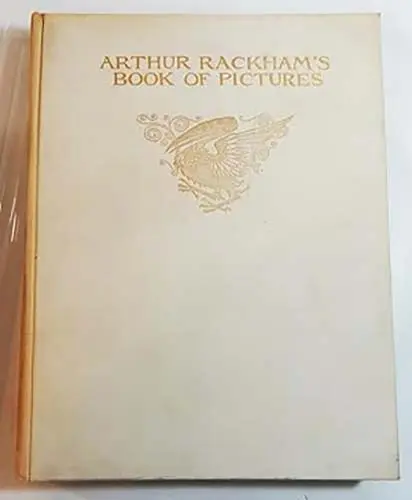
The book was published by William Heinemann in London and Doubleday, Page & Company in New York. It was a lavish production, issued in a limited, signed edition of 750 copies bound in vellum and a trade edition bound in cloth. The color plates were mounted on heavy paper and protected by captioned tissue guards, while the black-and-white illustrations were reproduced with the care and precision that had become the hallmark of Rackham’s publications.
The subjects of the illustrations range across the themes that had always captivated Rackham’s imagination: fairy folk and forest sprites, Gothic castles and enchanted forests, comic grotesques and ethereal maidens. Here is a gnome crouched beneath a toadstool, his face a masterpiece of wizened expression. There is a fairy queen attended by her diminutive court, rendered with the delicate line work that had become Rackham’s signature. A knight in armor pauses before a haunted wood; a witch stirs a cauldron beneath a gibbous moon; a dragon coils around a medieval tower.
Yet there is also a playful humor in many of these images that distinguishes them from Rackham’s more serious commissioned work. A group of frogs in waistcoats hold a woodland council. A gnome rides a snail through a garden of oversized flowers. A troll, rendered with grotesque charm, peers out from beneath a bridge. These illustrations reveal a lighter side of Rackham—an artist who delighted in the absurd, who could find humor in the fantastic without diminishing its wonder.
The critical response to Rackham’s Book of Pictures was enthusiastic. Reviewers praised the volume as a revelation of the artist’s range and imagination. For collectors, it offered something rare: a chance to own Rackham’s work in its purest form, unmediated by the demands of literary illustration.
Today, the book remains a treasure of the illustrated book tradition. First editions, especially the signed vellum copies, are among the most coveted of all Rackham collectibles. But its value lies not merely in its scarcity. Rackham’s Book of Pictures offers a window into the artist’s inner world—a place of enchantment, humor, and unbridled imagination.
In these pages, Rackham’s sprites and gnomes, his knights and dragons, his fairy queens and forest creatures, come together in a celebration of the fantastic. It is a book that reminds us why we return to Rackham again and again: because he saw, more clearly than most, that the world of the imagination is not an escape from reality but a deepening of it. In Rackham’s Book of Pictures, he left us a map to that world—a legacy of wonder that endures.
Recommended for Collectors
- The Ingoldsby Legends (1907), illustrated by Arthur Rackham – A mix of folklore and ghost stories with rich and spooky visuals.
- Rackham’s Color Illustrations for Wagner’s “Ring” (1910–1912) – For his mythic, dramatic side
- Undine (1909), illustrated by Arthur Rackham – A romantic fantasy tale with ethereal and melancholic illustrations.
- The Rhinegold & the Valkyrie (1910), illustrated by Arthur Rackham – Epic myth and Wagnerian drama with atmospheric, dramatic plates.
Other Rackham’s illustrated works available in our gallery: Rip Van Winkle, Tales of Mystery and Imagination, The Night Before Christmas, The Pied Piper of Hamelin, Midsummer’s Night Dream, Undine, Alice’s Adventures in Wonderland, Peter Pan in Kensington Garden, The Ingoldsby Legends, Grimm’s Fairy Tales.
Art Gallery: Arthur Rackham – Book of Pictures 1913
![Arthur Rackham - Arthur Rackham's Book of Pictures [rackham-pictures01] (art, illustrations)](https://www.nocloo.com/wp-content/plugins/justified-image-grid/timthumb.php?src=https%3A%2F%2Fwww.nocloo.com%2Fart%2Frackham-bookpictures%2Frackham-pictures01.jpg&h=280&q=90&f=.jpg)
![Arthur Rackham - Arthur Rackham's Book of Pictures [rackham-pictures02] (art, illustrations)](https://www.nocloo.com/wp-content/plugins/justified-image-grid/timthumb.php?src=https%3A%2F%2Fwww.nocloo.com%2Fart%2Frackham-bookpictures%2Frackham-pictures02.jpg&h=280&q=90&f=.jpg)
![Arthur Rackham - Arthur Rackham's Book of Pictures [rackham-pictures03] (art, illustrations)](https://www.nocloo.com/wp-content/plugins/justified-image-grid/timthumb.php?src=https%3A%2F%2Fwww.nocloo.com%2Fart%2Frackham-bookpictures%2Frackham-pictures03.jpg&h=280&q=90&f=.jpg)
![Arthur Rackham - Arthur Rackham's Book of Pictures [rackham-pictures04] (art, illustrations)](https://www.nocloo.com/wp-content/plugins/justified-image-grid/timthumb.php?src=https%3A%2F%2Fwww.nocloo.com%2Fart%2Frackham-bookpictures%2Frackham-pictures04.jpg&h=280&q=90&f=.jpg)
![Arthur Rackham - Arthur Rackham's Book of Pictures [rackham-pictures05] (art, illustrations)](https://www.nocloo.com/wp-content/plugins/justified-image-grid/timthumb.php?src=https%3A%2F%2Fwww.nocloo.com%2Fart%2Frackham-bookpictures%2Frackham-pictures05.jpg&h=280&q=90&f=.jpg)
![Arthur Rackham - Arthur Rackham's Book of Pictures [rackham-pictures06] (art, illustrations)](https://www.nocloo.com/wp-content/plugins/justified-image-grid/timthumb.php?src=https%3A%2F%2Fwww.nocloo.com%2Fart%2Frackham-bookpictures%2Frackham-pictures06.jpg&h=280&q=90&f=.jpg)
![Arthur Rackham - Arthur Rackham's Book of Pictures [rackham-pictures07] (art, illustrations)](https://www.nocloo.com/wp-content/plugins/justified-image-grid/timthumb.php?src=https%3A%2F%2Fwww.nocloo.com%2Fart%2Frackham-bookpictures%2Frackham-pictures07.jpg&h=280&q=90&f=.jpg)
![Arthur Rackham - Arthur Rackham's Book of Pictures [rackham-pictures08] (art, illustrations)](https://www.nocloo.com/wp-content/plugins/justified-image-grid/timthumb.php?src=https%3A%2F%2Fwww.nocloo.com%2Fart%2Frackham-bookpictures%2Frackham-pictures08.jpg&h=280&q=90&f=.jpg)
![Arthur Rackham - Arthur Rackham's Book of Pictures [rackham-pictures09] (art, illustrations)](https://www.nocloo.com/wp-content/plugins/justified-image-grid/timthumb.php?src=https%3A%2F%2Fwww.nocloo.com%2Fart%2Frackham-bookpictures%2Frackham-pictures09.jpg&h=280&q=90&f=.jpg)
![Arthur Rackham - Arthur Rackham's Book of Pictures [rackham-pictures10] (art, illustrations)](https://www.nocloo.com/wp-content/plugins/justified-image-grid/timthumb.php?src=https%3A%2F%2Fwww.nocloo.com%2Fart%2Frackham-bookpictures%2Frackham-pictures10.jpg&h=280&q=90&f=.jpg)
![Arthur Rackham - Arthur Rackham's Book of Pictures [rackham-pictures11] (art, illustrations)](https://www.nocloo.com/wp-content/plugins/justified-image-grid/timthumb.php?src=https%3A%2F%2Fwww.nocloo.com%2Fart%2Frackham-bookpictures%2Frackham-pictures11.jpg&h=280&q=90&f=.jpg)
![Arthur Rackham - Arthur Rackham's Book of Pictures [rackham-pictures12] (art, illustrations)](https://www.nocloo.com/wp-content/plugins/justified-image-grid/timthumb.php?src=https%3A%2F%2Fwww.nocloo.com%2Fart%2Frackham-bookpictures%2Frackham-pictures12.jpg&h=280&q=90&f=.jpg)
![Arthur Rackham - Arthur Rackham's Book of Pictures [rackham-pictures13] (art, illustrations)](https://www.nocloo.com/wp-content/plugins/justified-image-grid/timthumb.php?src=https%3A%2F%2Fwww.nocloo.com%2Fart%2Frackham-bookpictures%2Frackham-pictures13.jpg&h=280&q=90&f=.jpg)
![Arthur Rackham - Arthur Rackham's Book of Pictures [rackham-pictures14] (art, illustrations)](https://www.nocloo.com/wp-content/plugins/justified-image-grid/timthumb.php?src=https%3A%2F%2Fwww.nocloo.com%2Fart%2Frackham-bookpictures%2Frackham-pictures14.jpg&h=280&q=90&f=.jpg)
![Arthur Rackham - Arthur Rackham's Book of Pictures [rackham-pictures15] (art, illustrations)](https://www.nocloo.com/wp-content/plugins/justified-image-grid/timthumb.php?src=https%3A%2F%2Fwww.nocloo.com%2Fart%2Frackham-bookpictures%2Frackham-pictures15.jpg&h=280&q=90&f=.jpg)
![Arthur Rackham - Arthur Rackham's Book of Pictures [rackham-pictures16] (art, illustrations)](https://www.nocloo.com/wp-content/plugins/justified-image-grid/timthumb.php?src=https%3A%2F%2Fwww.nocloo.com%2Fart%2Frackham-bookpictures%2Frackham-pictures16.jpg&h=280&q=90&f=.jpg)
![Arthur Rackham - Arthur Rackham's Book of Pictures [rackham-pictures17] (art, illustrations)](https://www.nocloo.com/wp-content/plugins/justified-image-grid/timthumb.php?src=https%3A%2F%2Fwww.nocloo.com%2Fart%2Frackham-bookpictures%2Frackham-pictures17.jpg&h=280&q=90&f=.jpg)
![Arthur Rackham - Arthur Rackham's Book of Pictures [rackham-pictures18] (art, illustrations)](https://www.nocloo.com/wp-content/plugins/justified-image-grid/timthumb.php?src=https%3A%2F%2Fwww.nocloo.com%2Fart%2Frackham-bookpictures%2Frackham-pictures18.jpg&h=280&q=90&f=.jpg)
![Arthur Rackham - Arthur Rackham's Book of Pictures [rackham-pictures19] (art, illustrations)](https://www.nocloo.com/wp-content/plugins/justified-image-grid/timthumb.php?src=https%3A%2F%2Fwww.nocloo.com%2Fart%2Frackham-bookpictures%2Frackham-pictures19.jpg&h=280&q=90&f=.jpg)
![Arthur Rackham - Arthur Rackham's Book of Pictures [rackham-pictures20] (art, illustrations)](https://www.nocloo.com/wp-content/plugins/justified-image-grid/timthumb.php?src=https%3A%2F%2Fwww.nocloo.com%2Fart%2Frackham-bookpictures%2Frackham-pictures20.jpg&h=280&q=90&f=.jpg)
![Arthur Rackham - Arthur Rackham's Book of Pictures [rackham-pictures21] (art, illustrations)](https://www.nocloo.com/wp-content/plugins/justified-image-grid/timthumb.php?src=https%3A%2F%2Fwww.nocloo.com%2Fart%2Frackham-bookpictures%2Frackham-pictures21.jpg&h=280&q=90&f=.jpg)
![Arthur Rackham - Arthur Rackham's Book of Pictures [rackham-pictures22] (art, illustrations)](https://www.nocloo.com/wp-content/plugins/justified-image-grid/timthumb.php?src=https%3A%2F%2Fwww.nocloo.com%2Fart%2Frackham-bookpictures%2Frackham-pictures22.jpg&h=280&q=90&f=.jpg)
![Arthur Rackham - Arthur Rackham's Book of Pictures [rackham-pictures23] (art, illustrations)](https://www.nocloo.com/wp-content/plugins/justified-image-grid/timthumb.php?src=https%3A%2F%2Fwww.nocloo.com%2Fart%2Frackham-bookpictures%2Frackham-pictures23.jpg&h=280&q=90&f=.jpg)
![Arthur Rackham - Arthur Rackham's Book of Pictures [rackham-pictures24] (art, illustrations)](https://www.nocloo.com/wp-content/plugins/justified-image-grid/timthumb.php?src=https%3A%2F%2Fwww.nocloo.com%2Fart%2Frackham-bookpictures%2Frackham-pictures24.jpg&h=280&q=90&f=.jpg)
![Arthur Rackham - Arthur Rackham's Book of Pictures [rackham-pictures25] (art, illustrations)](https://www.nocloo.com/wp-content/plugins/justified-image-grid/timthumb.php?src=https%3A%2F%2Fwww.nocloo.com%2Fart%2Frackham-bookpictures%2Frackham-pictures25.jpg&h=280&q=90&f=.jpg)
![Arthur Rackham - Arthur Rackham's Book of Pictures [rackham-pictures26] (art, illustrations)](https://www.nocloo.com/wp-content/plugins/justified-image-grid/timthumb.php?src=https%3A%2F%2Fwww.nocloo.com%2Fart%2Frackham-bookpictures%2Frackham-pictures26.jpg&h=280&q=90&f=.jpg)
![Arthur Rackham - Arthur Rackham's Book of Pictures [rackham-pictures27] (art, illustrations)](https://www.nocloo.com/wp-content/plugins/justified-image-grid/timthumb.php?src=https%3A%2F%2Fwww.nocloo.com%2Fart%2Frackham-bookpictures%2Frackham-pictures27.jpg&h=280&q=90&f=.jpg)
![Arthur Rackham - Arthur Rackham's Book of Pictures [rackham-pictures28] (art, illustrations)](https://www.nocloo.com/wp-content/plugins/justified-image-grid/timthumb.php?src=https%3A%2F%2Fwww.nocloo.com%2Fart%2Frackham-bookpictures%2Frackham-pictures28.jpg&h=280&q=90&f=.jpg)
![Arthur Rackham - Arthur Rackham's Book of Pictures [rackham-pictures29] (art, illustrations)](https://www.nocloo.com/wp-content/plugins/justified-image-grid/timthumb.php?src=https%3A%2F%2Fwww.nocloo.com%2Fart%2Frackham-bookpictures%2Frackham-pictures29.jpg&h=280&q=90&f=.jpg)
![Arthur Rackham - Arthur Rackham's Book of Pictures [rackham-pictures30] (art, illustrations)](https://www.nocloo.com/wp-content/plugins/justified-image-grid/timthumb.php?src=https%3A%2F%2Fwww.nocloo.com%2Fart%2Frackham-bookpictures%2Frackham-pictures30.jpg&h=280&q=90&f=.jpg)
![Arthur Rackham - Arthur Rackham's Book of Pictures [rackham-pictures31] (art, illustrations)](https://www.nocloo.com/wp-content/plugins/justified-image-grid/timthumb.php?src=https%3A%2F%2Fwww.nocloo.com%2Fart%2Frackham-bookpictures%2Frackham-pictures31.jpg&h=280&q=90&f=.jpg)
![Arthur Rackham - Arthur Rackham's Book of Pictures [rackham-pictures32] (art, illustrations)](https://www.nocloo.com/wp-content/plugins/justified-image-grid/timthumb.php?src=https%3A%2F%2Fwww.nocloo.com%2Fart%2Frackham-bookpictures%2Frackham-pictures32.jpg&h=280&q=90&f=.jpg)
![Arthur Rackham - Arthur Rackham's Book of Pictures [rackham-pictures33] (art, illustrations)](https://www.nocloo.com/wp-content/plugins/justified-image-grid/timthumb.php?src=https%3A%2F%2Fwww.nocloo.com%2Fart%2Frackham-bookpictures%2Frackham-pictures33.jpg&h=280&q=90&f=.jpg)
![Arthur Rackham - Arthur Rackham's Book of Pictures [rackham-pictures34] (art, illustrations)](https://www.nocloo.com/wp-content/plugins/justified-image-grid/timthumb.php?src=https%3A%2F%2Fwww.nocloo.com%2Fart%2Frackham-bookpictures%2Frackham-pictures34.jpg&h=280&q=90&f=.jpg)
![Arthur Rackham - Arthur Rackham's Book of Pictures [rackham-pictures35] (art, illustrations)](https://www.nocloo.com/wp-content/plugins/justified-image-grid/timthumb.php?src=https%3A%2F%2Fwww.nocloo.com%2Fart%2Frackham-bookpictures%2Frackham-pictures35.jpg&h=280&q=90&f=.jpg)
![Arthur Rackham - Arthur Rackham's Book of Pictures [rackham-pictures36] (art, illustrations)](https://www.nocloo.com/wp-content/plugins/justified-image-grid/timthumb.php?src=https%3A%2F%2Fwww.nocloo.com%2Fart%2Frackham-bookpictures%2Frackham-pictures36.jpg&h=280&q=90&f=.jpg)
![Arthur Rackham - Arthur Rackham's Book of Pictures [rackham-pictures37] (art, illustrations)](https://www.nocloo.com/wp-content/plugins/justified-image-grid/timthumb.php?src=https%3A%2F%2Fwww.nocloo.com%2Fart%2Frackham-bookpictures%2Frackham-pictures37.jpg&h=280&q=90&f=.jpg)
![Arthur Rackham - Arthur Rackham's Book of Pictures [rackham-pictures38] (art, illustrations)](https://www.nocloo.com/wp-content/plugins/justified-image-grid/timthumb.php?src=https%3A%2F%2Fwww.nocloo.com%2Fart%2Frackham-bookpictures%2Frackham-pictures38.jpg&h=280&q=90&f=.jpg)
![Arthur Rackham - Arthur Rackham's Book of Pictures [rackham-pictures39] (art, illustrations)](https://www.nocloo.com/wp-content/plugins/justified-image-grid/timthumb.php?src=https%3A%2F%2Fwww.nocloo.com%2Fart%2Frackham-bookpictures%2Frackham-pictures39.jpg&h=280&q=90&f=.jpg)
![Arthur Rackham - Arthur Rackham's Book of Pictures [rackham-pictures40] (art, illustrations)](https://www.nocloo.com/wp-content/plugins/justified-image-grid/timthumb.php?src=https%3A%2F%2Fwww.nocloo.com%2Fart%2Frackham-bookpictures%2Frackham-pictures40.jpg&h=280&q=90&f=.jpg)
![Arthur Rackham - Arthur Rackham's Book of Pictures [rackham-pictures41] (art, illustrations)](https://www.nocloo.com/wp-content/plugins/justified-image-grid/timthumb.php?src=https%3A%2F%2Fwww.nocloo.com%2Fart%2Frackham-bookpictures%2Frackham-pictures41.jpg&h=280&q=90&f=.jpg)
![Arthur Rackham - Arthur Rackham's Book of Pictures [rackham-pictures42] (art, illustrations)](https://www.nocloo.com/wp-content/plugins/justified-image-grid/timthumb.php?src=https%3A%2F%2Fwww.nocloo.com%2Fart%2Frackham-bookpictures%2Frackham-pictures42.jpg&h=280&q=90&f=.jpg)
![Arthur Rackham - Arthur Rackham's Book of Pictures [rackham-pictures43] (art, illustrations)](https://www.nocloo.com/wp-content/plugins/justified-image-grid/timthumb.php?src=https%3A%2F%2Fwww.nocloo.com%2Fart%2Frackham-bookpictures%2Frackham-pictures43.jpg&h=280&q=90&f=.jpg)
![Arthur Rackham - Arthur Rackham's Book of Pictures [rackham-pictures44] (art, illustrations)](https://www.nocloo.com/wp-content/plugins/justified-image-grid/timthumb.php?src=https%3A%2F%2Fwww.nocloo.com%2Fart%2Frackham-bookpictures%2Frackham-pictures44.jpg&h=280&q=90&f=.jpg)