The Easton Press: A History of Crafting Literary Heirlooms
In the world of bibliophiles, few names evoke such a distinct blend of reverence for the canon and uncompromising material luxury as The Easton Press. Its story is not one of centuries-old tradition, but a deliberate and successful post-war creation—a testament to the enduring market for beauty, permanence, and status in the realm of the printed word. To understand Easton Press is to understand a specific philosophy of bookmaking, one that transformed the modern classic into a gilded, leather-bound artifact designed for the collector’s shelf.
Foundations and Philosophy (1972-1980s)
The Easton Press was founded in 1972, not in a storied literary capital, but in Norwalk, Connecticut, by entrepreneur and bibliophile M. (Michael) L. (Leonard) (Mickey) Bieber. The company’s name would later become geographically apt when it moved to the town of Easton, Connecticut. Bieber identified a unique niche. The era of the great private press editions from companies like Limited Editions Club or Grabhorn Press was fading, yet a discerning audience remained—readers and collectors who desired the aesthetic and tactile grandeur of a fine binding but for a more accessible, though still premium, price.
Bieber’s genius was in systematizing and marketing the “fine edition” for a modern audience. Rather than producing sporadic, limited-run volumes, Easton Press would offer ongoing, uniform series. The cornerstone and masterstroke was the launch of “The 100 Greatest Books Ever Written.” This collection, still in production today (though the list has evolved), provided a clear, aspirational goal for collectors: a ready-made library of Western civilization’s literary milestones, from Homer and Plato to Hemingway and Fitzgerald, all presented in a consistent, opulent style.
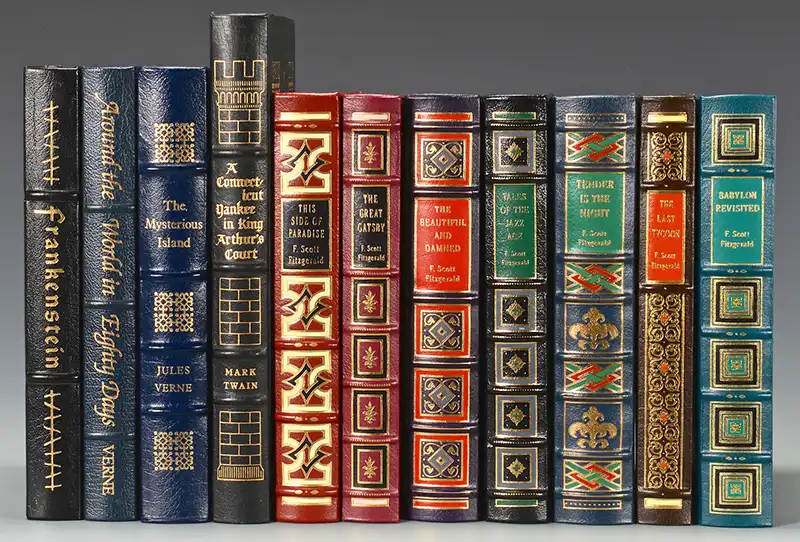
The signature Easton aesthetic was established from the outset and remains remarkably unchanged. Each volume is bound in genuine full-leather (often cowhide), typically in deep, dignified hues of burgundy, forest green, navy, or black. The covers and spines are lavishly decorated with 22-karat gold ornamentation, intricately stamped in patterns that suggest classical tooling without being individually handcrafted. The pages feature hubbed spines (a raised ridge on the spine for visual depth), acid-neutral paper to resist deterioration, sewn bindings for durability, and most iconically, gilt edges on all three sides. This creates the dazzling, solid block of gold that defines an Easton book on the shelf. The books are often accented with moiré fabric endpapers, satin ribbon markers, and commissioned illustrations. This was not about avant-garde design; it was about evoking a timeless, library-bound tradition of prestige.
Expansion and the Collector’s Market (1980s-2000s)
Building on the phenomenal success of the “100 Greatest Books,” Easton Press rapidly expanded its series model. It became a master of targeted collections, appealing to specific interests within the collector community. Major expansions included:
- The Masterpieces of Science Fiction & Fantasy: This series brought a new level of respect and physical grandeur to genre works, issuing seminal titles by Isaac Asimov, Arthur C. Clarke, Frank Herbert, and J.R.R. Tolkien in the full leather-and-gilt treatment.
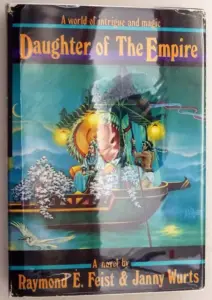
- The Signed First Editions of Science Fiction: A landmark series that captured signatures from living legends of the genre, including Ray Bradbury, Robert Heinlein, and later, stars like Stephen King, creating immensely valuable collectibles.
- Author-Focused Collections: Comprehensive, uniformly bound sets of Charles Dickens, William Shakespeare, Ernest Hemingway and Mark Twain.
- Non-Fictional Series: Lavish editions on topics like Military History (The Great Battles series), Natural Science (audubon-style wildlife books), Exploration, and Philosophy.
Easton’s business model relied heavily on direct marketing and subscription. Potential customers received lavish, detailed brochures in the mail, offering the allure of “building a legacy library.” The marketing emphasized the books as investments, heirlooms, and symbols of cultural attainment. This approach cultivated a dedicated, often lifelong, customer base.
Easton also ventured into even more exclusive territory with its “Library of Famous Editions”—exact, leather-bound replicas of famous first editions, like The Great Gatsby or Gone with the Wind, complete with faux wear and replication of original dust jackets. They also produced exceptional, one-off special editions, such as the monstrously large The Divine Comedy with Botticelli illustrations or the awe-inspiring The Bible in a solid oak case.
Modern Era, Challenges, and Legacy (2000s-Present)
The company faced significant change and challenge in the new millennium. In 2003, The Easton Press was acquired by MBI, Inc. (now Marine Book Investments), a Connecticut-based company known for its own series publishing (like the “Henry Ford Museum Collection”). While some longtime collectors noted subtle shifts in production materials or customer service under the new ownership, the core product and philosophy remained intact.
The rise of the digital age and e-books posed a philosophical challenge, but ironically, may have cemented Easton’s role. In a world of ephemeral pixels, the tangible, sensory appeal of a fine leather-bound book became even more pronounced. An Easton Press volume is the antithesis of a Kindle; it is heavy, fragrant, visually sumptuous, and demands physical engagement. It represents permanence in an ephemeral world.
Today, The Easton Press continues to publish new volumes across its many series. It has a vibrant secondary market on sites like eBay, where out-of-print titles command high prices, testament to their perceived value. Criticisms of the press—that its selections are conservative, its design formulaic, its appeal leaning toward conspicuous bibliographic consumption—are acknowledged but seem irrelevant to its devotees. For its customers, the uniformity is the point; it creates a majestic, coherent library where Pride and Prejudice and The Time Machine are given equal physical dignity.
The history of The Easton Press, therefore, is the history of a brilliantly realized idea. It successfully commodified the aura of the classic text, packaging literary greatness into a universally recognizable object of desire. It proved that even in a modern, mass-market world, there remains a profound longing for the book as a treasure—a beautifully crafted vessel for the word, designed not just to be read, but to be cherished, displayed, and passed on as a legacy.
Easton Press – 100 Greatest Books
| Year | Title | Author(s) |
|---|---|---|
| 1981 | The Adventures of Huckleberry Finn | Mark Twain |
| 1979 | The Aeneid | Virgil |
| 1979 | Aesop's Fables | Aesop |
| 1977 | Alice in Wonderland | Lewis Carroll |
| 1976 | The Analects of Confucius | Confucius |
| 2003 | Animal Farm | George Orwell |
| 1975 | Anna Karenina | Leo Tolstoy |
| 1976 | The Autobiography of Benjamin Franklin | Benjamin Franklin |
| 1967 | Beowulf | Anonymous |
| 1978 | Brave New World | Aldous Huxley |
| 1979 | The Brothers Karamazov | Fyodor Dostoevsky |
| 1977 | Candide | Voltaire |
| 1978 | The Canterbury Tales | Geoffrey Chaucer |
| 1977 | The Cherry Orchard/Three Sisters | Anton Chekhov |
| 1979 | Collected Poems | Robert Browning |
| 1995 | Collected Poems | Emily Dickinson |
| 1975 | Collected Poems | Robert Frost |
| 1980 | Collected Poems | John Keats |
| 1976 | Collected Poems | William Butler Yeats |
| 1980 | Crime and Punishment | Fyodor Dostoevsky |
| 1981 | Cyrano de Bergerac | Edmond Rostand |
| 1979 | David Copperfield | Charles Dickens |
| 1980 | The Decameron | Giovanni Boccaccio |
| 1978 | The Divine Comedy | Dante Alighieri |
| 1976 | Don Quixote | Miguel de Cervantes |
| 1991 | Dracula | Bram Stoker |
| 1980 | Dr. Jekyll and Mr. Hyde | Robert Louis Stevenson |
| 1979 | Essays | Ralph Waldo Emerson |
| 1983 | A Farewell to Arms | Ernest Hemingway |
| 1977 | Fathers and Sons | Ivan Turgenev |
| 1980 | Faust | Johann Wolfgang von Goethe |
| 1979 | The Federalist Papers | Alexander Hamilton, James Madison, John Jay |
| 1962 | Frankenstein | Mary Shelley |
| 1979 | Great Expectations | Charles Dickens |
| 1980 | Grimm's Fairy Tales | Jacob and Wilhelm Grimm, the Brothers Grimm |
| 1976 | Gulliver's Travels | Jonathan Swift |
| 1967 | Hamlet | William Shakespeare |
| 1980 | Heart of Darkness | Joseph Conrad |
| 1978 | The History of Early Rome | Livy |
| 1983 | The Hunchback of Notre Dame | Victor Hugo |
| 1977 | Ivanhoe | Walter Scott |
| 1976 | Jane Eyre | Charlotte Brontë |
| 1980 | The Jungle Book and The Second Jungle Book | Rudyard Kipling |
| 1988 | Lady Chatterley's Lover | D. H. Lawrence |
| 1979 | The Last of the Mohicans | James Fenimore Cooper |
| 1989 | Leaves of Grass | Walt Whitman |
| 1967 | The Legend of Sleepy Hollow and Other Stories | Washington Irving |
| 1966 | Les Misérables | Victor Hugo |
| 1978 | Madame Bovary | Gustave Flaubert |
| 1967 | A Midsummer Night's Dream | William Shakespeare |
| 1975 | Moby-Dick or, The Whale | Herman Melville |
| 1977 | The Necklace and Other Tales | Guy de Maupassant |
| 1978 | The Odyssey | Homer |
| 1980 | Oedipus the King | Sophocles |
| 1977 | Of Mice and Men | John Steinbeck |
| 1976 | On the Origin of Species | Charles Darwin |
| 1957 | The Picture of Dorian Gray | Oscar Wilde |
| 1979 | The Pilgrim's Progress | John Bunyan |
| 1979 | Politics | Aristotle |
| 1978 | The Portrait of a Lady | Henry James |
| 1977 | A Portrait of the Artist as a Young Man | James Joyce |
| 1977 | Pride and Prejudice | Jane Austen |
| 1980 | The Prince | Niccolo Machiavelli |
| 1974 | Pygmalion/Candida | George Bernard Shaw |
| 1980 | The Red and the Black | Stendhal |
| 1980 | The Red Badge of Courage | Stephen Crane |
| 1980 | The Republic | Plato |
| 1979 | The Rights of Man | Thomas Paine |
| 1968 | Romeo and Juliet | William Shakespeare |
| 1976 | Rubaiyat of Omar Khayyam | Omar Khayyam |
| 1975 | The Scarlet Letter | Nathaniel Hawthorne |
| 1978 | She Stoops to Conquer | Oliver Goldsmith |
| 1980 | Silas Marner | George Eliot |
| 1981 | A Tale of Two Cities | Charles Dickens |
| 1981 | Tales from the Arabian Nights | Richard Burton |
| 1975 | Tales of Mystery and Imagination | Edgar Allan Poe |
| 1976 | The Talisman | Walter Scott |
| 1984 | Tess of the d'Urbervilles | Thomas Hardy |
| 1978 | The Three Musketeers | Alexandre Dumas, père |
| 1964 | The Time Machine | H. G. Wells |
| 1979 | Tom Jones | Henry Fielding |
| 1977 | Twenty Thousand Leagues Under the Sea | Jules Verne |
| 1979 | Uncle Tom's Cabin | Harriet Beecher Stowe |
| 1979 | Vanity Fair | William Makepeace Thackeray |
| 1975 | Walden | Henry David Thoreau |
| 1981 | War and Peace | Leo Tolstoy |
| 1980 | The Way of All Flesh | Samuel Butler |
| 1980 | Wuthering Heights | Emily Brontë |
| 1980 | The Adventures of Sherlock Holmes | Arthur Conan Doyle |
| 1980 | Billy Budd and Benito Cereno | Herman Melville |
| 1979 | The Confessions of St. Augustine | Saint Augustine of Hippo |
| 1941 | The Count of Monte Cristo | Alexandre Dumas, père |
| 1979 | The Iliad | Homer |
| 1976 | Little Women | Louisa May Alcott |
| 1977 | Lord Jim | Joseph Conrad |
| 1976 | Paradise Lost | John Milton |
| 1976 | Robinson Crusoe | Daniel Defoe |
| 1992 | The Sound and the Fury | William Faulkner |
| 1979 | The Sea Wolf | Jack London |
| 1977 | Treasure Island | Robert Louis Stevenson |
At a later date a further 25 books were published this series, bringing the actual total to 125.
| Year | Title | Author(s) |
|---|---|---|
| 1978 | Tales of the Alhambra | Washington Irving |
| 1979 | The Birds and The Frogs | Aristophanes |
| 1980 | The Comedies | William Shakespeare |
| 1980 | The Confessions | Jean-Jacques Rousseau |
| 1977 | The Descent of Man | Charles Darwin |
| 1977 | Les Fleurs du Mal (The Flowers Of Evil) | Charles Baudelaire |
| 1980 | The Histories | William Shakespeare |
| 1982 | The Holy Bible | Various authors |
| 1977 | Jude the Obscure | Thomas Hardy |
| 1980 | The Mill on the Floss | George Eliot |
| 1980 | Medea/Hippolytus/The Bacchae | Euripides |
| 2004 | Middlemarch | George Eliot |
| 1979 | Oresteia | Aeschylus |
| 1979 | Three Plays | Henrik Ibsen |
| 1980 | Two Plays | Moliere |
| 1979 | Two Plays | George Bernard Shaw |
| 1979 | Poems | John Donne |
| 1971 | Short Stories | Charles Dickens |
| 1976 | Short Stories | Oscar Wilde |
| 1979 | The Symposium | Plato |
| 1980 | The Tragedies | William Shakespeare |
| 1980 | Tristram Shandy | Laurence Sterne |
| 1979 | Vanity Fair | William Thackeray |
| 1978 | The Return of the Native | Thomas Harding |
| 1978 | A Journal of the Plague Year | Daniel Defoe |
Reference: Wikipedia