Frank Herbert: The Collector’s Guide to First Editions, Rare and Collectible Books

Early Life and Pacific Northwest Roots
Franklin Patrick Herbert Jr. was born on October 8, 1920, in Tacoma, Washington, a blue-collar port city nestled between Puget Sound and Mount Rainier. He grew up in a struggling family during the Great Depression, his father working various jobs while his mother, a devout Catholic, shaped young Frank’s early education. The landscape of the Pacific Northwest—its dense forests, cold rains, and rugged coastline—imprinted on him a deep awareness of ecology and environment long before he ever saw a desert. He attended Salem High School in Oregon, where he showed early promise as a writer and photographer. After high school, he briefly attended the University of Washington, taking classes in creative writing and journalism, but he never earned a degree. In 1941, he married Flora Parkinson, a marriage that ended in divorce after only a few years. He served in the United States Navy during World War II as a photographer, though a medical discharge ended his military service early. After the war, he remarried, this time to Beverly Ann Stuart, a fellow writer and aspiring journalist. The couple moved frequently, working for newspapers in California and Oregon while raising two sons.
The Accidental Ecologist
Herbert’s path to becoming one of science fiction’s most respected authors was indirect and accidental. Throughout the 1950s, he worked as a journalist, covering politics, environmental issues, and local news for the San Francisco Examiner and other newspapers. In 1957, he traveled to Florence, Oregon, to write an article about a United States Department of Agriculture project attempting to stabilize coastal sand dunes with hardy grasses. The assignment changed his life. As he watched engineers and ecologists struggle to control the shifting sands, he began asking larger questions: How does a landscape shape its inhabitants? What happens when an environment reaches its carrying capacity? Could a society survive on a world without water? The article was never published, but the questions became the seed of a novel. He spent the next five years researching, writing, and rewriting what would become Dune. He immersed himself in Middle Eastern history, Islamic culture, desert ecology, psychology, and the politics of oil. He read about the water conservation methods of the Bedouin and the messianic cycles of oppressed peoples. He took detailed notes on the life cycle of sandworms and the chemistry of spice-like compounds.
The Long Rejection
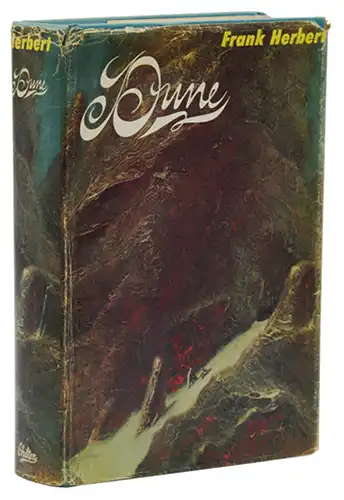
The manuscript for Dune was enormous—over 200,000 words, nearly twice the length of a typical science fiction novel of the era. Herbert began submitting it in 1963. Publisher after publisher rejected it. Editors called it too long, too strange, too complicated. Some complained that the glossary and appendices were pretentious. Others simply could not understand a story set almost entirely on a single desert planet with no recognizable technology. For two years, Herbert endured rejection. He worked odd jobs to support his family while his wife Beverly became the primary breadwinner, working as an advertising copywriter. At one low point, he considered abandoning fiction entirely. Then, in 1965, Chilton Books—a publisher best known for automobile repair manuals and not for science fiction—agreed to take a chance. The editor, Sterling Lanier, had to persuade his superiors that the book might sell. Chilton printed a modest first run of just over 3,000 copies.
Triumph and Transformation
Dune was published in 1965 and immediately won the Nebula Award for Best Novel. It shared the Hugo Award for Best Novel the following year. Critics praised its ecological vision, its complex world-building, and its rejection of simple heroism. Herbert had created a universe where the messianic figure, Paul Atreides, leads a genocidal war of conquest—hardly the triumphant hero of traditional space opera. The book never went out of print. Over the following decades, it became one of the bestselling science fiction novels of all time, eventually spawning five sequels written by Herbert: Dune Messiah (1969), Children of Dune (1976), God Emperor of Dune (1981), Heretics of Dune (1984), and Chapterhouse: Dune (1985). Each installment deepened his meditation on power, religion, ecology, and human evolution.
Later Life and Enduring Legacy
Herbert continued writing outside the Dune universe, producing novels such as The Dosadi Experiment (1977), The Jesus Incident (1979, with Bill Ransom), and The White Plague (1982), a chilling bioterrorism thriller. His second wife, Beverly, died in 1984 after a long battle with cancer. He remarried the following year to Theresa Shackleford. Frank Herbert died of pancreatic cancer on February 11, 1986, in Madison, Wisconsin, at the age of 65. He is buried in the family plot in Washington state. His son, Brian Herbert, and author Kevin J. Anderson later continued the Dune series with numerous prequels and sequels. Today, Frank Herbert is remembered as one of the few science fiction writers to achieve mainstream literary recognition. Dune remains a touchstone for world-building, ecological storytelling, and the dark complexities of power.
The Science Fiction Hall of Fame inducted Frank Herbert in 2006.
Frank Herbert – First Editions Identification Guide
Note: This list only includes works published prior to 1984.
| Year | Title | Publisher | First edition/Printing Identification Points |
|---|---|---|---|
| 1973 | THE BOOK OF FRANK HERBERT | New York: DAW Books, Inc., [1973} | Wrappers. First printing, January 1973 on © page. DAW: sf Books No. 39 UQ 1039 (95c). |
| 1966 | DESTINATION: VOID | [New York]: Published by Berkley Publishing Corporation, [1966] | Wrappers. June, 1966 on © page. Berkley Medallion F1249 (50c). |
| 1977 | THE DOSADI EXPERIMENT | New York: G. P. Putnam's Sons, [1977] | No statement of printing on © page. |
| 1956 | THE DRAGON IN THE SEA | Garden City: Doubleday & Company, Inc., 1956 | Boards. First edition so stated on © page. Reissued as 21ST CENTURY SUB and later as UNDER PRESSURE. |
| 1972 | THE GOD MAKERS | New York: G. P. Putnam's Sons. [1972] | Boards. No statement of printing on © page. |
| 1966 | THE GREEN BRAIN | New York: Ace Books, Inc., [1966] | Wrappers. No statement of printing on © page. Ace Book F-379 (40c). |
| 1972 | SOUL CATCHER | New York: G. P. Putnam's Sons, [1972] | No statement of printing on © page. |
| 1956 | 21ST CENTURY SUB | New York: Avon Publications, Inc., [1956] | Wrappers. No statement of printing on © page. Avon T-146 (35c). Reissue of THE DRAGON UN THE SEA. |
| 1974 | UNDER PRESSURE | New York: Ballantine Books , [1974] | Wrappers. First Printing: March, 1'974 On © page. Ballantine Books 23835 Science Fiction ($1.25). Reissue of THE DRAGON IN THE SEA. |
| 1975 | THE BEST OF FRANK HERBERT | London: Sidgwick & Jackson, [1975] | Boards. First published in Great Britain in 1975 on © page. Note: In 1976 this collection was divided into two paperback volumes and issued THE BEST OF FRANK HERBERT 1952-1964 and THE BEST OF FRANK HERBERT 1965-1970. |
| 1976 | CHILDREN OF DUNE | New York: Published by Berkley Publishing Corporation, [1976] | No statement of printing on © page. |
| 1965 | DUNE | Philadelphia/New York: Chilton Books a division of Chilton Company, [1965] | Blue boards with white letterings. © page of the first printing of the first edition reads: Copyright © 1965 by Frank Herbert. First Edition/All Rights Reserved/Published in Philadelphia by Chilton Company and simultaneously/in Toronto, Canada, by Ambassador Books, Ltd./Library of Congress Catalog Card Number 65-22547/Manufactured in the United States of America. NO ISBN. First state Dust Jacket price of $5.95, bottom rear flap has "CHILTON BOOKS/A DIVISION OF CHILTON COMPANY" |
| 1969 | DUNE MESSIAH | New York: G. P. Putnam's Sons, [1969] | Boards. No statement of printing on © page. Dust Jacket price $4.95. ALSO: [New York]: Published by Berkley Publishing Corporation, [1975]. Wrappers,. September, 1975 on © page.A Berkley Medallion Book D2952 ($1.50). Minor textual changes. |
| 1966 | THE EYES OF HEISENBERG | [New York]: Published by Berkley Publishing Corporation, [1966] | Wrappers. November, 1966 on © page. Berkley Medallion F1283 (50c). ALSO: [London]: New English Library, [1975]. Boards. First published in hardcover. 1975 on © page. First hardcover edition. |
| 1981 | GOD EMPEROR OF DUNE | New York: G. P. Putnam's Sons. [1981] | Boards. Two printings, no priority:
|
| 1968 | THE HEAVEN MAKERS | [New York]: An Avon Book, [1968] | Wrappers. First Avon Printing, November, 1968 on © page. An Avon Original 5379 (60c). ALSO: New York: Ballantine Books, [1977]. Wrappers. First Ballantine Books Edition: March 1977 on © page. Ballantine 25304 ($1.50). Textual revisions. |
| 1973 | HELLSTROM'S HIVE | Garden City: Nelson Doubleday, Inc., [1973] | Boards. Three printings, priority as listed:
|
| 1984 | HERETICS OF DUNE | New York: G. P. Putnam's Sons. [1984] | Boards. No statement of printing on © page. Dust Jacket price $16.95. |
| 1968 | THE SANTAROGA BARRIER | [New York]: Published by Berkley Publishing Corporation, [1968] | Wrappers. October, 1968 On © page. A Berkley Medallion Book S1615 (75c). ALSO: [London]: Rapp + Whiting, [1970]. Boards. First Published in Great Britain in 1970 on © page. First hardcover edition. |
| 1970 | WHIPPING STAR | New York: G. P. Putnam's Sons, [1970] | Boards. No statement of printing on © page. ALSO: [New York]: Published by Berkley Publishing Corporation, [1977]. Wrappers. September, 1977/Sixth Printing on © page. A Berkley Medallion Book 0-425-03504-2 ($1.5c). Revised text. |
| 1970 | THE WORLDS OF FRANK HERBERT | [London]: New English Library, [1970] | Wrappers. First NEL paperback edition December 1970 on © page. New English Library Science Fiction 2814 (30p). ALSO: New York: Ace Books, [1971]. Wrappers. No statement of printing on © page. Ace Book 90925 (75c). Adds "By the Book." |
| 1984 | CHAPTERHOUSE: DUNE | New York: G. P. Putnam's Sons. [1984] | Boards. Line number "1 2 3 4 5 6 7 8 9 10" on © page. Dust Jacket price $17.95. |
Frank Herbert – First Printing Dust Jackets Identification Guide
Gallery of First state Dust Jackets of Herbert’s works. Only includes the first appearance in book form. Either the UK or US edition and does not include later printings.


Reference:
- L. W. Currey, Science Fiction and Fantasy Authors: A Bibliography of First Printings of Their Fiction and Selected Nonfiction.