Aesop’s Fables in Shadow and Line: The Dark Magic of Arthur Rackham
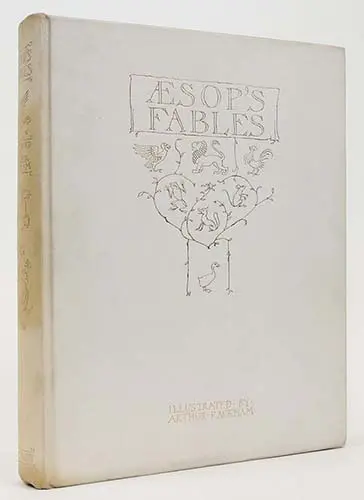
There are illustrated books that charm, and then there are those that haunt. Arthur Rackham’s edition of Aesop’s Fables, published in 1912, belongs firmly to the latter category. While Aesop’s ancient tales of cunning foxes, vain crows, and foolish mice have been rendered countless times for children—usually in bright, gentle colors that soften their hard moral edges—Rackham took a different path. He reached back into the shadowy, gnarled roots of the fables and gave them back their original bite. His illustrations do not comfort. They enchant through unease.
The fables themselves need little introduction. Compiled from oral traditions stretching back to ancient Greece, these short, sharp stories have served as moral instruction for over two thousand years. A race is not always won by the swift. Slow and steady wins the race. Kindness is better than strength. Appearances are often deceptive. The texts in this edition are rendered in clear, accessible prose, preserving the crisp, economical structure that makes Aesop so memorable. Each fable ends with its explicit moral, a little arrow aimed at the conscience. But the real revelation of this volume lies not in the words but in the images that accompany them.
Arthur Rackham was at the height of his powers when he undertook Aesop’s Fables. By 1912, he had already established himself as the preeminent fantasy illustrator of the Edwardian era, famous for his editions of Rip Van Winkle, Peter Pan in Kensington Gardens, and Alice’s Adventures in Wonderland. His style was immediately recognizable: a delicate, wiry line combined with a muted, earthy palette of browns, greens, and soft golds. He worked primarily in pen and ink with watercolor washes, often using a technique called “foreshortening” to create twisted, gnarled trees and figures that seemed to grow organically from the page.
What sets Rackham’s Aesop apart is his refusal to sentimentalize. His animals are not cute. They are lean, watchful, and slightly sinister. The fox who cannot reach the grapes is drawn with a sly, hungry desperation. The wolf in sheep’s clothing emerges from the shadows with eyes that glint with calculated malice. The crow who drops her cheese to the flattering fox is depicted mid-tumble, her beak open in regret, while the fox below grins with a predator’s satisfaction. Rackham understood that Aesop’s world is a Darwinian one. It is a world of hunger, trickery, and survival. His illustrations capture that tension beautifully.
The landscapes are equally evocative. Rackham places his fables in a mythic countryside of twisted oaks, misty hollows, and ancient stone walls. His trees have faces. His shadows have weight. There is a sense that the natural world is watching, judging, waiting for you to make a mistake. Even the smallest vignettes—a single mouse at the edge of a page, a crow perched on a branch—feel charged with narrative possibility.
To hold Rackham’s Aesop’s Fables is to hold a book that understands a profound truth: the best children’s stories are not safe. They are strange. They are dark. They remind us that the world is full of sharp teeth and clever liars, and that wisdom is the only true protection. Rackham’s pen gave those ancient lessons a visual language of unforgettable beauty and menace. It remains a masterpiece of the illustrated book.
Recommended for collectors:
- Grimm’s Fairy Tales (1909), illustrated by Arthur Rackham – A classic dark fairy tale collection with equally captivating artwork.
- The Wind in the Willows (1940), illustrated by Arthur Rackham – One of Rackham’s final works, filled with pastoral charm and rich characterization.
- Fables of La Fontaine (1931), illustrated by Jean de Bosschère – A French take on fables with vivid, surreal illustrations.
Art Gallery: Arthur Rackham – Aesop’s Fables, 1912
![Arthur Rackham - Aesop's Fables [rackham-aesop01] (art, illustrations)](https://www.nocloo.com/wp-content/plugins/justified-image-grid/timthumb.php?src=https%3A%2F%2Fwww.nocloo.com%2Fart%2Frackham-aesop%2Frackham-aesop01.jpg&h=280&q=90&f=.jpg "Arthur Rackham - Illustrations for Aesop's Fables 1912")
![Arthur Rackham - Aesop's Fables [rackham-aesop02] (art, illustrations)](https://www.nocloo.com/wp-content/plugins/justified-image-grid/timthumb.php?src=https%3A%2F%2Fwww.nocloo.com%2Fart%2Frackham-aesop%2Frackham-aesop02.jpg&h=280&q=90&f=.jpg "Arthur Rackham - Illustrations for Aesop's Fables 1912")
![Arthur Rackham - Aesop's Fables [rackham-aesop03] (art, illustrations)](https://www.nocloo.com/wp-content/plugins/justified-image-grid/timthumb.php?src=https%3A%2F%2Fwww.nocloo.com%2Fart%2Frackham-aesop%2Frackham-aesop03.jpg&h=280&q=90&f=.jpg "Arthur Rackham - Illustrations for Aesop's Fables 1912")
![Arthur Rackham - Aesop's Fables [rackham-aesop04] (art, illustrations)](https://www.nocloo.com/wp-content/plugins/justified-image-grid/timthumb.php?src=https%3A%2F%2Fwww.nocloo.com%2Fart%2Frackham-aesop%2Frackham-aesop04.jpg&h=280&q=90&f=.jpg "Arthur Rackham - Illustrations for Aesop's Fables 1912")
![Arthur Rackham - Aesop's Fables [rackham-aesop05] (art, illustrations)](https://www.nocloo.com/wp-content/plugins/justified-image-grid/timthumb.php?src=https%3A%2F%2Fwww.nocloo.com%2Fart%2Frackham-aesop%2Frackham-aesop05.jpg&h=280&q=90&f=.jpg "Arthur Rackham - Illustrations for Aesop's Fables 1912")
![Arthur Rackham - Aesop's Fables [rackham-aesop06] (art, illustrations)](https://www.nocloo.com/wp-content/plugins/justified-image-grid/timthumb.php?src=https%3A%2F%2Fwww.nocloo.com%2Fart%2Frackham-aesop%2Frackham-aesop06.jpg&h=280&q=90&f=.jpg "Arthur Rackham - Illustrations for Aesop's Fables 1912")
![Arthur Rackham - Aesop's Fables [rackham-aesop07] (art, illustrations)](https://www.nocloo.com/wp-content/plugins/justified-image-grid/timthumb.php?src=https%3A%2F%2Fwww.nocloo.com%2Fart%2Frackham-aesop%2Frackham-aesop07.jpg&h=280&q=90&f=.jpg "Arthur Rackham - Illustrations for Aesop's Fables 1912")
![Arthur Rackham - Aesop's Fables [rackham-aesop08] (art, illustrations)](https://www.nocloo.com/wp-content/plugins/justified-image-grid/timthumb.php?src=https%3A%2F%2Fwww.nocloo.com%2Fart%2Frackham-aesop%2Frackham-aesop08.jpg&h=280&q=90&f=.jpg "Arthur Rackham - Illustrations for Aesop's Fables 1912")
![Arthur Rackham - Aesop's Fables [rackham-aesop09] (art, illustrations)](https://www.nocloo.com/wp-content/plugins/justified-image-grid/timthumb.php?src=https%3A%2F%2Fwww.nocloo.com%2Fart%2Frackham-aesop%2Frackham-aesop09.jpg&h=280&q=90&f=.jpg "Arthur Rackham - Illustrations for Aesop's Fables 1912")
![Arthur Rackham - Aesop's Fables [rackham-aesop10] (art, illustrations)](https://www.nocloo.com/wp-content/plugins/justified-image-grid/timthumb.php?src=https%3A%2F%2Fwww.nocloo.com%2Fart%2Frackham-aesop%2Frackham-aesop10.jpg&h=280&q=90&f=.jpg "Arthur Rackham - Illustrations for Aesop's Fables 1912")
![Arthur Rackham - Aesop's Fables [rackham-aesop11] (art, illustrations)](https://www.nocloo.com/wp-content/plugins/justified-image-grid/timthumb.php?src=https%3A%2F%2Fwww.nocloo.com%2Fart%2Frackham-aesop%2Frackham-aesop11.jpg&h=280&q=90&f=.jpg "Arthur Rackham - Illustrations for Aesop's Fables 1912")
![Arthur Rackham - Aesop's Fables [rackham-aesop12] (art, illustrations)](https://www.nocloo.com/wp-content/plugins/justified-image-grid/timthumb.php?src=https%3A%2F%2Fwww.nocloo.com%2Fart%2Frackham-aesop%2Frackham-aesop12.jpg&h=280&q=90&f=.jpg "Arthur Rackham - Illustrations for Aesop's Fables 1912")