Canine Philosophy and Rackham’s Final Flourish: Where the Blue Begins
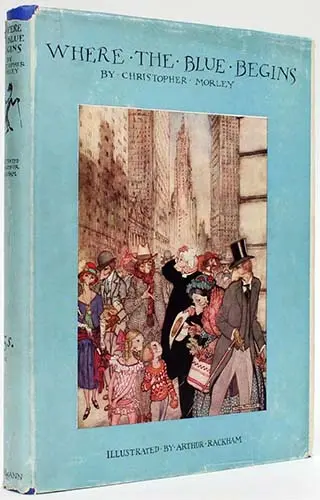
Arthur Rackham’s illustrations for Christopher Morley’s Where the Blue Begins represent a distinctive and somewhat unusual entry in the artist’s celebrated bibliography. Published in 1925 by William Heinemann in London and Doubleday, Page & Co. in New York, this edition marked the first appearance of Rackham’s work with Morley’s whimsical tale, though the story itself had been published without illustrations three years earlier in 1922 . The collaboration proved fortuitous; as one contemporary critic observed, Rackham “has here found a theme which exactly suits his style, and his style exactly suits the theme—he is one of the few artists, in fact, whose insight and imagination could match Mr Morley’s delicate art” .
The book presents a singular narrative conceit: a satirical fable in which all characters are dogs inhabiting a recognizably human world . The protagonist, Gissing—named after the novelist George Gissing—is a gentleman dog of leisure residing comfortably in the Canine Estates with Fuji, his Japanese pug butler. Living on an income of a thousand bones a year, Gissing nevertheless finds himself discontented and embarks upon a philosophical quest to discover “where the blue begins”—a metaphor for meaning and purpose in existence . Morley populates this canine cosmos with a delightful menagerie of character names: the curate Mr. J. Rover Poodle, the neighboring Mrs. Airedale and Mrs. Collie, the haughty Mr. and Mrs. Chow, and the salesclerk Miss Whippet, among many others. Real-world locations—Paris, Atlantic City, Broadway, Wall Street—ground the whimsy in a familiar geography, creating a world that is simultaneously our own and utterly transformed .
Rackham’s illustrations for the volume comprise four full-page color plates, including the frontispiece, and sixteen line drawings dispersed throughout the text, along with pictorial endpapers rendered in blue and white . The color illustrations are noted for their unusual quality within Rackham’s oeuvre, marrying perfectly to Morley’s singular story . Writing of Rackham’s work during this period, one scholar noted that he was achieving “a new harmony of colour,” his drawings becoming “light and sparkling with passionate rose, glowing greens and primrose yellow”—a palette that would have served this gentle satire well .
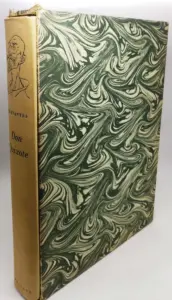
The book was issued in multiple formats reflecting the publishing conventions of the period. The English limited edition, numbering 175 copies, was signed by Rackham and bound in white boards with a black cloth back and gilt top edge . The American de luxe edition was more exclusive still, limited to just 100 copies signed by both author and illustrator, bound in striking blue and green mottled boards with a black cloth back . Trade editions appeared in both countries as well, bound in bright blue cloth with pictorial stamping in gold on the cover and spine .
Where the Blue Begins holds a special place in Rackham’s late career, arriving during a period when the artist was exploring new creative avenues. It brought him the friendship of Christopher Morley, whom one biographer described as “that most warm-hearted of authors” . For collectors and admirers of Rackham’s art, the volume remains a distinctive gem—a work in which the illustrator’s mature style meets a narrative of singular charm, proving that even in the latter years of his career, Rackham’s ability to match word with image remained undiminished.
Recommended for collectors:
- The Wind in the Willows (1931), illustrated by Arthur Rackham – A classic animal fantasy also given Rackham’s signature treatment.
- Peter Pan in Kensington Gardens (1906), illustrated by Arthur Rackham – One of Rackham’s most iconic works, full of whimsy and wonder.
- The Tale of Mr. Tootleoo (1925), illustrated by Bernard Sleigh – Another charming animal adventure with gentle allegorical themes.
Art Gallery: Arthur Rackham – Where the Blue Begins 1922
![Arthur Rackham - Where the Blue Begins [rackham-blue01] (art, illustrations)](https://www.nocloo.com/wp-content/plugins/justified-image-grid/timthumb.php?src=https%3A%2F%2Fwww.nocloo.com%2Fart%2Frackham-blue%2Frackham-blue01.jpg&h=280&q=90&f=.jpg "Arthur Rackham - Illustrations for Where the Blue Begins 1922")
![Arthur Rackham - Where the Blue Begins [rackham-blue02] (art, illustrations)](https://www.nocloo.com/wp-content/plugins/justified-image-grid/timthumb.php?src=https%3A%2F%2Fwww.nocloo.com%2Fart%2Frackham-blue%2Frackham-blue02.jpg&h=280&q=90&f=.jpg "Arthur Rackham - Illustrations for Where the Blue Begins 1922")
![Arthur Rackham - Where the Blue Begins [rackham-blue03] (art, illustrations)](https://www.nocloo.com/wp-content/plugins/justified-image-grid/timthumb.php?src=https%3A%2F%2Fwww.nocloo.com%2Fart%2Frackham-blue%2Frackham-blue03.jpg&h=280&q=90&f=.jpg "Arthur Rackham - Illustrations for Where the Blue Begins 1922")
![Arthur Rackham - Where the Blue Begins [rackham-blue04] (art, illustrations)](https://www.nocloo.com/wp-content/plugins/justified-image-grid/timthumb.php?src=https%3A%2F%2Fwww.nocloo.com%2Fart%2Frackham-blue%2Frackham-blue04.jpg&h=280&q=90&f=.jpg "Arthur Rackham - Illustrations for Where the Blue Begins 1922")