A Gentle Wonderland: Bessie Pease Gutmann’s Alice’s Adventures in Wonderland
In the long history of illustrating Lewis Carroll’s Alice’s Adventures in Wonderland, most artists have approached the task with a sense of the book’s strangeness—its linguistic play, its philosophical puzzles, its moments of near-nonsense. Bessie Pease Gutmann took a different path. Her 1907 edition, published in the same year that Carroll’s copyright expired and unleashed a flood of new interpretations, offered something the world had not quite seen before: a Wonderland rendered with warmth, tenderness, and the gentle aesthetic of the nursery.
Bessie Pease Gutmann (1876–1960) was an American illustrator who specialized in images of children. Born in Philadelphia, she studied at the Philadelphia School of Design for Women and the New York School of Art before establishing herself as one of the most popular illustrators of her era. Her work appeared on magazine covers, in children’s books, and most famously in a series of prints depicting babies and young children that became ubiquitous in American homes. Her style was characterized by soft pastels, rounded figures, and an extraordinary ability to capture the sweetness and innocence of childhood.
When Gutmann turned her attention to Alice, she brought these sensibilities with her. Her Alice is not the sharp, inquisitive figure of John Tenniel’s original illustrations nor the dreamy, ethereal child of Arthur Rackham’s contemporaneous interpretation. She is, instead, a quintessential Gutmann child: rosy-cheeked, wide-eyed, with golden hair and a expression of gentle curiosity. She looks less like a Victorian heroine and more like the child next door—approachable, familiar, and utterly endearing.
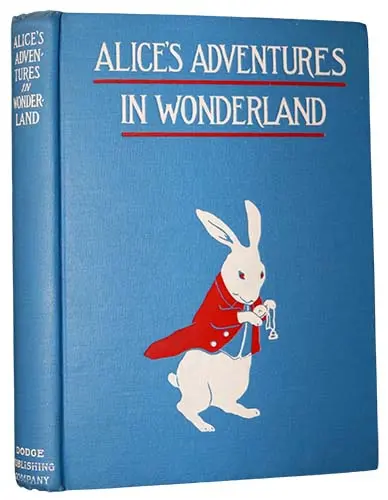
The 1907 edition, published by Dodge Publishing Company in New York, was a handsome production. The volume contained ten full-page color plates protected by captioned tissue guards, alongside numerous black-and-white illustrations scattered throughout the text. The binding was typically in pictorial boards, with a color illustration of Alice on the front cover inviting young readers to enter her world.
What distinguishes Gutmann’s approach to Wonderland is its warmth. Where other illustrators emphasized the strangeness of Carroll’s creations—the unsettling grin of the Cheshire Cat, the imperious cruelty of the Queen of Hearts—Gutmann softened them. Her creatures are rendered with rounded edges and gentle expressions. The Mad Hatter’s tea party becomes a scene of cozy eccentricity rather than surreal disorientation. The Queen of Hearts, while still commanding, possesses a certain plump grandmotherliness that diminishes her menace. Even the Cheshire Cat’s famous grin seems less unnerving and more, well, catlike.
This is not to say that Gutmann’s illustrations lack imagination. Her Wonderland is rendered in soft, dreamy colors—pale pinks, gentle blues, muted greens—that evoke the quality of a half-remembered dream. Her compositions are carefully balanced, with a keen attention to the decorative possibilities of each scene. Yet her primary concern is always the child: Alice’s expressions, her postures, her reactions to the strange creatures she encounters. Gutmann understood that for young readers, the appeal of Alice lies not in its philosophical complexities but in its child protagonist, and she made that protagonist the heart of her interpretation.
The publication of Gutmann’s Alice occurred at a pivotal moment. The expiration of Carroll’s copyright in 1907 had unleashed a wave of new editions, each offering a distinct vision of Wonderland. Rackham’s version, published the same year, emphasized mystery and atmosphere. Gutmann’s offered an alternative: a Wonderland that felt safe, familiar, and comforting—a place where a child could have adventures without ever leaving the warmth of the nursery.
Today, Gutmann’s Alice is a prized collectible, particularly among those who grew up with her images. First editions in good condition are increasingly scarce, as the book was intended for children and many copies were loved to pieces. Yet for those who discover it, Gutmann’s Wonderland remains a delight—a gentle reminder that even the strangest adventures can be approached with sweetness, and that sometimes the most enduring interpretations are the ones that speak directly to the child in all of us. In Gutmann’s hands, Alice’s journey becomes not a descent into absurdity but a gentle ramble through the imagination—a Wonderland where every child would feel at home.
Recommended for Collectors
- A Child’s Garden of Verses (c. 1900s) illustrated by Gutmann – Showcasing her signature child portraits
- Alice’s Adventures in Wonderland (1907) illustrated by Arthur Rackham – For a darker, more mystical interpretation
- The Velveteen Rabbit (1922) illustrated by William Nicholson – Another nostalgic childhood classic
Art Gallery: Bessie Pease Gutmann -Alice’s Adventures in Wonderland 1907
![Bessie Pease Gutmann - Alice's Adventures in Wonderland [gutmann-alice01] (art, illustrations)](https://www.nocloo.com/wp-content/plugins/justified-image-grid/timthumb.php?src=https%3A%2F%2Fwww.nocloo.com%2Fart%2Fgutmann-alice%2Fgutmann-alice01.jpg&h=280&q=90&f=.jpg "Bessie Pease Gutmann - Illustrations for Alice's Adventures in Wonderland 1907")
![Bessie Pease Gutmann - Alice's Adventures in Wonderland [gutmann-alice02] (art, illustrations)](https://www.nocloo.com/wp-content/plugins/justified-image-grid/timthumb.php?src=https%3A%2F%2Fwww.nocloo.com%2Fart%2Fgutmann-alice%2Fgutmann-alice02.jpg&h=280&q=90&f=.jpg "Bessie Pease Gutmann - Illustrations for Alice's Adventures in Wonderland 1907")
![Bessie Pease Gutmann - Alice's Adventures in Wonderland [gutmann-alice03] (art, illustrations)](https://www.nocloo.com/wp-content/plugins/justified-image-grid/timthumb.php?src=https%3A%2F%2Fwww.nocloo.com%2Fart%2Fgutmann-alice%2Fgutmann-alice03.jpg&h=280&q=90&f=.jpg "Bessie Pease Gutmann - Illustrations for Alice's Adventures in Wonderland 1907")
![Bessie Pease Gutmann - Alice's Adventures in Wonderland [gutmann-alice04] (art, illustrations)](https://www.nocloo.com/wp-content/plugins/justified-image-grid/timthumb.php?src=https%3A%2F%2Fwww.nocloo.com%2Fart%2Fgutmann-alice%2Fgutmann-alice04.jpg&h=280&q=90&f=.jpg "Bessie Pease Gutmann - Illustrations for Alice's Adventures in Wonderland 1907")
![Bessie Pease Gutmann - Alice's Adventures in Wonderland [gutmann-alice05] (art, illustrations)](https://www.nocloo.com/wp-content/plugins/justified-image-grid/timthumb.php?src=https%3A%2F%2Fwww.nocloo.com%2Fart%2Fgutmann-alice%2Fgutmann-alice05.jpg&h=280&q=90&f=.jpg "Bessie Pease Gutmann - Illustrations for Alice's Adventures in Wonderland 1907")
![Bessie Pease Gutmann - Alice's Adventures in Wonderland [gutmann-alice06] (art, illustrations)](https://www.nocloo.com/wp-content/plugins/justified-image-grid/timthumb.php?src=https%3A%2F%2Fwww.nocloo.com%2Fart%2Fgutmann-alice%2Fgutmann-alice06.jpg&h=280&q=90&f=.jpg "Bessie Pease Gutmann - Illustrations for Alice's Adventures in Wonderland 1907")
![Bessie Pease Gutmann - Alice's Adventures in Wonderland [gutmann-alice07] (art, illustrations)](https://www.nocloo.com/wp-content/plugins/justified-image-grid/timthumb.php?src=https%3A%2F%2Fwww.nocloo.com%2Fart%2Fgutmann-alice%2Fgutmann-alice07.jpg&h=280&q=90&f=.jpg "Bessie Pease Gutmann - Illustrations for Alice's Adventures in Wonderland 1907")
![Bessie Pease Gutmann - Alice's Adventures in Wonderland [gutmann-alice08] (art, illustrations)](https://www.nocloo.com/wp-content/plugins/justified-image-grid/timthumb.php?src=https%3A%2F%2Fwww.nocloo.com%2Fart%2Fgutmann-alice%2Fgutmann-alice08.jpg&h=280&q=90&f=.jpg "Bessie Pease Gutmann - Illustrations for Alice's Adventures in Wonderland 1907")
![Bessie Pease Gutmann - Alice's Adventures in Wonderland [gutmann-alice09] (art, illustrations)](https://www.nocloo.com/wp-content/plugins/justified-image-grid/timthumb.php?src=https%3A%2F%2Fwww.nocloo.com%2Fart%2Fgutmann-alice%2Fgutmann-alice09.jpg&h=280&q=90&f=.jpg "Bessie Pease Gutmann - Illustrations for Alice's Adventures in Wonderland 1907")
![Bessie Pease Gutmann - Alice's Adventures in Wonderland [gutmann-alice10] (art, illustrations)](https://www.nocloo.com/wp-content/plugins/justified-image-grid/timthumb.php?src=https%3A%2F%2Fwww.nocloo.com%2Fart%2Fgutmann-alice%2Fgutmann-alice10.jpg&h=280&q=90&f=.jpg "Bessie Pease Gutmann - Illustrations for Alice's Adventures in Wonderland 1907")