Timeless Wisdom, Playful Vision: Charles Folkard’s Aesop’s Fables
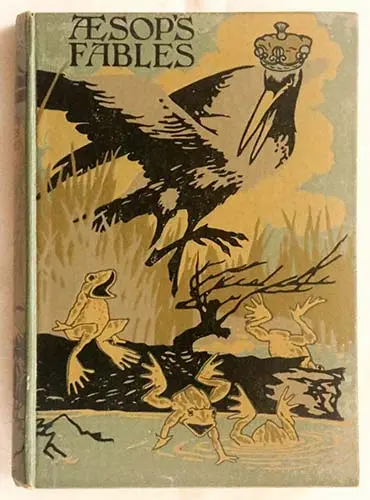
There is a particular joy in encountering a classic through the eyes of an artist who refuses to take it too seriously. Charles Folkard’s edition of Aesop’s Fables, published in 1912, brings the ancient moral tales to life with a warmth, humor, and theatrical flair that transforms them from dusty lessons into a rollicking visual feast. It is a book that understands a fundamental truth about Aesop: that wisdom, to be absorbed, must first be entertained.
Charles James Folkard (1878–1963) was an English illustrator and cartoonist whose career spanned much of the early twentieth century. He is perhaps best remembered as the creator of the beloved children’s comic character Teddy Tail, but his book illustrations represent a significant achievement in their own right. Folkard’s style is instantly recognizable: bold, playful lines, a keen eye for character, and a palette that favors rich, warm tones. Where other illustrators approached Aesop with reverence, Folkard approached him with a twinkle in his eye—and it is precisely this quality that makes his edition so enduringly delightful.
The 1912 edition, published by A & C Black in London, was a handsome production typical of the Golden Age of Illustration. The volume contained twelve color plates, alongside a wealth of black-and-white illustrations scattered throughout the text. From the title page to the final fable, Folkard’s presence is felt on nearly every page, his decorative borders and marginal drawings creating a cohesive visual experience that invites lingering.
What distinguishes Folkard’s approach to Aesop is his theatrical sensibility. His scenes feel like stage productions: animals stand on hind legs and wear human expressions, their postures exaggerated, their interactions rendered with the timing of a comic actor. The fox is not merely sly but positively scheming, his narrow eyes and raised eyebrow conveying volumes. The tortoise plods with the grim determination of a character who knows he will win by sheer stubbornness. The lion moves with the regal dignity of a Shakespearean king—until, of course, the moment calls for comedy.
Folkard’s color plates are particularly striking. His palette is warm and inviting—rich browns, deep greens, sunny yellows, and touches of russet and gold that evoke the natural world while never striving for literal realism. His animals are anthropomorphized with a light touch: they wear clothes when the story demands it, stand on two legs when it serves the narrative, yet retain enough of their animal nature to remain recognizably themselves. The compositions are dynamic, often crowded with incident, rewarding repeated viewing with new discoveries.
Yet there is also a delicacy to Folkard’s work that balances the boldness. His decorative borders, his intricate patterns, and his attention to the small details of landscape and costume reveal an artist who delighted in the richness of his material. These are not illustrations dashed off in haste but lovingly crafted compositions that reward sustained attention.
The choice of fables included in the edition reflects the breadth of Aesop’s tradition. Here are the familiar tales—the hare and the tortoise, the fox and the grapes, the boy who cried wolf—alongside lesser-known gems that reveal the full range of Aesop’s wit. Folkard’s illustrations treat each with equal care, finding the humor, the pathos, and the wisdom in every story.
Folkard’s Aesop’s Fables belongs to a particular moment in the history of children’s publishing—an era when illustrated gift books were produced with an artistry that seems almost extravagant today. The quality of the paper, the richness of the color reproduction, the careful mounting of plates behind tissue guards—all speak to a belief that children’s books deserved the same care as books for adults.
Today, Folkard’s edition is a cherished collectible. First editions in good condition, with clean plates and intact bindings, are increasingly scarce. For those fortunate enough to own a copy, the book offers something rare: an Aesop that can be read with pleasure by adults and children alike, a volume where ancient wisdom meets Edwardian charm. In Folkard’s hands, the fox and the stork, the lion and the mouse, the town mouse and the country mouse become characters in a grand, joyful comedy—reminding us that the best lessons are the ones that make us smile.
Recommended for Collectors
- The Arabian Nights (1912) also illustrated by Folkard – For another example of his vibrant storytelling art
- The Wind in the Willows (1908) by Kenneth Grahame – A complementary classic with rich animal illustrations
- Just So Stories (1902) by Rudyard Kipling, illustrated by the author – Whimsical animal tales with a similar charm
Art Gallery: Charles Folkard – Aesop’s Fables 1912
![Charles Folkard - Aesop's Fables [folkard-aesop01] (art, illustrations)](https://www.nocloo.com/wp-content/plugins/justified-image-grid/timthumb.php?src=https%3A%2F%2Fwww.nocloo.com%2Fart%2Ffolkard-aesop%2Ffolkard-aesop01.jpg&h=280&q=90&f=.jpg)
![Charles Folkard - Aesop's Fables [folkard-aesop02] (art, illustrations)](https://www.nocloo.com/wp-content/plugins/justified-image-grid/timthumb.php?src=https%3A%2F%2Fwww.nocloo.com%2Fart%2Ffolkard-aesop%2Ffolkard-aesop02.jpg&h=280&q=90&f=.jpg)
![Charles Folkard - Aesop's Fables [folkard-aesop03] (art, illustrations)](https://www.nocloo.com/wp-content/plugins/justified-image-grid/timthumb.php?src=https%3A%2F%2Fwww.nocloo.com%2Fart%2Ffolkard-aesop%2Ffolkard-aesop03.jpg&h=280&q=90&f=.jpg)
![Charles Folkard - Aesop's Fables [folkard-aesop04] (art, illustrations)](https://www.nocloo.com/wp-content/plugins/justified-image-grid/timthumb.php?src=https%3A%2F%2Fwww.nocloo.com%2Fart%2Ffolkard-aesop%2Ffolkard-aesop04.jpg&h=280&q=90&f=.jpg)
![Charles Folkard - Aesop's Fables [folkard-aesop05] (art, illustrations)](https://www.nocloo.com/wp-content/plugins/justified-image-grid/timthumb.php?src=https%3A%2F%2Fwww.nocloo.com%2Fart%2Ffolkard-aesop%2Ffolkard-aesop05.jpg&h=280&q=90&f=.jpg)
![Charles Folkard - Aesop's Fables [folkard-aesop06] (art, illustrations)](https://www.nocloo.com/wp-content/plugins/justified-image-grid/timthumb.php?src=https%3A%2F%2Fwww.nocloo.com%2Fart%2Ffolkard-aesop%2Ffolkard-aesop06.jpg&h=280&q=90&f=.jpg)
![Charles Folkard - Aesop's Fables [folkard-aesop07] (art, illustrations)](https://www.nocloo.com/wp-content/plugins/justified-image-grid/timthumb.php?src=https%3A%2F%2Fwww.nocloo.com%2Fart%2Ffolkard-aesop%2Ffolkard-aesop07.jpg&h=280&q=90&f=.jpg)
![Charles Folkard - Aesop's Fables [folkard-aesop08] (art, illustrations)](https://www.nocloo.com/wp-content/plugins/justified-image-grid/timthumb.php?src=https%3A%2F%2Fwww.nocloo.com%2Fart%2Ffolkard-aesop%2Ffolkard-aesop08.jpg&h=280&q=90&f=.jpg)
![Charles Folkard - Aesop's Fables [folkard-aesop09] (art, illustrations)](https://www.nocloo.com/wp-content/plugins/justified-image-grid/timthumb.php?src=https%3A%2F%2Fwww.nocloo.com%2Fart%2Ffolkard-aesop%2Ffolkard-aesop09.jpg&h=280&q=90&f=.jpg)
![Charles Folkard - Aesop's Fables [folkard-aesop10] (art, illustrations)](https://www.nocloo.com/wp-content/plugins/justified-image-grid/timthumb.php?src=https%3A%2F%2Fwww.nocloo.com%2Fart%2Ffolkard-aesop%2Ffolkard-aesop10.jpg&h=280&q=90&f=.jpg)
![Charles Folkard - Aesop's Fables [folkard-aesop11] (art, illustrations)](https://www.nocloo.com/wp-content/plugins/justified-image-grid/timthumb.php?src=https%3A%2F%2Fwww.nocloo.com%2Fart%2Ffolkard-aesop%2Ffolkard-aesop11.jpg&h=280&q=90&f=.jpg)
![Charles Folkard - Aesop's Fables [folkard-aesop12] (art, illustrations)](https://www.nocloo.com/wp-content/plugins/justified-image-grid/timthumb.php?src=https%3A%2F%2Fwww.nocloo.com%2Fart%2Ffolkard-aesop%2Ffolkard-aesop12.jpg&h=280&q=90&f=.jpg)