A Thousand and One Delights: Charles Folkard’s Arabian Nights
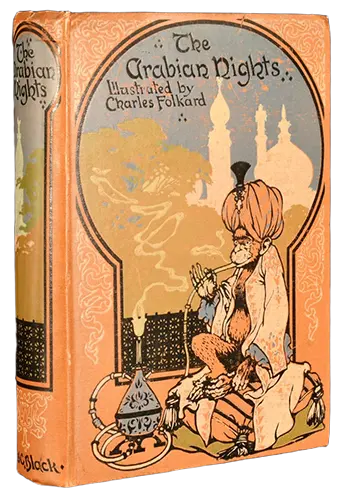
In the pantheon of Golden Age illustrators, Charles Folkard occupies a distinctive place. While contemporaries like Arthur Rackham and Kay Nielsen conjured worlds of ethereal mystery and Nordic grandeur, Folkard brought to his work something altogether different: a rollicking sense of humor, a theatrical flair, and an infectious delight in storytelling. These qualities find their fullest expression in his 1913 edition of The Arabian Nights, a book that captures the wit, wonder, and endless variety of Scheherazade’s tales with unmatched verve.
Charles James Folkard (1878–1963) was an English illustrator and cartoonist whose career spanned much of the early twentieth century. He is perhaps best remembered for creating the beloved children’s comic character Teddy Tail, but his book illustrations represent a significant achievement in their own right. Folkard’s style is instantly recognizable: bold, playful lines, a keen eye for character, and a palette that favors rich, warm tones. Where other illustrators approached fairy tales with reverence, Folkard approached them with a twinkle in his eye—and it is precisely this quality that makes his Arabian Nights so enduringly delightful.
Published by A & C Black in London, Folkard’s The Arabian Nights was conceived as a lavish gift book, befitting the richness of its source material. The volume features a striking brown decorative binding. And treasures there are: twelve full-color plates, alongside a wealth of black-and-white illustrations scattered throughout the text. From the title page to the final chapter, Folkard’s presence is felt on nearly every page.
What distinguishes Folkard’s approach from other illustrators of the period is his theatrical sensibility. His scenes feel like stage productions: characters strike dramatic poses, costumes are rendered with meticulous attention to pattern and texture, and the compositions often suggest a proscenium arch framing the action. There is a joyous artificiality to his work—a recognition that these stories are performances, meant to be relished for their drama, their humor, and their sheer entertainment value.
His characters are wonderfully expressive. Sinbad the Sailor strides across the page with bluff confidence; the Genie of the Lamp looms with comedic menace; Aladdin’s mother bustles with maternal anxiety. Folkard understood that the tales of The Arabian Nights are populated by vivid personalities, and he renders each with a distinct physical presence. His figures possess a rounded, almost cartoonish quality that never descends into caricature but instead invites the reader into a world of heightened emotion and adventure.
The color plates are particularly striking. Folkard’s palette is warm and inviting—rich reds, deep blues, burnished golds, and sun-baked ochres that evoke the desert landscapes and bustling bazaars of the tales’ settings. His use of light is masterful, often employing dramatic contrasts to highlight key moments: the gleam of treasure in a darkened cave, the glow of a magical lamp, the shimmer of silk robes in a palace courtyard.
Yet there is also a delicacy to his work that balances the boldness. His decorative borders, his intricate patterns, and his attention to the small details of architecture and costume reveal an artist who delighted in the richness of the source material. These are not illustrations dashed off in haste but lovingly crafted compositions that reward sustained attention.
The publication of Folkard’s Arabian Nights coincided with a broader fascination with Orientalism in European art and design. Yet Folkard’s treatment avoids the exoticizing tendencies of some contemporaries. His world is one of playful imagination rather than ethnographic pretension—a Neverland of the mind where camels are comical, sultans are pompous, and adventures unfold with satisfying regularity.
Today, Folkard’s Arabian Nights remains a cherished volume among collectors. First editions, especially those with clean plates and intact bindings, are increasingly scarce. For those fortunate enough to own a copy, the book offers something rare: an illustrated classic that never fails to provoke a smile. In a field often dominated by the ethereal and the mysterious, Charles Folkard’s Arabian Nights stands as a reminder that enchantment can also be delightful, and that the greatest adventures are often the ones that make us laugh.
For readers who appreciate this edition:
- Stories from the Arabian Nights (1907, Hodder & Stoughton) with Edmund Dulac‘s lavish color plates
- The Fairy Tales of the Brothers Grimm (1909, Constable & Co.) featuring Arthur Rackham’s iconic illustrations
- Arabian Nights (1909, Scribners) illustrated by Maxfield Parrish
Art Gallery: Charles Folkard – The Arabian Nights 1912
![Charles Folkard - Arabian Nights [folkard-arabian01] (art, illustrations)](https://www.nocloo.com/wp-content/plugins/justified-image-grid/timthumb.php?src=https%3A%2F%2Fwww.nocloo.com%2Fart%2Ffolkard-arabian%2Ffolkard-arabian01.jpg&h=280&q=90&f=.jpg)
![Charles Folkard - Arabian Nights [folkard-arabian02] (art, illustrations)](https://www.nocloo.com/wp-content/plugins/justified-image-grid/timthumb.php?src=https%3A%2F%2Fwww.nocloo.com%2Fart%2Ffolkard-arabian%2Ffolkard-arabian02.jpg&h=280&q=90&f=.jpg)
![Charles Folkard - Arabian Nights [folkard-arabian03] (art, illustrations)](https://www.nocloo.com/wp-content/plugins/justified-image-grid/timthumb.php?src=https%3A%2F%2Fwww.nocloo.com%2Fart%2Ffolkard-arabian%2Ffolkard-arabian03.jpg&h=280&q=90&f=.jpg)
![Charles Folkard - Arabian Nights [folkard-arabian04] (art, illustrations)](https://www.nocloo.com/wp-content/plugins/justified-image-grid/timthumb.php?src=https%3A%2F%2Fwww.nocloo.com%2Fart%2Ffolkard-arabian%2Ffolkard-arabian04.jpg&h=280&q=90&f=.jpg)
![Charles Folkard - Arabian Nights [folkard-arabian05] (art, illustrations)](https://www.nocloo.com/wp-content/plugins/justified-image-grid/timthumb.php?src=https%3A%2F%2Fwww.nocloo.com%2Fart%2Ffolkard-arabian%2Ffolkard-arabian05.jpg&h=280&q=90&f=.jpg)
![Charles Folkard - Arabian Nights [folkard-arabian06] (art, illustrations)](https://www.nocloo.com/wp-content/plugins/justified-image-grid/timthumb.php?src=https%3A%2F%2Fwww.nocloo.com%2Fart%2Ffolkard-arabian%2Ffolkard-arabian06.jpg&h=280&q=90&f=.jpg)
![Charles Folkard - Arabian Nights [folkard-arabian07] (art, illustrations)](https://www.nocloo.com/wp-content/plugins/justified-image-grid/timthumb.php?src=https%3A%2F%2Fwww.nocloo.com%2Fart%2Ffolkard-arabian%2Ffolkard-arabian07.jpg&h=280&q=90&f=.jpg)
![Charles Folkard - Arabian Nights [folkard-arabian08] (art, illustrations)](https://www.nocloo.com/wp-content/plugins/justified-image-grid/timthumb.php?src=https%3A%2F%2Fwww.nocloo.com%2Fart%2Ffolkard-arabian%2Ffolkard-arabian08.jpg&h=280&q=90&f=.jpg)
![Charles Folkard - Arabian Nights [folkard-arabian09] (art, illustrations)](https://www.nocloo.com/wp-content/plugins/justified-image-grid/timthumb.php?src=https%3A%2F%2Fwww.nocloo.com%2Fart%2Ffolkard-arabian%2Ffolkard-arabian09.jpg&h=280&q=90&f=.jpg)
![Charles Folkard - Arabian Nights [folkard-arabian10] (art, illustrations)](https://www.nocloo.com/wp-content/plugins/justified-image-grid/timthumb.php?src=https%3A%2F%2Fwww.nocloo.com%2Fart%2Ffolkard-arabian%2Ffolkard-arabian10.jpg&h=280&q=90&f=.jpg)
![Charles Folkard - Arabian Nights [folkard-arabian11] (art, illustrations)](https://www.nocloo.com/wp-content/plugins/justified-image-grid/timthumb.php?src=https%3A%2F%2Fwww.nocloo.com%2Fart%2Ffolkard-arabian%2Ffolkard-arabian11.jpg&h=280&q=90&f=.jpg)
![Charles Folkard - Arabian Nights [folkard-arabian12] (art, illustrations)](https://www.nocloo.com/wp-content/plugins/justified-image-grid/timthumb.php?src=https%3A%2F%2Fwww.nocloo.com%2Fart%2Ffolkard-arabian%2Ffolkard-arabian12.jpg&h=280&q=90&f=.jpg)