Arabian Nights (1909) – Illustrated by Maxfield Parrish
The Master of Make-Believe: Maxfield Parrish’s The Arabian Nights
In the golden age of American illustration, few artists achieved the iconic status of Maxfield Parrish. His luminous, otherworldly style—with its saturated colors, idealized figures, and that unmistakable “Parrish blue”—became synonymous with the imagination itself. And nowhere does his genius shine more brilliantly than in his 1909 edition of The Arabian Nights, a work that transformed the ancient tales of Scheherazade into a visual feast of wonder and beauty.
Maxfield Parrish (1870–1966) was, by the turn of the century, already recognized as one of America’s most successful artists. His distinctive technique—painting in layers of oil glazes over precise drawings—created a luminous quality that seemed to glow from within . When Collier’s magazine commissioned him to illustrate the Arabian Nights tales between 1904 and 1910, the result was so extraordinary that Charles Scribner’s Sons collected them into a lavish book volume, first published in October 1909.
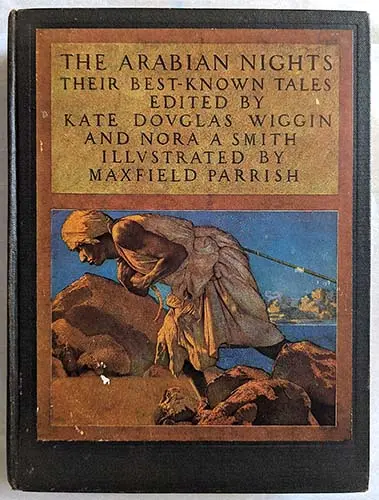
The 1909 edition, titled The Arabian Nights: Their Best-Known Tales, was edited by Kate Douglas Wiggin and Nora A. Smith, the literary sisters behind classics like Rebecca of Sunnybrook Farm . It was conceived from the start as a vehicle for Parrish’s art—a “master of make-believe” whose work could transport readers into the enchanted world of Aladdin, Sinbad, and Ali Baba. The book featured twelve full-color plates, a color-illustrated title page, and pictorial endpapers, all designed by Parrish himself . The stories selected included ten of the most beloved tales: “Aladdin’s Wonderful Lamp,” “Ali Baba and the Forty Thieves,” “The Seven Voyages of Sinbad the Sailor,” and others .
What makes Parrish’s illustrations so distinctive is their combination of theatrical grandeur and intimate detail. His palette is characteristically rich—deep cerulean blues, warm golden yellows, and luminous earth tones that evoke the sun-baked landscapes of the Middle East . His figures possess an idealized, statuesque beauty, yet they are rendered with a psychological depth that brings the characters to life. In one illustration, Aladdin stands before the magician as the earth opens to reveal the hidden lamp, the scene rendered with dramatic contrast between shadow and light . In another, the fisherman releases the genie from the brass vessel, smoke ascending to the clouds in a swirling column that seems almost alive .
Parrish’s technique was revolutionary. He often photographed his subjects in costume, using these photographs as references for his paintings. He then built his compositions layer by layer, applying oil glazes over detailed underpaintings to achieve a jewel-like luminosity . The result is work that feels both photographically real and impossibly dreamlike—a perfect fit for tales that hover between the everyday and the magical.
The first edition was bound in black cloth with gilt stamping on the spine and a color pictorial label—an illustration by Parrish—pasted on the front cover. The plates were printed in four-color process, a relatively new technology at the time, and mounted throughout the text.
The critical and popular response was immediate. The book sold well and remained in print for decades, with later printings appearing in 1912, 1916, 1930, and beyond . It cemented Parrish’s reputation as the preeminent illustrator of his generation and established a visual language for the Arabian Nights that has never been surpassed. In the words of one biographer, Parrish “created and painted a world of his own”—a world where the tales of Scheherazade found their perfect visual counterpart.
Today, first editions of Parrish’s Arabian Nights are treasures of the rare book market. Copies in fine condition, especially those with the original dust jacket, command prices in the hundreds. Yet the true value of the book lies not in its scarcity but in its enduring beauty. In Parrish’s hands, the lamp of Aladdin gleams with a light that seems to transcend the page, and the voyages of Sinbad unfold across seas of impossible blue. It is a book that reminds us why we return to these tales again and again: because in them, and in Parrish’s luminous vision, the imagination finds its truest home.
Recommended for Collectors
- The Knave of Hearts (1925) by Louise Saunders, illustrated by Parrish – A later showcase of his theatrical style
- Poems of Childhood (1904) by Eugene Field, illustrated by Parrish – For more of his early dreamlike imagery
- Stories from the Arabian Nights (1907) illustrated by Edmund Dulac – A complementary jewel-toned interpretation
Art Gallery: Maxfield Parrish – The Arabian Nights 1909
![Maxfield Parrish - Arabian Nights [parrish-arabian01] (art, illustrations)](https://www.nocloo.com/wp-content/plugins/justified-image-grid/timthumb.php?src=https%3A%2F%2Fwww.nocloo.com%2Fart%2Fparrish-arabian%2Fparrish-arabian01.jpg&h=280&q=90&f=.jpg)
![Maxfield Parrish - Arabian Nights [parrish-arabian02] (art, illustrations)](https://www.nocloo.com/wp-content/plugins/justified-image-grid/timthumb.php?src=https%3A%2F%2Fwww.nocloo.com%2Fart%2Fparrish-arabian%2Fparrish-arabian02.jpg&h=280&q=90&f=.jpg)
![Maxfield Parrish - Arabian Nights [parrish-arabian03] (art, illustrations)](https://www.nocloo.com/wp-content/plugins/justified-image-grid/timthumb.php?src=https%3A%2F%2Fwww.nocloo.com%2Fart%2Fparrish-arabian%2Fparrish-arabian03.jpg&h=280&q=90&f=.jpg)
![Maxfield Parrish - Arabian Nights [parrish-arabian04] (art, illustrations)](https://www.nocloo.com/wp-content/plugins/justified-image-grid/timthumb.php?src=https%3A%2F%2Fwww.nocloo.com%2Fart%2Fparrish-arabian%2Fparrish-arabian04.jpg&h=280&q=90&f=.jpg)
![Maxfield Parrish - Arabian Nights [parrish-arabian05] (art, illustrations)](https://www.nocloo.com/wp-content/plugins/justified-image-grid/timthumb.php?src=https%3A%2F%2Fwww.nocloo.com%2Fart%2Fparrish-arabian%2Fparrish-arabian05.jpg&h=280&q=90&f=.jpg)
![Maxfield Parrish - Arabian Nights [parrish-arabian06] (art, illustrations)](https://www.nocloo.com/wp-content/plugins/justified-image-grid/timthumb.php?src=https%3A%2F%2Fwww.nocloo.com%2Fart%2Fparrish-arabian%2Fparrish-arabian06.jpg&h=280&q=90&f=.jpg)
![Maxfield Parrish - Arabian Nights [parrish-arabian07] (art, illustrations)](https://www.nocloo.com/wp-content/plugins/justified-image-grid/timthumb.php?src=https%3A%2F%2Fwww.nocloo.com%2Fart%2Fparrish-arabian%2Fparrish-arabian07.jpg&h=280&q=90&f=.jpg)
![Maxfield Parrish - Arabian Nights [parrish-arabian08] (art, illustrations)](https://www.nocloo.com/wp-content/plugins/justified-image-grid/timthumb.php?src=https%3A%2F%2Fwww.nocloo.com%2Fart%2Fparrish-arabian%2Fparrish-arabian08.jpg&h=280&q=90&f=.jpg)
![Maxfield Parrish - Arabian Nights [parrish-arabian09] (art, illustrations)](https://www.nocloo.com/wp-content/plugins/justified-image-grid/timthumb.php?src=https%3A%2F%2Fwww.nocloo.com%2Fart%2Fparrish-arabian%2Fparrish-arabian09.jpg&h=280&q=90&f=.jpg)
![Maxfield Parrish - Arabian Nights [parrish-arabian10] (art, illustrations)](https://www.nocloo.com/wp-content/plugins/justified-image-grid/timthumb.php?src=https%3A%2F%2Fwww.nocloo.com%2Fart%2Fparrish-arabian%2Fparrish-arabian10.jpg&h=280&q=90&f=.jpg)
![Maxfield Parrish - Arabian Nights [parrish-arabian11] (art, illustrations)](https://www.nocloo.com/wp-content/plugins/justified-image-grid/timthumb.php?src=https%3A%2F%2Fwww.nocloo.com%2Fart%2Fparrish-arabian%2Fparrish-arabian11.jpg&h=280&q=90&f=.jpg)
![Maxfield Parrish - Arabian Nights [parrish-arabian12] (art, illustrations)](https://www.nocloo.com/wp-content/plugins/justified-image-grid/timthumb.php?src=https%3A%2F%2Fwww.nocloo.com%2Fart%2Fparrish-arabian%2Fparrish-arabian12.jpg&h=280&q=90&f=.jpg)