A World of Whimsy: Maxfield Parrish’s Knave of Hearts
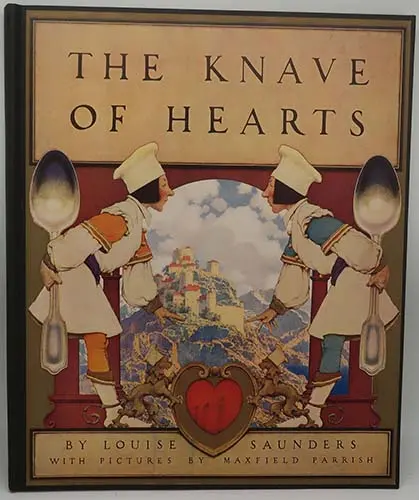
There are certain books that transcend the ordinary bounds of illustration, becoming instead a complete immersion into an artist’s singular vision. Maxfield Parrish’s Knave of Hearts, published in 1925, is such a work. This enchanting volume represents the pinnacle of Parrish’s career as a book illustrator—a luminous collaboration with author Louise Saunders that transforms a playful fairy tale into a visual symphony of color, wit, and otherworldly beauty.
Maxfield Parrish (1870–1966) was, by the time Knave of Hearts appeared, already one of the most celebrated and commercially successful artists in America. His distinctive style—characterized by luminous, saturated colors, idealized figures, and a palette dominated by his signature “Parrish blue”—had become instantly recognizable to millions through his magazine covers, advertisements, and prints. Yet book illustration remained a passion, and Knave of Hearts would become his most ambitious and beloved work in the medium.
The story, written by Louise Saunders with the encouragement of Parrish himself, is a playful riff on the traditional playing-card tales. It follows the misadventures of the Knave of Hearts, who steals the Queen’s tarts and must embark on a journey of redemption through a series of whimsical kingdoms. The narrative is light, charming, and deliberately theatrical—a perfect vehicle for Parrish’s decorative sensibility.
What sets Knave of Hearts apart is its conception as a total work of art. Parrish did not merely illustrate an existing text; he collaborated closely with Saunders to create a book where word and image were inseparable from the start. The result is a volume of extraordinary unity—each page designed as a cohesive composition, with Parrish’s illustrations, decorative borders, and ornamental initials weaving seamlessly with the text.
The book contains twelve full-page color plates, each a masterpiece of Parrish’s mature style. His palette is typically sumptuous—deep cerulean blues, warm golden yellows, rich crimsons, and soft mauves, all rendered with his characteristic technique of layering oil glazes over precise drawings to achieve an almost jewel-like luminosity. The figures possess the idealized beauty for which Parrish was famous: elegant, statuesque, existing in a realm that hovers between classical mythology and fairy-tale whimsy.
Yet there is also a playful humor in these illustrations that distinguishes them from his more serious works. The Knave himself is rendered as a charming rogue, his expressions conveying a mixture of mischief and regret. The Queen of Hearts presides with comic imperiousness, her court a delightful confection of costume and ceremony. Parrish understood that Knave of Hearts was a lark, and his illustrations capture the lighthearted spirit of the enterprise without sacrificing any of his technical mastery.
The physical production of the book matched the ambition of its art. Published by Charles Scribners & Sons in New York, 1925. Knave of Hearts was released in a large folio trade edition, housed in a slipcase that itself was exceptionally handsome. The plates were printed on heavy, high-quality paper,. The book was later issued in a cheaper spiral bound edition.
Critical and popular response to Knave of Hearts was immediate and enthusiastic. The book sold well and quickly became a collector’s treasure. For many, it remains the definitive Parrish book—the work that best captures the artist’s unique combination of technical virtuosity, decorative elegance, and imaginative whimsy.
Today, Knave of Hearts stands as a testament to a moment when the illustrated book was elevated to the status of fine art. Its images continue to enchant, their colors as luminous today as they were a century ago. In the pantheon of Golden Age illustrators, Maxfield Parrish occupies a singular place—an artist whose vision was so distinctive, so utterly his own, that his work is recognizable at a glance. Knave of Hearts is that vision in its purest form: a book that invites us to step into a world of beauty, wit, and endless imagination.
For collectors of this edition, these related works may fascinate:
• The Arabian Nights (1909) illustrated by Parrish – his earlier color experiments
• A Wonder Book (1910) also by Parrish – showing his Greek mythology interpretations
• The Bishop’s Candlesticks (1926) by Norman Rockwell – contemporary narrative painting
Art Gallery: Maxfield Parrish – Knave of Hearts 1925
![Maxfield Parrish - Knave of Hearts [parrish-knave00] (art, illustrations)](https://www.nocloo.com/wp-content/plugins/justified-image-grid/timthumb.php?src=https%3A%2F%2Fwww.nocloo.com%2Fart%2Fparrish-knave%2Fparrish-knave00.jpg&h=280&q=90&f=.jpg)
![Maxfield Parrish - Knave of Hearts [parrish-knave01] (art, illustrations)](https://www.nocloo.com/wp-content/plugins/justified-image-grid/timthumb.php?src=https%3A%2F%2Fwww.nocloo.com%2Fart%2Fparrish-knave%2Fparrish-knave01.jpg&h=280&q=90&f=.jpg)
![Maxfield Parrish - Knave of Hearts [parrish-knave02] (art, illustrations)](https://www.nocloo.com/wp-content/plugins/justified-image-grid/timthumb.php?src=https%3A%2F%2Fwww.nocloo.com%2Fart%2Fparrish-knave%2Fparrish-knave02.jpg&h=280&q=90&f=.jpg)
![Maxfield Parrish - Knave of Hearts [parrish-knave03] (art, illustrations)](https://www.nocloo.com/wp-content/plugins/justified-image-grid/timthumb.php?src=https%3A%2F%2Fwww.nocloo.com%2Fart%2Fparrish-knave%2Fparrish-knave03.jpg&h=280&q=90&f=.jpg)
![Maxfield Parrish - Knave of Hearts [parrish-knave04] (art, illustrations)](https://www.nocloo.com/wp-content/plugins/justified-image-grid/timthumb.php?src=https%3A%2F%2Fwww.nocloo.com%2Fart%2Fparrish-knave%2Fparrish-knave04.jpg&h=280&q=90&f=.jpg)
![Maxfield Parrish - Knave of Hearts [parrish-knave05] (art, illustrations)](https://www.nocloo.com/wp-content/plugins/justified-image-grid/timthumb.php?src=https%3A%2F%2Fwww.nocloo.com%2Fart%2Fparrish-knave%2Fparrish-knave05.jpg&h=280&q=90&f=.jpg)
![Maxfield Parrish - Knave of Hearts [parrish-knave06] (art, illustrations)](https://www.nocloo.com/wp-content/plugins/justified-image-grid/timthumb.php?src=https%3A%2F%2Fwww.nocloo.com%2Fart%2Fparrish-knave%2Fparrish-knave06.jpg&h=280&q=90&f=.jpg)
![Maxfield Parrish - Knave of Hearts [parrish-knave07] (art, illustrations)](https://www.nocloo.com/wp-content/plugins/justified-image-grid/timthumb.php?src=https%3A%2F%2Fwww.nocloo.com%2Fart%2Fparrish-knave%2Fparrish-knave07.jpg&h=280&q=90&f=.jpg)
![Maxfield Parrish - Knave of Hearts [parrish-knave08] (art, illustrations)](https://www.nocloo.com/wp-content/plugins/justified-image-grid/timthumb.php?src=https%3A%2F%2Fwww.nocloo.com%2Fart%2Fparrish-knave%2Fparrish-knave08.jpg&h=280&q=90&f=.jpg)
![Maxfield Parrish - Knave of Hearts [parrish-knave09] (art, illustrations)](https://www.nocloo.com/wp-content/plugins/justified-image-grid/timthumb.php?src=https%3A%2F%2Fwww.nocloo.com%2Fart%2Fparrish-knave%2Fparrish-knave09.jpg&h=280&q=90&f=.jpg)
![Maxfield Parrish - Knave of Hearts [parrish-knave10] (art, illustrations)](https://www.nocloo.com/wp-content/plugins/justified-image-grid/timthumb.php?src=https%3A%2F%2Fwww.nocloo.com%2Fart%2Fparrish-knave%2Fparrish-knave10.jpg&h=280&q=90&f=.jpg)
![Maxfield Parrish - Knave of Hearts [parrish-knave11] (art, illustrations)](https://www.nocloo.com/wp-content/plugins/justified-image-grid/timthumb.php?src=https%3A%2F%2Fwww.nocloo.com%2Fart%2Fparrish-knave%2Fparrish-knave11.jpg&h=280&q=90&f=.jpg)
![Maxfield Parrish - Knave of Hearts [parrish-knave12] (art, illustrations)](https://www.nocloo.com/wp-content/plugins/justified-image-grid/timthumb.php?src=https%3A%2F%2Fwww.nocloo.com%2Fart%2Fparrish-knave%2Fparrish-knave12.jpg&h=280&q=90&f=.jpg)
![Maxfield Parrish - Knave of Hearts [parrish-knave13] (art, illustrations)](https://www.nocloo.com/wp-content/plugins/justified-image-grid/timthumb.php?src=https%3A%2F%2Fwww.nocloo.com%2Fart%2Fparrish-knave%2Fparrish-knave13.jpg&h=280&q=90&f=.jpg)
![Maxfield Parrish - Knave of Hearts [parrish-knave14] (art, illustrations)](https://www.nocloo.com/wp-content/plugins/justified-image-grid/timthumb.php?src=https%3A%2F%2Fwww.nocloo.com%2Fart%2Fparrish-knave%2Fparrish-knave14.jpg&h=280&q=90&f=.jpg)
![Maxfield Parrish - Knave of Hearts [parrish-knave15] (art, illustrations)](https://www.nocloo.com/wp-content/plugins/justified-image-grid/timthumb.php?src=https%3A%2F%2Fwww.nocloo.com%2Fart%2Fparrish-knave%2Fparrish-knave15.jpg&h=280&q=90&f=.jpg)
![Maxfield Parrish - Knave of Hearts [parrish-knave16] (art, illustrations)](https://www.nocloo.com/wp-content/plugins/justified-image-grid/timthumb.php?src=https%3A%2F%2Fwww.nocloo.com%2Fart%2Fparrish-knave%2Fparrish-knave16.jpg&h=280&q=90&f=.jpg)
![Maxfield Parrish - Knave of Hearts [parrish-knave17] (art, illustrations)](https://www.nocloo.com/wp-content/plugins/justified-image-grid/timthumb.php?src=https%3A%2F%2Fwww.nocloo.com%2Fart%2Fparrish-knave%2Fparrish-knave17.jpg&h=280&q=90&f=.jpg)
![Maxfield Parrish - Knave of Hearts [parrish-knave18] (art, illustrations)](https://www.nocloo.com/wp-content/plugins/justified-image-grid/timthumb.php?src=https%3A%2F%2Fwww.nocloo.com%2Fart%2Fparrish-knave%2Fparrish-knave18.jpg&h=280&q=90&f=.jpg)
![Maxfield Parrish - Knave of Hearts [parrish-knave19] (art, illustrations)](https://www.nocloo.com/wp-content/plugins/justified-image-grid/timthumb.php?src=https%3A%2F%2Fwww.nocloo.com%2Fart%2Fparrish-knave%2Fparrish-knave19.jpg&h=280&q=90&f=.jpg)
![Maxfield Parrish - Knave of Hearts [parrish-knave20] (art, illustrations)](https://www.nocloo.com/wp-content/plugins/justified-image-grid/timthumb.php?src=https%3A%2F%2Fwww.nocloo.com%2Fart%2Fparrish-knave%2Fparrish-knave20.jpg&h=280&q=90&f=.jpg)
![Maxfield Parrish - Knave of Hearts [parrish-knave21] (art, illustrations)](https://www.nocloo.com/wp-content/plugins/justified-image-grid/timthumb.php?src=https%3A%2F%2Fwww.nocloo.com%2Fart%2Fparrish-knave%2Fparrish-knave21.jpg&h=280&q=90&f=.jpg)