A Tapestry of Camelot: Eleanor Fortescue-Brickdale’s The Idylls of the King
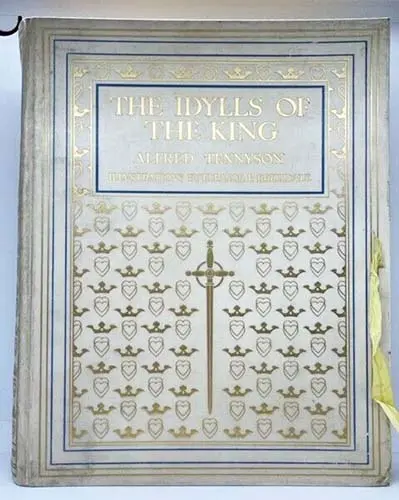
In the grand tradition of Arthurian illustration, certain artists achieve such a profound synthesis with their subject that their work becomes inseparable from the stories themselves. Eleanor Fortescue-Brickdale’s 1911 edition of Alfred, Lord Tennyson’s The Idylls of the King represents one such achievement. A masterpiece of the Pre-Raphaelite revival, this volume stands as the crowning achievement of an artist who dedicated her career to the pursuit of beauty, narrative, and the revival of medieval romanticism in the Edwardian age.
Eleanor Fortescue-Brickdale (1872–1945) was a painter, illustrator, and stained-glass designer who carried the torch of the Pre-Raphaelite Brotherhood into the twentieth century. Trained at the Royal Academy Schools, where she won a gold medal for historical painting, she remained devoted throughout her career to the ideals of artists like Holman Hunt and John Everett Millais: meticulous attention to detail, luminous color, and a profound engagement with literary and historical subject matter. By 1911, she was already an established artist, with her work appearing in prestigious exhibitions and her illustrations gracing volumes of Shakespeare and Tennyson.
The commission to illustrate The Idylls of the King was a natural fit. Tennyson’s cycle of twelve narrative poems, first published between 1859 and 1885, had become the definitive Victorian interpretation of the Arthurian legend—a sweeping meditation on chivalry, faith, betrayal, and the fall of a golden age. For Fortescue-Brickdale, whose artistic sensibility was steeped in the medieval revival, the subject offered an opportunity to engage with themes that had occupied her imagination for years.
The 1911 edition, published by Hodder & Stoughton in London, was a lavish production befitting its subject. The volume contained a series of full-color illustrations—each mounted on heavy paper and protected by captioned tissue guards. These were accompanied by numerous black-and-white drawings and decorative elements woven throughout the text. The physical book itself was substantial: bound in cloth with gilt stamping, often featuring a design by the artist on the front cover, it was intended as a gift book of the highest quality, a treasure to be displayed and cherished.
What distinguishes Fortescue-Brickdale’s illustrations for The Idylls is their combination of Pre-Raphaelite intensity with a distinctly Edwardian elegance. Her palette is rich and jewel-like—deep crimson, sapphire blue, emerald green, and burnished gold—colors that evoke both the medieval world she depicts and the sumptuous aesthetic of the Pre-Raphaelite painters she admired. Her figures possess the idealized beauty characteristic of the movement: women with flowing hair and solemn expressions, knights in shining armor, landscapes that shimmer with atmospheric light.
Yet there is also a narrative clarity to her work that sets it apart. Fortescue-Brickdale was a master of storytelling through imagery, and each of her illustrations functions as a window into Tennyson’s text. The moment of the Lady of Shalott’s fateful departure, Guinevere’s repentance before Arthur, Elaine’s vigil over Lancelot’s shield—these scenes are rendered with a dramatic intensity that draws the viewer into the emotional heart of the poem. She understood that Tennyson’s Idylls are not merely tales of adventure but psychological studies in love, duty, and betrayal, and her illustrations capture that complexity.
The Arthurian legend had attracted some of the greatest illustrators of the nineteenth century—Gustave Doré, Aubrey Beardsley, Howard Pyle—yet Fortescue-Brickdale brought something distinct to her interpretation. Her Camelot is a place of serene beauty shadowed by impending tragedy, her characters rendered with a tenderness that makes their fall all the more poignant. In her hands, Tennyson’s medievalism meets Pre-Raphaelite passion, creating a vision of Arthurian Britain that is at once romantic and deeply human.
Today, first editions of Fortescue-Brickdale’s The Idylls of the King are highly prized by collectors. The combination of Tennyson’s literary stature, Fortescue-Brickdale’s artistic reputation, and the exceptional production quality of the Hodder & Stoughton edition makes it one of the most desirable illustrated books of the Edwardian era. For those fortunate enough to own a copy, it offers not merely a book but an experience—a journey into a world of knights and ladies, of honor and sorrow, rendered with a beauty that, like the legend itself, endures across the centuries. In her illustrations for The Idylls, Eleanor Fortescue-Brickdale achieved something rare: a visual counterpart to Tennyson’s poetry that feels less like illustration than like revelation.
Recommended for Collectors
- The High History of the Holy Graal (1908) illustrated by Jessie M. King – Another Arthurian-inspired work with Art Nouveau flair
- Le Morte d’Arthur (1893) illustrated by Aubrey Beardsley – For a more decadent, fin-de-siècle take on the legends
Art Gallery: Eleanor Fortescue-Brickdale – The Idylls of the King 1911