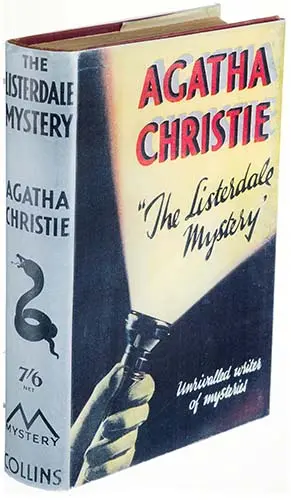
The Listerdale Mystery is a short story collection written by Agatha Christie and first published in the UK by William Collins and Sons in June 1934. The book retailed at seven shillings and sixpence (7/6). The collection did not appear in the US; however, all of the stories contained within it did appear in other collections only published there.
The collection contains twelve stories, featuring characters such as Parker Pyne and Harley Quin, alongside standalone tales of romance, adventure, and detection. Notably, no stories in this collection feature Hercule Poirot or Miss Marple. Critical reception was mixed, with some reviewers praising the variety of genres while others noted the absence of Christie’s famous detectives. The collection sold respectably but less vigorously than her full-length novels. The first paperback edition appeared in the United States from Pocket Books in 1948, followed by a UK paperback from Fontana Books in 1961. Several stories had previously appeared in magazines such as The Grand Magazine and The Strand between 1926 and 1933.
References to other works
- In Mr Eastwood’s Adventure, Anthony Eastwood misquotes from the Rubaiyat of Omar Khayyam when he states “Tomorrow I may be Myself with Yesterday’s ten thousand years”. The quote should be for seven thousand years.
- In The Rajah’s Emerald, James Bond quotes “Thanking heaven fasting, for a good man’s love” from Act III, Scene 5 of As You Like It. The name of James Bond is pure coincidence to the famous literary secret agent, The Rajah’s Emerald having first appeared in print twenty-seven years before the first Bond book by Ian Fleming, Casino Royale. Lord Edward Campion is a character in the Parade’s End novels by Ford Madox Ford.
- In Swan Song, Paula Nazorkoff’s final words, “La commedia è finita!” are taken from the opera Pagliacci. This opera is also referenced in The Face of Helen, a short story in the 1930 collection The Mysterious Mr. Quin.
Publication history
- 1934, William Collins and Sons, June 1934, Hardcover, 256 pp
- 1961, Fontana Books (Imprint of HarperCollins), Paperback, 192 pp
- 1970, Pan Books, Paperback, 188 pp, ISBN 0-330-02504-X
First publication of stories
The first UK publication details of all the stories contained in The Listerdale Mystery are as follows:
- The Listerdale Mystery: First published in issue 250 of The Grand Magazine in December 1925.
- Philomel Cottage: First published in issue 237 of The Grand Magazine in November 1924.
- The Girl in the Train: First published in issue 228 of The Grand Magazine in February 1924.
- Sing a Song of Sixpence: First published in Holly Leaves, the annual Christmas special of the Illustrated Sporting and Dramatic News in December 1929 with illustrations by C. Watson.
- The Manhood of Edward Robinson: First published in issue 238 of The Grand Magazine in December 1924.
- Accident: First published as The Uncrossed Path in the 22 September 1929 issue of the Sunday Dispatch with an uncredited illustration.
- Jane in Search of a Job: First published in issue 234 of The Grand Magazine in August 1924.
- A Fruitful Sunday: First published in the Daily Mail on 11 August 1928 with an uncredited illustration.
- Mr Eastwood’s Adventure: First published as The Mystery of the Second Cucumber in issue 233 of The Novel Magazine in August 1924, with an illustration by Wilmot Lunt.
- The Golden Ball: First published as Playing the Innocent in the Daily Mail on 5 August 1929 with an illustration by Lowtham. The line early in the story where Ephraim Leadbetter tells his nephew that he has failed to grasp “the golden ball of opportunity” is missing from this version but the reference to the “Golden Ball” is intact at the end of the tale.
- The Rajah’s Emerald: First published in issue 420 of the fortnightly Red Magazine on 30 July 1926, with an illustration by Jack M. Faulks.
- Swan Song: First published in issue 259 of The Grand Magazine in September 1926.
Publication of book collection
As with Parker Pyne Investigates, this collection did not appear under the usual imprint of the Collins Crime Club but instead appeared as part of the Collins Mystery series. Along with The Hound of Death, this makes The Listerdale Mystery one of only three major book publications of Christie’s crime works not to appear under the Crime Club imprint in the UK between 1930 and 1979.
US book appearances of stories
The stories contained in The Listerdale Mystery appeared in the following US collections:
- The Witness for the Prosecution and Other Stories (1948) – Accident, Mr Eastwood’s Adventure (under the revised title of The Mystery of the Spanish Shawl), Philomel Cottage and Sing a Song of Sixpence.
- The Golden Ball and Other Stories (1971) – The Listerdale Mystery, The Girl in the Train, The Manhood of Edward Robinson, Jane in Search of a Job, A Fruitful Sunday, The Golden Ball, The Rajah’s Emerald, Swan Song
The Listerdale Mystery – First Edition Book Identification Guide
The books are listed in the order of publication. While the majority of Agatha Christie’s books were first published in the UK. There are many titles that were first published in the US. The title of the book may differs from the UK edition in some cases.
| Year | Title | Publisher | First edition/printing identification points |
|---|---|---|---|
| 1934 | The Listerdale Mystery | Collins, London, 1934 | First edition. "Copyright, 1934". No statement of later printings. Burgundy cloth lettred in silver. No US edition. Price 7/6. |
Note about Book Club Editions (BCE) and reprints:
UK: You can see statements of later reprint dates or of book club on the copyright page.
US: The US reprint publishers usually use the same sheets as the first edition and are harder to identify by looking at the title page or the copyright page. One may identify a BCE by looking at the DJ, which doesn’t have a price on top of the front flap and a “Book Club Edition” imprint at the bottom. If the dust jacked is clipped at both the top/bottom of the front flap. You can safely assume it’s a BCE . If the book is missing the dust jacket. Later BCE editions can be identified by its plain boards, while first printings are issued in quarter cloth.
Please refer to the gallery for detailed images of true first edition bindings and dust jackets.
The Listerdale Mystery – First Edition Dust Jacket Identification Guide
First edition bindings and various dust jacket printings identification.


Reference: