A Masterpiece of Enchantment: Kay Nielsen’s East of the Sun, West of the Moon
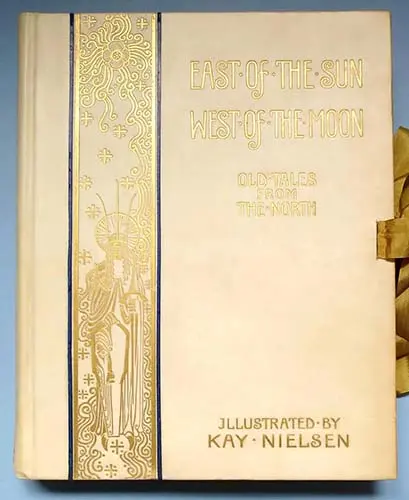
Limited Edition
There are illustrated books that merely accompany a story, and then there are those that become the story itself—where the artist’s vision is so potent, so utterly immersive, that it reshapes how generations of readers experience the tale. Kay Nielsen’s 1914 edition of East of the Sun, West of the Moon belongs firmly to the latter category. It is a book that stands as one of the crowning achievements of the Golden Age of Illustration, a work of breathtaking beauty that transformed a beloved Norwegian folktale into a visual symphony of wonder and longing.
Kay Nielsen was, at the time of this publication, a young Danish artist on the cusp of greatness. Born in Copenhagen in 1886, he had studied art in Paris at the Académie Julian and the Académie Colarossi, absorbing the influences of Art Nouveau, Symbolism, and the Pre-Raphaelites. Yet his style was entirely his own—a fusion of Nordic melancholy, Persian miniature precision, and a decorative sensibility that seemed to belong to no single tradition. East of the Sun, West of the Moon was his second major commission, following the success of In Powder and Crinoline the previous year, and it would cement his reputation as one of the most original illustrators of his generation.
The book presents a collection of Norwegian folktales, with the title story serving as its centerpiece. This tale of a white bear, a curious maiden, and a journey to a castle beyond the world’s end was perfectly suited to Nielsen’s artistic sensibilities. It possessed everything he excelled at rendering: romance, mystery, melancholy, and the tension between earthly beauty and otherworldly magic. In his hands, these elements coalesced into something extraordinary.
Published by Hodder & Stoughton in London, East of the Sun, West of the Moon was conceived as a lavish gift book, issued in both a limited, signed edition and a trade edition. The volume featured twenty-five color plates, each mounted on heavy paper and protected by captioned tissue guards, alongside numerous black-and-white illustrations and decorative elements woven throughout the text. From the moment one opens the book, Nielsen’s vision unfolds in all its intricacy and grandeur.
What distinguishes Nielsen’s illustrations is their extraordinary synthesis of influences and their emotional depth. His palette ranges from the ethereal—pale blues, soft golds, and misty lavenders—to the richly dramatic—deep crimsons, midnight blacks, and burnished ochres. The compositions are masterfully balanced, often employing flattened perspectives and decorative patterning that recall Persian miniatures and Japanese prints. His figures possess an elegant, elongated grace, their flowing garments rendered with meticulous attention to line and texture.
Among the most celebrated plates is the depiction of the heroine riding the white bear across a frozen, star-strewn landscape. The image captures both the loneliness of her journey and the quiet magic of her companion, the bear rendered as a creature of monumental dignity and hidden power. Another notable illustration shows the princess discovering the prince in his castle, the scene bathed in a golden, otherworldly light that suggests the fragile beauty of love redeemed.
Nielsen’s work is also notable for its handling of the folktale’s darker elements. There is a haunting quality to his trolls and witches, rendered with a grotesque elegance that never descends into mere caricature. The troll princesses, with their elongated features and elaborate costumes, possess a sinister beauty that makes the hero’s plight all the more poignant.
The critical response to East of the Sun, West of the Moon was immediate and enthusiastic. Reviewers praised Nielsen’s “exquisite decorative sense” and his ability to capture “the very spirit of the Northern tales.” The book quickly became a collector’s treasure, prized for its beauty and its rarity.
Today, more than a century after its publication, Kay Nielsen’s East of the Sun, West of the Moon remains a touchstone of illustrated literature. Its images have influenced generations of artists and continue to captivate new readers with their timeless beauty. It stands as a testament to what happens when an artist of extraordinary vision meets a story worthy of his gifts—a book that truly deserves its place as a masterpiece of enchantment.
For collectors of this edition, these complementary works may captivate:
• Hansel and Gretel (1925) also illustrated by Nielsen – his later Germanic fairy tale work
• The Fairy Tales of the Brothers Grimm (1909) illustrated by Arthur Rackham – for contrasting Edwardian style
• Norwegian Folktales (1982) illustrated by Theodor Kittelsen – authentic Nordic interpretations
Art Gallery: Kay Nielsen – East of the Sun, West of the Moon 1914
![Kay Nielsen - East of the Sun, West of the Moon [nielsen-moon01] (art, illustrations)](https://www.nocloo.com/wp-content/plugins/justified-image-grid/timthumb.php?src=https%3A%2F%2Fwww.nocloo.com%2Fart%2Fnielsen-sun%2Fnielsen-moon01.jpg&h=280&q=90&f=.jpg)
![Kay Nielsen - East of the Sun, West of the Moon [nielsen-moon02] (art, illustrations)](https://www.nocloo.com/wp-content/plugins/justified-image-grid/timthumb.php?src=https%3A%2F%2Fwww.nocloo.com%2Fart%2Fnielsen-sun%2Fnielsen-moon02.jpg&h=280&q=90&f=.jpg)
![Kay Nielsen - East of the Sun, West of the Moon [nielsen-moon03] (art, illustrations)](https://www.nocloo.com/wp-content/plugins/justified-image-grid/timthumb.php?src=https%3A%2F%2Fwww.nocloo.com%2Fart%2Fnielsen-sun%2Fnielsen-moon03.jpg&h=280&q=90&f=.jpg)
![Kay Nielsen - East of the Sun, West of the Moon [nielsen-moon04] (art, illustrations)](https://www.nocloo.com/wp-content/plugins/justified-image-grid/timthumb.php?src=https%3A%2F%2Fwww.nocloo.com%2Fart%2Fnielsen-sun%2Fnielsen-moon04.jpg&h=280&q=90&f=.jpg)
![Kay Nielsen - East of the Sun, West of the Moon [nielsen-moon05] (art, illustrations)](https://www.nocloo.com/wp-content/plugins/justified-image-grid/timthumb.php?src=https%3A%2F%2Fwww.nocloo.com%2Fart%2Fnielsen-sun%2Fnielsen-moon05.jpg&h=280&q=90&f=.jpg)

![Kay Nielsen - East of the Sun, West of the Moon [nielsen-moon07] (art, illustrations)](https://www.nocloo.com/wp-content/plugins/justified-image-grid/timthumb.php?src=https%3A%2F%2Fwww.nocloo.com%2Fart%2Fnielsen-sun%2Fnielsen-moon07.jpg&h=280&q=90&f=.jpg)

![Kay Nielsen - East of the Sun, West of the Moon [nielsen-moon09] (art, illustrations)](https://www.nocloo.com/wp-content/plugins/justified-image-grid/timthumb.php?src=https%3A%2F%2Fwww.nocloo.com%2Fart%2Fnielsen-sun%2Fnielsen-moon09.jpg&h=280&q=90&f=.jpg)
![Kay Nielsen - East of the Sun, West of the Moon [nielsen-moon10] (art, illustrations)](https://www.nocloo.com/wp-content/plugins/justified-image-grid/timthumb.php?src=https%3A%2F%2Fwww.nocloo.com%2Fart%2Fnielsen-sun%2Fnielsen-moon10.jpg&h=280&q=90&f=.jpg)
![Kay Nielsen - East of the Sun, West of the Moon [nielsen-moon11] (art, illustrations)](https://www.nocloo.com/wp-content/plugins/justified-image-grid/timthumb.php?src=https%3A%2F%2Fwww.nocloo.com%2Fart%2Fnielsen-sun%2Fnielsen-moon11.jpg&h=280&q=90&f=.jpg)
![Kay Nielsen - East of the Sun, West of the Moon [nielsen-moon12] (art, illustrations)](https://www.nocloo.com/wp-content/plugins/justified-image-grid/timthumb.php?src=https%3A%2F%2Fwww.nocloo.com%2Fart%2Fnielsen-sun%2Fnielsen-moon12.jpg&h=280&q=90&f=.jpg)
![Kay Nielsen - East of the Sun, West of the Moon [nielsen-moon13] (art, illustrations)](https://www.nocloo.com/wp-content/plugins/justified-image-grid/timthumb.php?src=https%3A%2F%2Fwww.nocloo.com%2Fart%2Fnielsen-sun%2Fnielsen-moon13.jpg&h=280&q=90&f=.jpg)
![Kay Nielsen - East of the Sun, West of the Moon [nielsen-moon14] (art, illustrations)](https://www.nocloo.com/wp-content/plugins/justified-image-grid/timthumb.php?src=https%3A%2F%2Fwww.nocloo.com%2Fart%2Fnielsen-sun%2Fnielsen-moon14.jpg&h=280&q=90&f=.jpg)
![Kay Nielsen - East of the Sun, West of the Moon [nielsen-moon15] (art, illustrations)](https://www.nocloo.com/wp-content/plugins/justified-image-grid/timthumb.php?src=https%3A%2F%2Fwww.nocloo.com%2Fart%2Fnielsen-sun%2Fnielsen-moon15.jpg&h=280&q=90&f=.jpg)
![Kay Nielsen - East of the Sun, West of the Moon [nielsen-moon16] (art, illustrations)](https://www.nocloo.com/wp-content/plugins/justified-image-grid/timthumb.php?src=https%3A%2F%2Fwww.nocloo.com%2Fart%2Fnielsen-sun%2Fnielsen-moon16.jpg&h=280&q=90&f=.jpg)
![Kay Nielsen - East of the Sun, West of the Moon [nielsen-moon17] (art, illustrations)](https://www.nocloo.com/wp-content/plugins/justified-image-grid/timthumb.php?src=https%3A%2F%2Fwww.nocloo.com%2Fart%2Fnielsen-sun%2Fnielsen-moon17.jpg&h=280&q=90&f=.jpg)

![Kay Nielsen - East of the Sun, West of the Moon [nielsen-moon19] (art, illustrations)](https://www.nocloo.com/wp-content/plugins/justified-image-grid/timthumb.php?src=https%3A%2F%2Fwww.nocloo.com%2Fart%2Fnielsen-sun%2Fnielsen-moon19.jpg&h=280&q=90&f=.jpg)
![Kay Nielsen - East of the Sun, West of the Moon [nielsen-moon20] (art, illustrations)](https://www.nocloo.com/wp-content/plugins/justified-image-grid/timthumb.php?src=https%3A%2F%2Fwww.nocloo.com%2Fart%2Fnielsen-sun%2Fnielsen-moon20.jpg&h=280&q=90&f=.jpg)
![Kay Nielsen - East of the Sun, West of the Moon [nielsen-moon21] (art, illustrations)](https://www.nocloo.com/wp-content/plugins/justified-image-grid/timthumb.php?src=https%3A%2F%2Fwww.nocloo.com%2Fart%2Fnielsen-sun%2Fnielsen-moon21.jpg&h=280&q=90&f=.jpg)
![Kay Nielsen - East of the Sun, West of the Moon [nielsen-moon22] (art, illustrations)](https://www.nocloo.com/wp-content/plugins/justified-image-grid/timthumb.php?src=https%3A%2F%2Fwww.nocloo.com%2Fart%2Fnielsen-sun%2Fnielsen-moon22.jpg&h=280&q=90&f=.jpg)
![Kay Nielsen - East of the Sun, West of the Moon [nielsen-moon23] (art, illustrations)](https://www.nocloo.com/wp-content/plugins/justified-image-grid/timthumb.php?src=https%3A%2F%2Fwww.nocloo.com%2Fart%2Fnielsen-sun%2Fnielsen-moon23.jpg&h=280&q=90&f=.jpg)
![Kay Nielsen - East of the Sun, West of the Moon [nielsen-moon24] (art, illustrations)](https://www.nocloo.com/wp-content/plugins/justified-image-grid/timthumb.php?src=https%3A%2F%2Fwww.nocloo.com%2Fart%2Fnielsen-sun%2Fnielsen-moon24.jpg&h=280&q=90&f=.jpg)
![Kay Nielsen - East of the Sun, West of the Moon [nielsen-moon25] (art, illustrations)](https://www.nocloo.com/wp-content/plugins/justified-image-grid/timthumb.php?src=https%3A%2F%2Fwww.nocloo.com%2Fart%2Fnielsen-sun%2Fnielsen-moon25.jpg&h=280&q=90&f=.jpg)