A Sisterly Collaboration: Millicent Sowerby’s Childhood
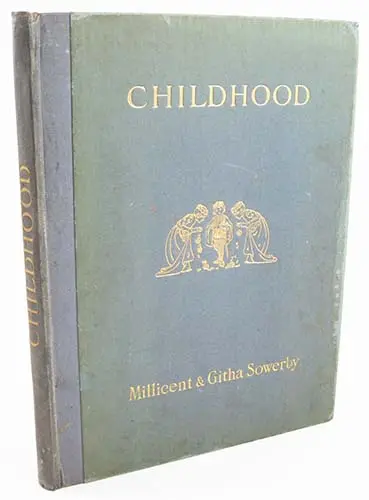
In the golden age of children’s book illustration, few collaborations were as fruitful and enduring as that of the Sowerby sisters. Githa Sowerby wrote the verses; Millicent Sowerby brought them to life with her gentle, evocative illustrations. Their 1907 volume, Childhood, stands as a testament to this remarkable partnership—a book that captures the quiet wonder, the small adventures, and the timeless moments of being young.
Millicent Sowerby (1878–1967) was an English painter and illustrator whose work became synonymous with Edwardian childhood . Born in Gateshead, she was the daughter of illustrator John G. Sowerby and the fourth of six children, including her sister Katherine Githa (1876–1970), who would become her most frequent collaborator. Though Millicent took some art classes in Newcastle, she was largely self-taught, initially focusing on watercolors and landscape painting before falling under the influence of artists like Kate Greenaway and the Arts and Crafts movement.
Childhood, published in 1907 by Chatto & Windus in London and Duffield & Co. in New York, was a collection of poems whose subjects ranged from “pretending to be a king” to “going to church, looking at an old tapestry, and writing books”. The volume contained twelve color plates, mounted on heavy paper, alongside illustrations printed in olive green with text in rust-colored ink—a distinctive design choice that set the book apart from other children’s volumes of the era . The binding was in blue-gray cloth with gilt stamping, and the pictorial endpapers, printed in white, invited young readers into the world within .
What distinguishes Millicent’s work in Childhood is its warmth and accessibility. Her style, often compared to that of Kate Greenaway, was characterized by rounded, rosy-cheeked children, soft watercolors, and scenes of cozy domesticity . A contemporary review in The Academy praised her work in this volume as “much better” than her better-known illustrations for Alice in Wonderland, noting that “the bistre drawings have a charming effect, and she has a pretty fancy”.
The subjects of the poems, written by Githa, reflected the Sowerby sisters’ own childhood sensibilities. Their family had settled in Sutton Courtenay, and the natural world, the rhythms of domestic life, and the small dramas of growing up all found their way into the verses . Millicent’s illustrations captured these moments with a tender realism—children at play, lost in books, observing the world around them with the quiet intensity that only the young possess.
The book appeared at a significant moment in Millicent’s career. Just months earlier, she had become one of the first women to illustrate Alice in Wonderland following the expiration of its UK copyright . While that edition brought her wider fame, critics recognized that her work for her sister’s books was where her true genius lay. A 1911 review of three books produced with Githa proclaimed, “Millicent Sowerby is Kate Greenaway come to life again” .
Today, first editions of Childhood are treasured by collectors of Golden Age illustration. The book’s fragile binding makes surviving copies in fine condition increasingly scarce . For those fortunate enough to own one, the volume offers a window into a particular moment in children’s literature—when the Sowerby sisters, working in harmony, created books of quiet beauty that captured the essence of childhood.
In the pages of Childhood, the children still play, still dream, still discover the world anew. Millicent Sowerby’s illustrations, with their “pretty fancy” and their charming effect, preserve those moments for us, more than a century later. It is a book that reminds us that the best art, like the best childhoods, is made of small wonders—and the love that brings them to life.
For the Collector’s Library:
- A Apple Pie (1900), illustrated by Kate Greenaway – A beautifully illustrated alphabet book with vintage charm.
- The Water-Babies (1909), illustrated by Warwick Goble – A poetic, whimsical tale with delicate fairy tale illustrations.
- Mother Goose (1913), illustrated by Blanche Fisher Wright – A classic nursery rhyme collection with colorful, nostalgic imagery.
- A Child’s Garden of Verses (1905) – R.L. Stevenson, Illustrated by Jessie Willcox Smith – A comparable Golden Age celebration of childhood.
- Kate Greenaway’s Almanacs (1880s-1890s) – Earlier influences on the Sowerbys’ nostalgic illustration style.
Art Gallery: Millicent Sowerby – Childhood 1907
![Millicent Sowerby - Childhood [sowerby-childhood01] (art, illustrations)](https://www.nocloo.com/wp-content/plugins/justified-image-grid/timthumb.php?src=https%3A%2F%2Fwww.nocloo.com%2Fart%2Fsowerby-childhood%2Fsowerby-childhood01.jpg&h=280&q=90&f=.jpg "Millicent Sowerby - Illustrations for Childhood 1907")
![Millicent Sowerby - Childhood [sowerby-childhood02] (art, illustrations)](https://www.nocloo.com/wp-content/plugins/justified-image-grid/timthumb.php?src=https%3A%2F%2Fwww.nocloo.com%2Fart%2Fsowerby-childhood%2Fsowerby-childhood02.jpg&h=280&q=90&f=.jpg "Millicent Sowerby - Illustrations for Childhood 1907")
![Millicent Sowerby - Childhood [sowerby-childhood03] (art, illustrations)](https://www.nocloo.com/wp-content/plugins/justified-image-grid/timthumb.php?src=https%3A%2F%2Fwww.nocloo.com%2Fart%2Fsowerby-childhood%2Fsowerby-childhood03.jpg&h=280&q=90&f=.jpg "Millicent Sowerby - Illustrations for Childhood 1907")
![Millicent Sowerby - Childhood [sowerby-childhood04] (art, illustrations)](https://www.nocloo.com/wp-content/plugins/justified-image-grid/timthumb.php?src=https%3A%2F%2Fwww.nocloo.com%2Fart%2Fsowerby-childhood%2Fsowerby-childhood04.jpg&h=280&q=90&f=.jpg "Millicent Sowerby - Illustrations for Childhood 1907")
![Millicent Sowerby - Childhood [sowerby-childhood05] (art, illustrations)](https://www.nocloo.com/wp-content/plugins/justified-image-grid/timthumb.php?src=https%3A%2F%2Fwww.nocloo.com%2Fart%2Fsowerby-childhood%2Fsowerby-childhood05.jpg&h=280&q=90&f=.jpg "Millicent Sowerby - Illustrations for Childhood 1907")
![Millicent Sowerby - Childhood [sowerby-childhood06] (art, illustrations)](https://www.nocloo.com/wp-content/plugins/justified-image-grid/timthumb.php?src=https%3A%2F%2Fwww.nocloo.com%2Fart%2Fsowerby-childhood%2Fsowerby-childhood06.jpg&h=280&q=90&f=.jpg "Millicent Sowerby - Illustrations for Childhood 1907")
![Millicent Sowerby - Childhood [sowerby-childhood07] (art, illustrations)](https://www.nocloo.com/wp-content/plugins/justified-image-grid/timthumb.php?src=https%3A%2F%2Fwww.nocloo.com%2Fart%2Fsowerby-childhood%2Fsowerby-childhood07.jpg&h=280&q=90&f=.jpg "Millicent Sowerby - Illustrations for Childhood 1907")
![Millicent Sowerby - Childhood [sowerby-childhood08] (art, illustrations)](https://www.nocloo.com/wp-content/plugins/justified-image-grid/timthumb.php?src=https%3A%2F%2Fwww.nocloo.com%2Fart%2Fsowerby-childhood%2Fsowerby-childhood08.jpg&h=280&q=90&f=.jpg "Millicent Sowerby - Illustrations for Childhood 1907")
![Millicent Sowerby - Childhood [sowerby-childhood09] (art, illustrations)](https://www.nocloo.com/wp-content/plugins/justified-image-grid/timthumb.php?src=https%3A%2F%2Fwww.nocloo.com%2Fart%2Fsowerby-childhood%2Fsowerby-childhood09.jpg&h=280&q=90&f=.jpg "Millicent Sowerby - Illustrations for Childhood 1907")
![Millicent Sowerby - Childhood [sowerby-childhood10] (art, illustrations)](https://www.nocloo.com/wp-content/plugins/justified-image-grid/timthumb.php?src=https%3A%2F%2Fwww.nocloo.com%2Fart%2Fsowerby-childhood%2Fsowerby-childhood10.jpg&h=280&q=90&f=.jpg "Millicent Sowerby - Illustrations for Childhood 1907")
![Millicent Sowerby - Childhood [sowerby-childhood11] (art, illustrations)](https://www.nocloo.com/wp-content/plugins/justified-image-grid/timthumb.php?src=https%3A%2F%2Fwww.nocloo.com%2Fart%2Fsowerby-childhood%2Fsowerby-childhood11.jpg&h=280&q=90&f=.jpg "Millicent Sowerby - Illustrations for Childhood 1907")
![Millicent Sowerby - Childhood [sowerby-childhood12] (art, illustrations)](https://www.nocloo.com/wp-content/plugins/justified-image-grid/timthumb.php?src=https%3A%2F%2Fwww.nocloo.com%2Fart%2Fsowerby-childhood%2Fsowerby-childhood12.jpg&h=280&q=90&f=.jpg "Millicent Sowerby - Illustrations for Childhood 1907")