The Outlaw of Sherwood: N.C. Wyeth’s Robin Hood
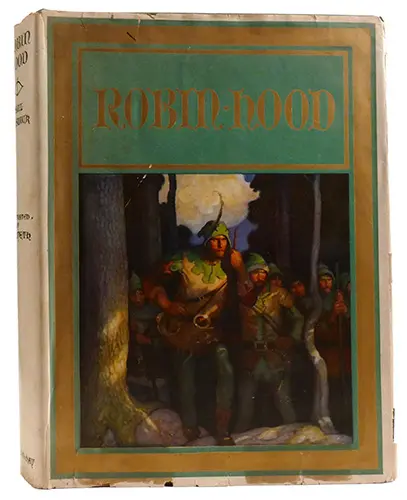
There are illustrated books that define the way generations imagine a legend. N.C. Wyeth’s 1917 edition of The Merry Adventures of Robin Hood is such a work. Published by David McKay in Philadelphia as part of their Scribner Illustrated Classics series, this volume transformed the outlaw of Sherwood Forest from a figure of folklore into a vibrant, muscular presence—a hero rendered with the full force of American illustration at its zenith .
Newell Convers Wyeth (1882–1945) was, by 1917, already established as one of America’s greatest illustrators. A student of the legendary Howard Pyle at the Brandywine School, he had inherited his teacher’s commitment to historical accuracy, dramatic composition, and the power of narrative art. His Treasure Island of 1911 had set a new standard for adventure illustration; Robin Hood would prove equally influential, establishing a visual language for the medieval outlaw that has never been surpassed.
Paul Creswick’s retelling of the Robin Hood legend, first published in 1902, provided the text for Wyeth’s edition. It was a comprehensive collection of the tales—Robin’s first meeting with Little John, the archery contest, the rescue of Maid Marian, the death of the hero—all rendered in prose that captured the spirit of the ballads while remaining accessible to young readers. Yet it was Wyeth’s illustrations that would make this edition unforgettable.
The 1917 edition was a lavish production, containing eight full-page color plates. The binding was in green cloth with a pictorial pastedown on the front cover—a Wyeth illustration of Robin drawing his bow that promised the adventure within.
What distinguishes Wyeth’s Robin Hood is its physicality. His Robin is no ethereal figure of romance but a robust, athletic presence—a man of the greenwood, comfortable in his body, fierce in his purpose. The illustrations pulse with action: the clash of quarterstaffs, the flight of arrows, the ambush in the forest. Wyeth had a gift for capturing the instant before impact, the moment of maximum tension, and he deployed it throughout the volume.
The landscape paintings are equally remarkable. Wyeth’s Sherwood Forest is a place of dappled light and deep shadow, of ancient oaks and sun-dappled glades. He understood that the forest was not merely a setting but a character—a refuge, a home, a world unto itself. His palette is rich with the greens and golds of the English countryside, punctuated by the bright colors of medieval costume: Lincoln green, crimson, royal blue.
Wyeth’s research was meticulous. He studied medieval armor, weaponry, and architecture, ensuring that every detail—from the construction of a longbow to the folds of a tunic—was historically accurate. Yet accuracy never came at the expense of drama. His compositions are dynamic, his figures heroic, his lighting theatrical. Each plate reads as a scene from a film, a moment frozen in time that tells a story all its own.
The character studies are particularly strong. Little John is rendered with a giant’s bulk and a gentle face; Friar Tuck embodies both piety and appetite; Maid Marian possesses a quiet dignity that makes her more than mere love interest. And Robin himself—confident, charismatic, sometimes reckless—emerges as a fully realized hero, flawed but noble, a man of the people who fights for justice against corruption.
The critical and popular response to Wyeth’s Robin Hood was immediate and lasting. The book sold well and became a cornerstone of the Scribner Illustrated Classics series. For generations of American children, Wyeth’s images became the definitive visual interpretation of the legend—the Robin Hood they carried in their minds when they read the tales, played in the woods, dreamed of adventure.
Today, first editions of Wyeth’s Robin Hood are among the most prized of all illustrated books. The combination of Paul Creswick’s text, Wyeth’s peerless illustrations, and the exceptional production quality creates a volume that transcends its historical moment. It is a book that invites us into Sherwood Forest, to stand beside Robin and his merry men, to draw a bow, to fight for justice, to live freely in the greenwood.
In the pages of this book, the legend lives. Robin stands with his foot upon a fallen log, his bow drawn, his eyes fixed on the distant target. Little John wields his quarterstaff; Friar Tuck raises his tankard; Maid Marian waits in the castle. And N.C. Wyeth, with his brush and his palette, gave them all the gift of permanence—a place in the American imagination, as enduring as the stories themselves.
Recommended for Collectors
- The Merry Adventures of Robin Hood (1883) by Howard Pyle – The definitive text with Pyle’s own illustrations
- Treasure Island (1911) illustrated by N.C. Wyeth – For another pinnacle of his swashbuckling style
- The Boy’s King Arthur (1917) illustrated by Wyeth – A chivalric companion to this medieval epic
- The Last of the Mohicans (1919), illustrated by N.C. Wyeth – A visually stunning adventure set in colonial America.
Art Gallery: N.C. Wyeth – Illustrations for Robin Hood 1917