Oriental Splendor: René Bull’s Rubáiyát of Omar Khayyám
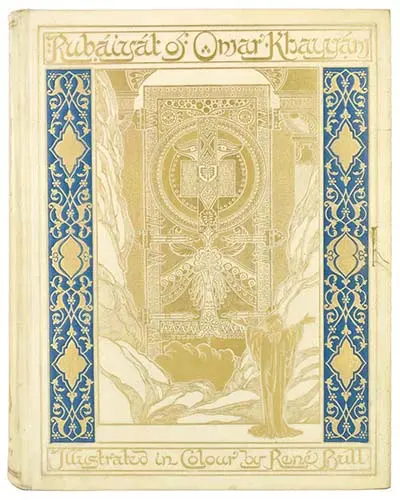
Limited EEdition
In the glittering years just before the First World War, the illustrated gift book reached heights of opulence that have rarely been matched. Among the masterpieces of this final flowering of the Golden Age, René Bull’s 1913 edition of the Rubáiyát of Omar Khayyám stands as a jewel of Orientalist splendor—a volume that captures the hedonistic wisdom of the Persian poet with the visual richness of the Arabian Nights.
René Bull (1872–1942) was a man of extraordinary adventures before he ever turned to book illustration . Born in Dublin to a French mother and an English father, he studied engineering in Paris but abandoned the profession to take drawing lessons from the famed French caricaturist Caran d’Ache . His early career was that of a war artist and photographer, covering the Tirah Campaign in India, the Battle of Omdurman in Sudan, and the Boer War—experiences that gave him a deep appreciation for the cultures and landscapes of the East . Wounded in 1900 and invalided out of service, he settled in England and began illustrating books, starting with La Fontaine’s Fables in 1905.
The 1913 Rubáiyát, published by Hodder & Stoughton in London, was a lavish production typical of the era’s finest illustrated books . It was issued in a large quarto format, bound in cloth with elaborate gilt stamping. Inside, readers discovered twenty-eight mounted color plates, alongside line drawings printed in a distinctive blue ink that echoed the Persian palette. The color plates were reproduced using techniques that preserved the richness of Bull’s watercolors, and each was framed within decorative gilt borders that enhanced their jewel-like quality.
What distinguishes Bull’s illustrations is his deep engagement with the Orientalist aesthetic. His palette is rich and warm—deep blues, burnished golds, rich crimsons, and the soft greens of Persian gardens. His figures, rendered with the precision of a draftsman trained in the French tradition, possess an elegant, almost theatrical quality. The landscapes evoke the Persia of Khayyam’s imagination: domed mosques, flowering gardens, caravans traversing desert sands, and lovers reclining in moonlit courtyards.
Bull’s illustrations for the Rubáiyát are notable for their atmospheric depth. The famous quatrains—“A Book of Verses underneath the Bough, / A Jug of Wine, a Loaf of Bread—and Thou / Beside me singing in the Wilderness”—receive visual treatment that captures both the sensuality and the melancholy of Fitzgerald’s translation. His depictions of the “Moon of Heav’n” rising over the desert, the “Treasury of Joy” opening its gates, and the “Vessel of the Night” sailing across the sky are among the most evocative ever created for the poem.
Bull’s career had already produced a celebrated edition of The Arabian Nights in 1912, and the Rubáiyát followed naturally from that success . His style, with its sinuous lines, decorative borders, and rich coloration, was perfectly suited to the Persian setting. Critics at the time praised his ability to capture “the spirit of the Orient” and his “mastery of color and design.” The 1913 edition quickly became a collector’s treasure.
Today, first editions of Bull’s Rubáiyát are highly prized. The combination of Fitzgerald’s timeless translation, Bull’s peerless illustrations, and the exceptional production quality creates a volume that embodies the height of Edwardian bookmaking.
In the pages of this book, the eleventh-century astronomer-poet meets the Edwardian illustrator, and the result is a work of enduring beauty. The wine flows, the roses bloom, the lovers whisper in the garden, and the “Moon of Heav’n” rises over a world that, in Bull’s luminous vision, seems suspended between the ancient and the modern—a moment of beauty captured, like a quatrain, for eternity.
For the Collector’s Library:
- The Arabian Nights (1912) – Illustrated by René Bull – A companion volume to his Rubáiyát, featuring similarly opulent Eastern-inspired art.
- The Rubáiyát of Omar Khayyam (1909) – Illustrated by Edmund Dulac – A more delicate, dreamlike interpretation of Khayyam’s verses.
Art Gallery: René Bull – Rubaiyat of Omar Khayyam 1913