A Saga in Black and White: W.B. MacDougall’s The Fall of the Nibelungs
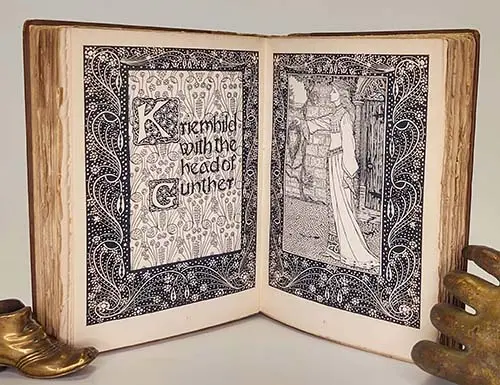
In the grand tradition of heroic literature, few epics carry the weight of tragedy and grandeur found in the Nibelungenlied—the medieval German saga of dragons, treasure, betrayal, and the destruction of kings. W.B. MacDougall’s 1897 edition of The Fall of the Nibelungs, translated by Margaret Armour and published by J.M. Dent & Co. in London, brought this ancient tale to English readers with a visual interpretation of extraordinary power. MacDougall’s illustrations, rendered in bold black and white, capture the stark heroism and inevitable doom of the saga with an intensity that few color plates could match.
The Nibelungenlied, composed in the early thirteenth century, is one of the great works of German literature. It tells the story of Siegfried, the dragon-slayer who wins the treasure of the Nibelungs, his betrayal and murder, and the terrible vengeance wrought by his widow, Kriemhild. It is a tale of love, honor, treachery, and the inexorable pull of fate—themes that resonated deeply with Victorian and Edwardian readers, who saw in its heroic ethos a mirror of their own medieval revivals.
W.B. MacDougall was a Scottish artist whose work bridged the nineteenth and twentieth centuries. His style, deeply influenced by the Pre-Raphaelites and the Arts and Crafts movement, was characterized by strong lines, dramatic contrasts, and a keen sense of design. For The Fall of the Nibelungs, he created a series of full-page illustrations, each a masterpiece of black-and-white composition. The absence of color in these images is not a limitation but a strength—it emphasizes the stark moral choices, the shadowed halls, the glint of steel, and the darkness of the saga’s conclusion.
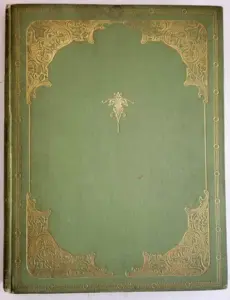
The 1897 edition was a handsome production typical of Dent’s commitment to fine bookmaking. The volume was bound in cloth with gilt stamping, featuring a design by MacDougall on the cover and spine. The illustrations, printed on heavy paper, were interspersed throughout the text, each protected by a captioned tissue guard. Decorative initials, headpieces, and tailpieces—all by MacDougall—created a cohesive visual experience from cover to cover.
What distinguishes MacDougall’s illustrations is their dramatic intensity. His Siegfried is a figure of heroic beauty, yet there is a shadow of doom in the composition; his Kriemhild progresses from grieving widow to implacable avenger, her face hardening across the sequence of plates. The dragon-slaying scene is rendered with a ferocity that captures the primal power of the myth; the final slaughter in Etzel’s hall is a composition of chaos and sorrow, the heroes falling one by one as the saga reaches its inevitable conclusion.
MacDougall’s technique draws upon the graphic traditions of Albrecht Dürer and the German Renaissance, whose woodcuts had illustrated early editions of the Nibelungenlied. The bold lines, the careful cross-hatching, the attention to texture and pattern—all reflect this influence while remaining distinctly MacDougall’s own. The result is a series of illustrations that feel both medieval and modern, rooted in the tradition they illustrate yet fresh in their execution.
The collaboration with Margaret Armour (1860–1943), the translator, was a fruitful one. Armour was a Scottish poet and translator whose version of the Nibelungenlied brought the saga’s rhythmic, formal qualities into English with fidelity and grace. Her translation became the standard English version for decades, and MacDougall’s illustrations were integral to its success.
Today, the 1897 edition of The Fall of the Nibelungs is a prized collectible. First editions in good condition, with their cloth bindings intact and their plates clean, are increasingly scarce. For collectors of illustrated books, for admirers of the Arts and Crafts movement, and for lovers of heroic literature, MacDougall’s Nibelungs represents a treasure—a book that captures the power of one of the world’s great epics with a visual language of stark beauty.
In its pages, Siegfried still slays the dragon, Kriemhild still plots her vengeance, and the heroes still fall in the great hall of Etzel’s court. W.B. MacDougall’s illustrations, rendered in black and white with a draftsman’s precision, give form to the saga’s enduring themes: that glory and destruction are intertwined, that love can curdle into vengeance, and that the greatest heroes are often the most tragic. It is a book for those who understand that sometimes, in the stark contrast of light and shadow, the truest stories are told.
Recommended for Collectors
- Siegfried & The Twilight of the Gods (1911) – Arthur Rackham‘s iconic illustrations present an alternative artistic interpretation of the Nibelung legend
- The Rhinegold & The Valkyrie (1910), illustrated by Arthur Rackham – A lavish interpretation of Wagner’s Ring Cycle with mystical Art Nouveau imagery.
Art Gallery: W.B. Macdougall – The Fall of the Nibelungs 1897
![W.B. Macdougall - The Fall of the Nibelungs [macdougall-nibelungs01] (art, illustrations)](https://www.nocloo.com/wp-content/plugins/justified-image-grid/timthumb.php?src=https%3A%2F%2Fwww.nocloo.com%2Fart%2Fmacdougall-nibelungs%2Fmacdougall-nibelungs01.jpg&h=280&q=90&f=.jpg "W.B. Macdougall - Illustrations for The Fall of the Nibelungs 1897")
![W.B. Macdougall - The Fall of the Nibelungs [macdougall-nibelungs02] (art, illustrations)](https://www.nocloo.com/wp-content/plugins/justified-image-grid/timthumb.php?src=https%3A%2F%2Fwww.nocloo.com%2Fart%2Fmacdougall-nibelungs%2Fmacdougall-nibelungs02.jpg&h=280&q=90&f=.jpg "W.B. Macdougall - Illustrations for The Fall of the Nibelungs 1897")
![W.B. Macdougall - The Fall of the Nibelungs [macdougall-nibelungs03] (art, illustrations)](https://www.nocloo.com/wp-content/plugins/justified-image-grid/timthumb.php?src=https%3A%2F%2Fwww.nocloo.com%2Fart%2Fmacdougall-nibelungs%2Fmacdougall-nibelungs03.jpg&h=280&q=90&f=.jpg "W.B. Macdougall - Illustrations for The Fall of the Nibelungs 1897")
![W.B. Macdougall - The Fall of the Nibelungs [macdougall-nibelungs04] (art, illustrations)](https://www.nocloo.com/wp-content/plugins/justified-image-grid/timthumb.php?src=https%3A%2F%2Fwww.nocloo.com%2Fart%2Fmacdougall-nibelungs%2Fmacdougall-nibelungs04.jpg&h=280&q=90&f=.jpg "W.B. Macdougall - Illustrations for The Fall of the Nibelungs 1897")
![W.B. Macdougall - The Fall of the Nibelungs [macdougall-nibelungs05] (art, illustrations)](https://www.nocloo.com/wp-content/plugins/justified-image-grid/timthumb.php?src=https%3A%2F%2Fwww.nocloo.com%2Fart%2Fmacdougall-nibelungs%2Fmacdougall-nibelungs05.jpg&h=280&q=90&f=.jpg "W.B. Macdougall - Illustrations for The Fall of the Nibelungs 1897")
![W.B. Macdougall - The Fall of the Nibelungs [macdougall-nibelungs06] (art, illustrations)](https://www.nocloo.com/wp-content/plugins/justified-image-grid/timthumb.php?src=https%3A%2F%2Fwww.nocloo.com%2Fart%2Fmacdougall-nibelungs%2Fmacdougall-nibelungs06.jpg&h=280&q=90&f=.jpg "W.B. Macdougall - Illustrations for The Fall of the Nibelungs 1897")
![W.B. Macdougall - The Fall of the Nibelungs [macdougall-nibelungs07] (art, illustrations)](https://www.nocloo.com/wp-content/plugins/justified-image-grid/timthumb.php?src=https%3A%2F%2Fwww.nocloo.com%2Fart%2Fmacdougall-nibelungs%2Fmacdougall-nibelungs07.jpg&h=280&q=90&f=.jpg "W.B. Macdougall - Illustrations for The Fall of the Nibelungs 1897")
![W.B. Macdougall - The Fall of the Nibelungs [macdougall-nibelungs08] (art, illustrations)](https://www.nocloo.com/wp-content/plugins/justified-image-grid/timthumb.php?src=https%3A%2F%2Fwww.nocloo.com%2Fart%2Fmacdougall-nibelungs%2Fmacdougall-nibelungs08.jpg&h=280&q=90&f=.jpg "W.B. Macdougall - Illustrations for The Fall of the Nibelungs 1897")
![W.B. Macdougall - The Fall of the Nibelungs [macdougall-nibelungs09] (art, illustrations)](https://www.nocloo.com/wp-content/plugins/justified-image-grid/timthumb.php?src=https%3A%2F%2Fwww.nocloo.com%2Fart%2Fmacdougall-nibelungs%2Fmacdougall-nibelungs09.jpg&h=280&q=90&f=.jpg "W.B. Macdougall - Illustrations for The Fall of the Nibelungs 1897")
![W.B. Macdougall - The Fall of the Nibelungs [macdougall-nibelungs10] (art, illustrations)](https://www.nocloo.com/wp-content/plugins/justified-image-grid/timthumb.php?src=https%3A%2F%2Fwww.nocloo.com%2Fart%2Fmacdougall-nibelungs%2Fmacdougall-nibelungs10.jpg&h=280&q=90&f=.jpg "W.B. Macdougall - Illustrations for The Fall of the Nibelungs 1897")
![W.B. Macdougall - The Fall of the Nibelungs [macdougall-nibelungs11] (art, illustrations)](https://www.nocloo.com/wp-content/plugins/justified-image-grid/timthumb.php?src=https%3A%2F%2Fwww.nocloo.com%2Fart%2Fmacdougall-nibelungs%2Fmacdougall-nibelungs11.jpg&h=280&q=90&f=.jpg "W.B. Macdougall - Illustrations for The Fall of the Nibelungs 1897")
![W.B. Macdougall - The Fall of the Nibelungs [macdougall-nibelungs12] (art, illustrations)](https://www.nocloo.com/wp-content/plugins/justified-image-grid/timthumb.php?src=https%3A%2F%2Fwww.nocloo.com%2Fart%2Fmacdougall-nibelungs%2Fmacdougall-nibelungs12.jpg&h=280&q=90&f=.jpg "W.B. Macdougall - Illustrations for The Fall of the Nibelungs 1897")
![W.B. Macdougall - The Fall of the Nibelungs [macdougall-nibelungs13] (art, illustrations)](https://www.nocloo.com/wp-content/plugins/justified-image-grid/timthumb.php?src=https%3A%2F%2Fwww.nocloo.com%2Fart%2Fmacdougall-nibelungs%2Fmacdougall-nibelungs13.jpg&h=280&q=90&f=.jpg "W.B. Macdougall - Illustrations for The Fall of the Nibelungs 1897")
![W.B. Macdougall - The Fall of the Nibelungs [macdougall-nibelungs14] (art, illustrations)](https://www.nocloo.com/wp-content/plugins/justified-image-grid/timthumb.php?src=https%3A%2F%2Fwww.nocloo.com%2Fart%2Fmacdougall-nibelungs%2Fmacdougall-nibelungs14.jpg&h=280&q=90&f=.jpg "W.B. Macdougall - Illustrations for The Fall of the Nibelungs 1897")
![W.B. Macdougall - The Fall of the Nibelungs [macdougall-nibelungs15] (art, illustrations)](https://www.nocloo.com/wp-content/plugins/justified-image-grid/timthumb.php?src=https%3A%2F%2Fwww.nocloo.com%2Fart%2Fmacdougall-nibelungs%2Fmacdougall-nibelungs15.jpg&h=280&q=90&f=.jpg "W.B. Macdougall - Illustrations for The Fall of the Nibelungs 1897")
![W.B. Macdougall - The Fall of the Nibelungs [macdougall-nibelungs16] (art, illustrations)](https://www.nocloo.com/wp-content/plugins/justified-image-grid/timthumb.php?src=https%3A%2F%2Fwww.nocloo.com%2Fart%2Fmacdougall-nibelungs%2Fmacdougall-nibelungs16.jpg&h=280&q=90&f=.jpg "W.B. Macdougall - Illustrations for The Fall of the Nibelungs 1897")
![W.B. Macdougall - The Fall of the Nibelungs [macdougall-nibelungs17] (art, illustrations)](https://www.nocloo.com/wp-content/plugins/justified-image-grid/timthumb.php?src=https%3A%2F%2Fwww.nocloo.com%2Fart%2Fmacdougall-nibelungs%2Fmacdougall-nibelungs17.jpg&h=280&q=90&f=.jpg "W.B. Macdougall - Illustrations for The Fall of the Nibelungs 1897")
![W.B. Macdougall - The Fall of the Nibelungs [macdougall-nibelungs18] (art, illustrations)](https://www.nocloo.com/wp-content/plugins/justified-image-grid/timthumb.php?src=https%3A%2F%2Fwww.nocloo.com%2Fart%2Fmacdougall-nibelungs%2Fmacdougall-nibelungs18.jpg&h=280&q=90&f=.jpg "W.B. Macdougall - Illustrations for The Fall of the Nibelungs 1897")
![W.B. Macdougall - The Fall of the Nibelungs [macdougall-nibelungs19] (art, illustrations)](https://www.nocloo.com/wp-content/plugins/justified-image-grid/timthumb.php?src=https%3A%2F%2Fwww.nocloo.com%2Fart%2Fmacdougall-nibelungs%2Fmacdougall-nibelungs19.jpg&h=280&q=90&f=.jpg "W.B. Macdougall - Illustrations for The Fall of the Nibelungs 1897")
![A.A. Milne - When We Were Very Young 1924. First edition [1]](https://www.nocloo.com/wp-content/uploads/2020/07/aam-young1-214x300.webp)